New "Analogue" Project

Thread Starter

Kim Sleep

Joined Nov 6, 2014
391
Ok, a new "Analogue" (555,4017, etc...etc...)Project Design. If it cant be done with this, then I will need more help, as I know NOTHING of this
This is for a kids game, to absolute accuracy in its operation is NOT NECESSARY!


this is hard to explain, so feel free to ask questions:
-imagine a clock face with only 3 places for the hand to go to, at position 9, 12, and 3
-there is a singular hand, driven by a servo (or any other motor. I just state servo because they are small, and easily mounted. There are "Continuous Run Servos" that contain no electronics, just a motor, and speed reduction gears, and can run 360 degrees)
-I already have a circuit with 3 outputs that provide 9vdc at this time, but can be Opto Isolated to provide logic level (if needed)
-I would like this circuit to run at 9vdc please
So what I would like a circuit to do, is drive the servo to one of the 3 positions when that output is activated.
For example, when output of the existing circuit lights the "B" led, the hand on the servo goes to the 12 o'clock position
For example, when output of the existing circuit lights the "A" led, the hand on the servo goes to the 9 o'clock position
For example, when output of the existing circuit lights the "C" led, the hand on the servo goes to the 3 o'clock position
Going to the EXACT stop point is not necessary

I realize that the hand may need to know where it is, in its travel, so I was thinking that each "Stop" position on the dial have something like a reed switch that would be activated when a magnet on the arm activates it. So magnets could be placed on the hand at different places. For example stop position A could be placed on the end of the arm, B in the middle of the arm, and C in the area closest to the motor.

I was only thinking of this, its not an absolute requirement of one of the possible design problems.
 

KeithWalker

Joined Jul 10, 2017
3,603
Most inexpensive R/C servos will rotate slightly more than 180 degrees. The servos are driven by a 5V positive pulse with a repetition rate of 18 milliseconds. The length of the pulse determines the servo position and is usually between the limits of 0.5mS and 2.5mS.
Using an ATTiny85 would be one of the simplest way of creating the different length pulses to drive the servo, depending on which input is activated. No other components would be necessary.
If you are not conversant with AVR microcontrollers, the same signals could be produced using several LM555 timer chips.
 

MisterBill2

Joined Jan 23, 2018
27,181
The fundamental difference between a motor driver and a servo driver is feedback.
RC "Servo" packages are entirely different from the rest of the definition of a servo systems, and only serve to confuse discussions.
A system that only has a motor and reduction gears is not a servo system. It is a motor system. WITHOUT FEEDBACK IT IS NOT A SERVO!!!!!!
A three position drive package for a game could be as simple as a circuit board and a wiper that would carry the motor power and have gaps in the conductor pattern where the motor must stop. Adding the conductor switching scheme will convert it into a servo system. The same conductive cover could be heavy aluminum foil glued to a cardboard game platform, like the clock face, but with gaps to remove the motor power.. Much cheaper to produce than any RC servo package, and not needing any controller hardware except for a momentary switch of some kind.
 

Thread Starter

Kim Sleep

Joined Nov 6, 2014
391
If you are not conversant with AVR microcontrollers, (this is a great way to put this... BTW)I am not, altho another subscriber has kindly offered me one pre-programmed
 

Thread Starter

Kim Sleep

Joined Nov 6, 2014
391
The fundamental difference between a motor driver and a servo driver is feedback.
RC "Servo" packages are entirely different from the rest of the definition of a servo systems, and only serve to confuse discussions.
A system that only has a motor and reduction gears is not a servo system. It is a motor system. WITHOUT FEEDBACK IT IS NOT A SERVO!!!!!!
A three position drive package for a game could be as simple as a circuit board and a wiper that would carry the motor power and have gaps in the conductor pattern where the motor must stop. Adding the conductor switching scheme will convert it into a servo system. The same conductive cover could be heavy aluminum foil glued to a cardboard game platform, like the clock face, but with gaps to remove the motor power.. Much cheaper to produce than any RC servo package, and not needing any controller hardware except for a momentary switch of some kind.
You are quite correct, I called a continuous running motor, a servo... simply because its mounted in a servo casing, with the same gear ratio to slow it down. Its truly not aa Servo!!
https://www.amazon.ca/DIYmalls-Feet...tinuous+rotation+servos&qid=1736511729&sr=8-6
 
Last edited:

MrSoftware

Joined Oct 29, 2013
2,273
Since there are only 3 positions, and you have what sounds like 3 separate signals to indicate the required position, I would be tempted to do it 100% analog, just a DC gear reduced motor and some switches (hall effect, contact, etc..) to stop the hand when it reaches the desired destination. I'm doing this in my head so double check me, but run all 3 inputs to the V+ on the motor (use a transistor or relay if necessary...), separate them with diodes, then use the switch at each location to interrupt the appropriate input. Now if the hand is at location A and needs to go to location B, the location B input comes on powering the motor until the hand physically interrupts the B input when the hand arrives at location B, stopping the motor. The caveat is you need to be sure no more than one input is on at a time, or the motor will keep going. Take your choice on switches; a contact switch, or a hall effect switch and transistor, etc.. Sure you could do it with a servo or stepper motor and micro controller, but this just seems easier.
 

Thread Starter

Kim Sleep

Joined Nov 6, 2014
391
Since there are only 3 positions, and you have what sounds like 3 separate signals to indicate the required position, I would be tempted to do it 100% analog, just a DC gear reduced motor and some switches (hall effect, contact, etc..) to stop the hand when it reaches the desired destination. I'm doing this in my head so double check me, but run all 3 inputs to the V+ on the motor (use a transistor or relay if necessary...), separate them with diodes, then use the switch at each location to interrupt the appropriate input. Now if the hand is at location A and needs to go to location B, the location B input comes on powering the motor until the hand physically interrupts the B input when the hand arrives at location B, stopping the motor. The caveat is you need to be sure no more than one input is on at a time, or the motor will keep going. Take your choice on switches; a contact switch, or a hall effect switch and transistor, etc.. Sure you could do it with a servo or stepper motor and micro controller, but this just seems easier.
I find this worth a giggle, that this comes from a person called Mr Software"............giggle....Snort! BUT THIS IS A VERY CLEVER RESPONSE nonetheless!
 

KeithWalker

Joined Jul 10, 2017
3,603
The fundamental difference between a motor driver and a servo driver is feedback.
RC "Servo" packages are entirely different from the rest of the definition of a servo systems, and only serve to confuse discussions.
R/C servos DO have feedback. They internally generate a pulse having length proportional to the position of the output shaft. The pulse is compared to the length of the incoming pulse. The difference is used to move the output shaft to the correct position.
 

KeithWalker

Joined Jul 10, 2017
3,603
If you are not conversant with AVR microcontrollers, (this is a great way to put this... BTW)I am not, altho another subscriber has kindly offered me one pre-programmed
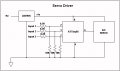
Here is the circuit diagram. You will probably have to change which pins are used for input and output to correspond with the software, but what could be simpler?

Servo.jpg
 

MrSoftware

Joined Oct 29, 2013
2,273
R/C servos DO have feedback. They internally generate a pulse having length proportional to the position of the output shaft. The pulse is compared to the length of the incoming pulse. The difference is used to move the output shaft to the correct position.
I know you know this, but just to clarify the discussion: the feedback for servos is internal. There are 3 wires into a typical RC servo: V+, V- and the pulse input. Internally the servo will seek the position that correlates to the width of the pulse that it's receiving. This information is not fed back to the servo controller that is external to the servo. This is speaking about typical RC servos, others may be different.
 
Last edited:

MrSoftware

Joined Oct 29, 2013
2,273
Here is the circuit diagram. You will probably have to change which pins are used for input and output to correspond with the software, but what could be simpler?

View attachment 340038
Nice idea. Maybe add some ~5V zeners to pins 2,3,7 just for over voltage protection of the ATTiny, in the event of something unforeseen.

I find this worth a giggle, that this comes from a person called Mr Software"............giggle....Snort! BUT THIS IS A VERY CLEVER RESPONSE nonetheless!
I make most of my living with software, but have done enough hardware to know that software is not always the best solution. ;)
 

sghioto

Joined Dec 31, 2017
8,633
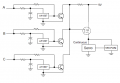
Analog version #1.
A small magnet is attached under the clock hand at the end of the hand.
The magnetic switches (AH1807) are place behind the clock face at the 3,9 and 12 positions.
When A,B or C gets the 9 volt signal the servo will start and move the clock hand to the appropriate position and stop.
1736532138753.png
 
Last edited:

sarahMCML

Joined May 11, 2019
695
A few question, if you will.
1) Are the A, B and C signal provided by momentary push buttons, and are they held down or immediately released?
2) If immediately released, should the servo go to and remain at the new position, or only while the button is pressed? If only whilst pressed, what should happen when released?
3) Does it matter if the servo is in any one of the three positions to start with?
 
Top