Need to identify an electronic element

Are you suggesting that this is essentially like a Zener diode and if so why did they not use a plain Zener diode?
Your comment confuses me, if I assume that your comment was in reference to *my* post (i.e. #19). I want to explain why it is confusing and do so without being offensive. Again, I am not an engineer and it would take me hours to get a good idea of what your circuit drawings are describing functionally, if I could ever do so.

An 1N914 diode is definitely not a zener diode. I have not suggested anywhere that your component is/was a zener diode. I stated outright that it looks identical to components that I have and that I marked (many years ago) as 1n914 and which I tested yesterday confirming that they act like 1n914 diodes. Hoping to be helpful, I took and posted the photographs. Subsequently, I came up with a (plausible if not clever - IMO) rationale for how that component found it's way onto that board with that silk screen.

Can you explain why you thought I was suggesting that it was a zener diode, Or were you simply not responding to my comments?
 

Thread Starter

cstroh

Joined Jan 16, 2019
111
Your comment confuses me, if I assume that your comment was in reference to *my* post (i.e. #19). I want to explain why it is confusing and do so without being offensive. Again, I am not an engineer and it would take me hours to get a good idea of what your circuit drawings are describing functionally, if I could ever do so.

An 1N914 diode is definitely not a zener diode. I have not suggested anywhere that your component is/was a zener diode. I stated outright that it looks identical to components that I have and that I marked (many years ago) as 1n914 and which I tested yesterday confirming that they act like 1n914 diodes. Hoping to be helpful, I took and posted the photographs. Subsequently, I came up with a (plausible if not clever - IMO) rationale for how that component found it's way onto that board with that silk screen.

Can you explain why you thought I was suggesting that it was a zener diode, Or were you simply not responding to my comments?
I appreciate your input and meant no offense. It was along the lines that was suggested it might be a diac that I was thinking something of a voltage limiter was needed and falsely concluded that you were suggesting a diode with reverse polarity.
 
I appreciate your input and meant no offense. It was along the lines that was suggested it might be a diac that I was thinking something of a voltage limiter was needed and falsely concluded that you were suggesting a diode with reverse polarity.
Understood and absolutely no offense taken at all. I truly am curious about what it is and how you end up fixing it!
 

MisterBill2

Joined Jan 23, 2018
27,530
There are quite a few different 2-lead devices that use that package, because it is simple for a machine to insert and even a human will be able to get the polarity correct. Seeing the stripe on a diode can be a challenge for many folks, but the flat is easy to feel. Then when the bean counters get hold of the BOM and start changing things no telling what may happen.
In post #8 I think that I see one side of it connected to +12 volts and the other side connected to both an inverting input and an output.That makes the function that it had a bit of a puzzle. If the numbers are not IC pin numbers then what are they? And while the drawing may be correct that approach does not make it easy to figure out the function of the circuit. And now that the nature of the malfunction is explained it seems more important to understand the circuit and how it functions, so that the function of the mystery pat can be understood. It is possible that the "D" is OK and that the problem is elsewhere.
 
Last edited:

Thread Starter

cstroh

Joined Jan 16, 2019
111
If it is a diac or transient voltage protection device it would appear open with less than several volts. For diacs this voltage is likely to be in the range of 25 to 40 volts.

Edit: Corrected cell phone induced typos.
It appears to be a diac as you suggested. It starts conducting at roughly 30 volts DC in either direction. Thanks for your help and all the help from the others. Now I still need to find out the problem with the bike.
 

Thread Starter

cstroh

Joined Jan 16, 2019
111
There are quite a few different 2-lead devices that use that package, because it is simple for a machine to insert and even a human will be able to get the polarity correct. Seeing the stripe on a diode can be a challenge for many folks, but the flat is easy to feel. Then when the bean counters get hold of the BOM and start changing things no telling what may happen.
In post #8 I think that I see one side of it connected to +12 volts and the other side connected to both an inverting input and an output.That makes the function that it had a bit of a puzzle. If the numbers are not IC pin numbers then what are they? And while the drawing may be correct that approach does not make it easy to figure out the function of the circuit. And now that the nature of the malfunction is explained it seems more important to understand the circuit and how it functions, so that the function of the mystery pat can be understood. It is possible that the "D" is OK and that the problem is elsewhere.
In fact the element D has now been identified as a diac and conduct when voltage reaches 30 volts DC. So you are correct, the problem must be elsewhere. Thanks.
 

Thread Starter

cstroh

Joined Jan 16, 2019
111
Terrific! Well good that you identified it (and it was not a zener :) ) but I get that you still need to find a bad component.
No hint as to how you identified it?
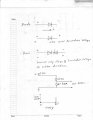
I happen to have a DC power supply so I hooked up the with a 500 k ohm resister in series and started increasing the DC voltage until I saw voltage across the resister. I then reversed the connection on the element did the test again.
 
I happen to have a DC power supply so I hooked up the with a 500 k ohm resister in series and started increasing the DC voltage until I saw voltage across the resister. I then reversed the connection on the element did the test again.
For my education, did you basically do this test here, but because you were not using an AC supply, you reversed the connections?
https://www.repairfaq.org/sam/semitest.htm#sttds

Now I know something (but not very much) about diacs.:)
 

Thread Starter

cstroh

Joined Jan 16, 2019
111
For my education, did you basically do this test here, but because you were not using an AC supply, you reversed the connections?
https://www.repairfaq.org/sam/semitest.htm#sttds

Now I know something (but not very much) about diacs.:)
I make no claims as to the accuracy of my representation but the attached sketch shows a diac as I understand it. PDiac.JPG ictures of a diac are not typically represented in this way but my sketch shows how it reacted to my test. The orientation of the diac in this test setup did not matter.
 

DickCappels

Joined Aug 21, 2008
10,661
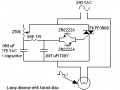
If you take a transistor with the base open it acts like half a diac. When you take it beyond the reverse emitter-base breakdown voltage the transistor avalanches and stays "shorted" until the current drops below some point. If you take two transistors and place them in antiparallel configuration, you get what I understand to be inside a diac, or "silicon bilateral switch" as Motorola used to call them. Below is a diac application using a pair of transistors.

upload_2019-1-26_2-39-59.png
 
If you take a transistor with the base open it acts like half a diac. When you take it beyond the reverse emitter-base breakdown voltage the transistor avalanches and stays "shorted" until the current drops below some point. If you take two transistors and place them in antiparallel configuration, you get what I understand to be inside a diac, or "silicon bilateral switch" as Motorola used to call them. Below is a diac application using a pair of transistors.

View attachment 168696
Is that the same as a SIDAC? From what I am reading here at least what I can understand, they are basically the same but with some details different, but I might expect those details to different in different components of the same type, e.g., breakdown voltage in different diodes.
 

MisterBill2

Joined Jan 23, 2018
27,530
Now locating the source of the complaint still needs to be done. At this stage, with some pieces of electronics, a quick repair consists of resoldering every connection on the board. A skilled soldering person can do one joint about every three to five seconds, and so every connection on the board only takes a very few minutes. And if that fixes it you are home free, although not knowing where exactly the problem was. Of course it does take a fair amount of skill to do that, and some folks soldering efforts look more like a mud-ball attack.And if it does not repair the problem it may still change the failure mode to something easier to locate.
Interestingly enough, the symptoms do sound a bit like an intermittant poor connection.
 
Top