Need to find a good carbide tool manufacturer

Thread Starter

cmartinez

Joined Jan 17, 2007
8,862
Does anyone here know an affordable carbide tool manufacturer?

I need to fabricate these special drill bits:
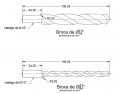
Capture.JPG​

The prices that I got from my local supplier are exorbitant. $370.00 and $220.00 dlls each!

@MaxHeadRoom
 

tcmtech

Joined Nov 4, 2013
2,867
What are you trying to drill into and how much drilling do you need to do?

My cheat for drilling into metals that normal drill bits wont touch and carbide will has always been to regrind the tips of common masonry drill bits to have the correct tip profiles for metal work.

The nice part about masonry drill bits is they typically have a reduced flute diameter compared to their carbide tip insert dimensions so its easy to make something like a 3/8" (24/64")masonry bit into a 21/64" specialty bit if you don't mind doing a bit of micrometer measuring as you do the hand regrind of the carbide insert.
 

Thread Starter

cmartinez

Joined Jan 17, 2007
8,862
Thank you both, shortbus and tcmtech for your responses. Unfortunately, the drill bits must be manufactured with the specs given, since they're for a special, custom-made machine participating in an automated process.

That's why I'd still like to know the names of a few manufacturers out there, if you know any.
 

Thread Starter

cmartinez

Joined Jan 17, 2007
8,862

Thread Starter

cmartinez

Joined Jan 17, 2007
8,862
So what is the variance between needing custom made drill bits Vs change the manufacturing process to use a more common standardized unit that has the same OD and related specs?
To answer your question. What's special about those bits is their length, and not their diameter nor shank.
 

GopherT

Joined Nov 23, 2012
8,009
To answer your question. What's special about those bits is their length, and not their diameter nor shank.
A manufacturer (or possibly a distributor) can diamond cut/hone a standard bit to length. The 2 mm radius on the neck might be the only odd measurement that doesn't meet the stand are bit but I have a feeling that that dimension is not critical to your client.
 

Thread Starter

cmartinez

Joined Jan 17, 2007
8,862
The 2 mm radius on the neck might be the only odd measurement that doesn't meet the stand are bit but I have a feeling that that dimension is not critical to your client.
You're right, that dimension is not critical. But what is also critical, other than the total length, is the flute's length. And I'm not sure if that is standard.
 

GopherT

Joined Nov 23, 2012
8,009
You're right, that dimension is not critical. But what is also critical, other than the total length, is the flute's length. And I'm not sure if that is standard.
Then the number you order will be a great impact on price. To get low prices, the manufacturers use carbide compacts and molds are required. They are tried up by machining with diamond tools but near-net-shape is achieved with powder WC or SiC (your spec) and some wax or polymer binder (1 to 2%). They are sintered in a kiln then use, essentially a Swiss Screw Machine to get the net shape. Others use blank rods of carbide and cut the whole shape.

Either way, a custom flute will likely cost you and $200 to $300 a pop is not bad - I assume less than 100 pieces.

Why the custom flute?
 

Thread Starter

cmartinez

Joined Jan 17, 2007
8,862
Then the number you order will be a great impact on price. To get low prices, the manufacturers use carbide compacts and molds are required. They are tried up by machining with diamond tools but near-net-shape is achieved with powder WC or SiC (your spec) and some wax or polymer binder (1 to 2%). They are sintered in a kiln then use, essentially a Swiss Screw Machine to get the net shape. Others use blank rods of carbide and cut the whole shape.

Either way, a custom flute will likely cost you and $200 to $300 a pop is not bad - I assume less than 100 pieces.

Why the custom flute?
The purpose of those bits is to drill through 8 layers of 1/2" plywood, spinning at about 5,000 rpm

The flute length is to allow the wood chips to travel upwards and out when the bit is at its deepest.

HSS bits just won't work for this application.
 

#12

Joined Nov 30, 2010
18,224
J&L Industrial Supply 1995 Catalog
Carbide tipped straight shank taper length drills
Dia. 11/16"
flute length 5-3/8"
overall length 9-1/4"
Order number CTT-50244J $44.58

21/64"
flute length 4-1/8"
OAL 6-1/2"
Order No. CTT-50221M
$19.36

1-800-525-6817
 

tcmtech

Joined Nov 4, 2013
2,867
J&L Industrial Supply 1995 Catalog
Carbide tipped straight shank taper length drills
Dia. 11/16"
flute length 5-3/8"
overall length 9-1/4"
Order number CTT-50244J $44.58

21/64"
flute length 4-1/8"
OAL 6-1/2"
Order No. CTT-50221M
$19.36

1-800-525-6817
But that will never work.

He needs a special drill bit that's 4 1/2" long to drill through 4" of plywood which would make the 4 1/8" and the 5 3/8" bits too long to work.
I mean sure he could just cut 7/8" "off and inch off the chuck end of the 5 3/8" bit and machine the top of the flute down to 1/2" to compensate or chuck the 4 1/8" bit up 3/8" of and inch shallower but that would never work. :rolleyes:

Plus they need to be solid carbide as well since they will be drilling into wood at 5000 RPM and not the typical 30,000+ RPM like a common tool steel wood router bit does. :oops:
 

shortbus

Joined Sep 30, 2009
10,049
Then the number you order will be a great impact on price. To get low prices, the manufacturers use carbide compacts and molds are required.
Gopher is right about how this works. Set up for making something is always a big part of the cost, the more you need the 'set up' is spread out over the number needed. And carbide is harder to machine to finish size.
 

shortbus

Joined Sep 30, 2009
10,049
The purpose of those bits is to drill through 8 layers of 1/2" plywood, spinning at about 5,000 rpm

The flute length is to allow the wood chips to travel upwards and out when the bit is at its deepest.

HSS bits just won't work for this application.
Wow, who ever was behind the design of the machine must never have done it before. Never saw a multiple spindle machine(inferring this from your description) that wasn't able to adjust tool "stick out" to make standard tooling work.

And from both being both a wood worker and a machinist, can't see how a spade bit wood(pun) be a problem to a wood working machine. Especially when wood is the item being worked. What type of plywood is being cut? 5,000 RPM is not a problem with HSS, and there is always TIN (titanium nitride) coated bits out there that increase cutting tool longevity. There must be something about this your not telling. https://en.wikipedia.org/wiki/Titanium_nitride
 

Thread Starter

cmartinez

Joined Jan 17, 2007
8,862
Wow, who ever was behind the design of the machine must never have done it before. Never saw a multiple spindle machine(inferring this from your description) that wasn't able to adjust tool "stick out" to make standard tooling work.

And from both being both a wood worker and a machinist, can't see how a spade bit wood(pun) be a problem to a wood working machine. Especially when wood is the item being worked. What type of plywood is being cut? 5,000 RPM is not a problem with HSS, and there is always TIN (titanium nitride) coated bits out there that increase cutting tool longevity. There must be something about this your not telling. https://en.wikipedia.org/wiki/Titanium_nitride
Actually I'm the one who designed it... and it's been working reliably for the last 12 years. And it's got two Milwaukee routers functioning as spindles. The bits are changed manually, btw.

Here's the thing:
  • The drilling has to be done at high RPM so as to leave a clean-cut hole, plus the operation is much faster.
  • A spade bit won't leave a nice and sharp edge in the wood being cut, plus there's no way for the chips to evacuate when drilling 4" of commercial pine plywood.
  • If HSS bits are used:
    • The holes won't come perfectly round, and will be quite oblong, even at much lower RPM, and even if TIN (or Cobalt) coated bits are used.
    • The bits' sharpness won't last more than a couple of hours, and the wood will start to smoke. Whereas a solid carbide bit will stay sharp for up to a year.
  • In the 12 years that the machine has been working, there has never been an accident. A bit broke once (and only once) due to overuse and lack of sharpening maintenance (you can tell by the smoke being produced while drilling). When that happened, the bit stayed inside the wood, and didn't fly out. And the bit is protected by a tube (used to vacuum the chips) that also acts as a shield.
  • As for adapting a commercially available solid carbide bit, I had looked into that years ago, but either a 1/2" shank was not available for those diameters, or the length was not long enough. Maybe things have changed, so I'll go and look into that again.
Any suggestions (and even critique, I know you guys mean well and are trying to help) will be thoroughly appreciated.

Thanks again all for your help.
 

Thread Starter

cmartinez

Joined Jan 17, 2007
8,862
This puts things into perspective :eek::

upload_2017-1-28_12-50-9.png

upload_2017-1-28_12-55-51.png​

Of course, the first bit is twice as long as I require... but still.
 
Last edited:
Top