Need some guidance on transistor workings and reading datasheets

Thread Starter

Aleksey Shurtygin

Joined Dec 21, 2018
75
I will clarify my initial post. I may have underestimated how deep the rabbit hole goes. However given I am not a professional in electronics and definitely not an expert but a simple hobbyist, it does help to try to understand first from practical perspective and possibly apply gained (pun intended) knowledge for some quick project to test out understanding. And keep digging more if needed.

I do however appreciate any input and I will update the post to clarify this.
 

Thread Starter

Aleksey Shurtygin

Joined Dec 21, 2018
75
5mA is for the maximum rated transistor current, which is likely overkill for a typical application.

You determine the maximum collector current that the RLoad allows at the operating supply voltage.
You then provide a base current about 5 to 10% of that current to insure saturation.
Any base current above that value, is just a waste of current and power.
On my example circuit I was looking at transistor as a basic switch or relay or a variable resistor and I wanted to ensure I provide all voltage/current to a load that I can, obviously within allowed Ic.

Let's for the sake of the argument assume the load is a light bulb (or a LED strip) and I use high current transistor (not BC550). If I do not open transistor all the way the light would be not as bright as it would be if I connected it directly to a voltage source. Of course there will be a voltage drop even if I open it all the way so the LED strip won't be as bright already and I may accept that. I just did not want to add even more voltage drop by not opening it all the way.
 

Jony130

Joined Feb 17, 2009
5,598
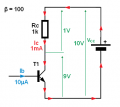
The transistor saturation isn't a property of the transistor itself, but instead a property of the circuit surrounding the transistor and the transistor, as part of it.


35b.png

For this circuit with an ideal transistor (CCCS) any base current large than:

Ib > (Vcc/Rc)/β = (10V/1kΩ)/100 = 0.1mA
will saturate the BJT's

Do you understand why?

But in real life the ideal transistor doesn't exist. Heanc, for any real-world transistor the β factor is not constant.
Beta varies with collector current, Vce voltage and with temperature. And what is worse, every single transistor will have different beta.
Also in saturation Ic = Ib * β do not hold anymore.

So too overcome this problem with beta variation we are forced to use the "overdrive factor" or "Forced Beta" trick.

We simply increase the base current well beyond Ib > (Vcc/Rc)/β (beyond minimum beta). We do this to make sure that we have enough base current to put transistor well into saturation region for every condition we have in our circuit.

Most of the BJT's vendors define the saturation region when Ic/Ib = 10 (called Forced Beta). And the most data-sheet show Vce_sat for Ic/Ib = 10
So, to be one hundred percent sure that your BJT's will be in saturation you must use this so-called forced beta technique when choosing base resistor value.

Ic/Ib = 10
or Rb/Rc = 10

Rb = (Vin - Vbe)/(0.1*Ic)

Rc = (Vcc - Vce_sat)/Ic

In my example if Vin = 5V we have:

Ib_sat = 10mA/10 = 1mA

Rb = (5V - 0.7V)/1mA = 4.7kΩ
 

Thread Starter

Aleksey Shurtygin

Joined Dec 21, 2018
75
The transistor saturation isn't a property of the transistor itself, but instead a property of the circuit surrounding the transistor and the transistor, as part of it.


View attachment 176806

For this circuit with an ideal transistor (CCCS) any base current large than:

Ib > (Vcc/Rc)/β = (10V/1kΩ)/100 = 0.1mA
will saturate the BJT's

Do you understand why?
I do not think I understand why physically, but I think I can take it just as a Ic⇔Ib relationship unless there is something important that I would need to know.

However I keep seeing this β=100 everywhere. Is that some physical constant and varies only because of manufacturing "defects" or some BJT transistors are manufactured specifically to have different ideal target β?

Otherwise I think its coming together now. So, if I wanted to apply this to my scenario with a mini light bulb my calculations would be following.

Assumptions:
Light bulb resistance: 10Ω
Bulb voltage source = 1.5V
Base signal voltage = 3V
β = 100

First I would calculate current required to light the bulb not taking transistor into account. 1.5V/10Ω=150mA. To get transistor into saturation I would need Ib to be 150mA/100=1.5mA. Now, if my control signal is 3V then I do (3-0.7)/1.5mA=1.4KΩ. If I want to use "overdrive factor" I could make Ib to be, say, 2mA. In that case my Rb would be ≈1.1K.

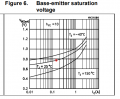
So, the 0.7V comes from the datasheet. For example if I take datasheet TIP31C it does not have specific values for Vbe(sat) but looking at the graph I can see that it would be around 0.75V for Ic=150mA (red dot).
upload_2019-5-7_13-19-11.png
However now the question. Under this condition there will be a voltage drop on collector-emitter and the light bulb will not get full 1.5V and will get only a bit under 1V and will be dimmer. And to answer my own question my only choice here is really to increase the voltage source for the light bulb and recalculate everything with new values, correct?
 
Last edited:

Thread Starter

Aleksey Shurtygin

Joined Dec 21, 2018
75
However I keep seeing this β=100 everywhere. Is that some physical constant and varies only because of manufacturing "defects" or some BJT transistors are manufactured specifically to have different ideal target β?
I think I may have just answered my own question again. After closer look at the TIP31C datasheet I noticed it has much lower β. This can't be some manufacturing defect...
upload_2019-5-7_13-45-28.png
I am guessing people take value of 100 since most low-current transistors hover around that and for ease of calculations.
 

Jony130

Joined Feb 17, 2009
5,598
However I keep seeing this β=100 everywhere. Is that some physical constant and varies only because of manufacturing "defects" or some BJT transistors are manufactured specifically to have different ideal target β?
No, defenetly it is not a " physical constant" it is only a nice round number that we use for small signal BJT's only.
And you almost never find in real life a transistor with a beta value equal exactly to 100.

First I would calculate current required to light the bulb ignoring transistor completely. 1.5V/10Ω=150mA. To get transistor into saturation I would need Ib to be 150mA/100=1.5mA. Now, if my control signal is 3V then I do (3-0.7)/1.5mA=1.4KΩ. If I want to use "overdrive factor" I could make Ib to be, say, 2mA. In that case my Rb would be ≈1.1K.
No, wrong your "overdrive factor" is to small.

"overdrive factor" = 5....20

You shoud start your design like this:

Ib_sat = Ic/10 = 150mA/10 = 15mA

Rb = (3V - 0.7V)/15mA = 160Ω

However now the question. Under this condition there will be a voltage drop on collector-emitter and the light bulb will not get full 1.5V and will get only a bit under 1V and will be dimmer. And to answer my own question my only choice here is really to increase the voltage source for the light bulb and recalculate everything with new values, correct?
Vce(sat) will be around 60mV
http://www.mouser.com/ds/2/149/fairchild semiconductor_tip31a-549394.pdf (fig.2)

I think I may have just answered my own question again. After closer look at the TIP31C datasheet I noticed it has much lower β. This can't be some manufacturing defect...
View attachment 176819
I am guessing people take value of 100 since most low-current transistors hover around that and for ease of calculations.
But this beta value is for Ic > 1A...3A.
 

Thread Starter

Aleksey Shurtygin

Joined Dec 21, 2018
75
No, wrong your "overdrive factor" is to small.

"overdrive factor" = 5....20

You shoud start your design like this:

Ib_sat = Ic/10 = 150mA/10 = 15mA

Rb = (3V - 0.7V)/15mA = 160Ω
I take it that its not conceptually wrong, just needed to use proper factor value. And value 10 in Ib_sat formula is basically β=100 with taking "overdrive factor" value of 10 into account, correct?
I.e.: ((Vcc/Rc)/β)*factor = (Ic/β)*factor = Ic*(factor/β) = Ic/(β/factor)

Yes, so its not too bad. But if I encounter scenario with a relatively large voltage drop, my only option is to increase voltage, right?

But this beta value is for Ic > 1A...3A.
Yes, I was referring to a β value in your circuit and a general trend, not specifically TIP31C. Essentially I was just saying same thing that you said.
it is only a nice round number that we use for small signal BJT's only.
 

Jony130

Joined Feb 17, 2009
5,598
I take it that its not conceptually wrong, just needed to use proper factor value. And value 10 in Ib_sat formula is basically β=100 with taking "overdrive factor" value of 10 into account, correct?
I.e.: ((Vcc/Rc)/β)*factor = (Ic/β)*factor = Ic*(factor/β) = Ic/(β/factor)
Perhaps I didn't make myself clear earlier.
But this 10 is a "Forced Beta" value Ic/Ib = 10 not a "overdrive factor".
Notice that almost all BJT vendors are using this "Forced Beta" when they plot Vce(sat) or Vbe(sat).
 

Thread Starter

Aleksey Shurtygin

Joined Dec 21, 2018
75
Perhaps I didn't make myself clear earlier.
But this 10 is a "Forced Beta" value Ic/Ib = 10 not a "overdrive factor".
Notice that almost all BJT vendors are using this "Forced Beta" when they plot Vce(sat) or Vbe(sat).
So, when you say this:
So too overcome this problem with beta variation we are forced to use the "overdrive factor" or "Forced Beta" trick.
you mean these are two different things - 1) overdrive factor, and 2) "Forced Beta"
I've read it as "we are forced to use the "overdrive factor" a.k.a. "Forced Beta" trick

How are they different? Based on quick google it still feels like it is really the same thing. The only thing maybe is that Forced Beta is really a cross-vendor convention and is like a constant. Or maybe conceptually its different but mathematically its really the same?

Or possibly Forced beta is simply a minimal β value available for BJT and vendors use it as a value to ensure all other transistors are covered?
And overdrive factor simply a value you can use to increase the Ib.
 
Last edited:

crutschow

Joined Mar 14, 2008
38,584
The nominal Beta value is only used when the transistor is used as amp.
When the transistor is used as a switch, you ignore the transistor Beta value and use a forced value of 10 to 20.

Note that the phrase "open" is not normally used with transistors when used as a switch.
Typically they are referred to as either "on" or "off".

To minimize the "on" saturation voltage of a transistor you either use a larger transistor, or use a MOSFET which can have an on-resistance in the low milliohm region.
 
Top