Need more math for higher electronics education. Feeling a bit overwhelmed.

Thread Starter

ballsystemlord

Joined Nov 19, 2018
249
Hello,
The four book series I started out reading on electronics were written for anyone who had graduated highschool (I.E you know algebra). Now that I've completed them, I find myself starting to read books that have far more advanced mathematics inside of them. Among the new stuff I've encountered are some form of matrix math E.G.,
|2, 4|
|3, 6|
integrals (looks like an "f"),
and some symbol that looks like this: Σ

Though I don't much care for math*, I have no problem learning more if necessary. So, I peeked into some books on algebra, to get a refresher before looking into calculus where integrals can be learnt, and realized that the algebra I knew and the algebra that could be known were not one in the same.

For example, there's ring algebra, linear algebra, tensor algebra, set algebra, and group algebra. This is not to mention that the few chapters of geometry I got were nothing compared to the tomes I've seen on the subject. And that's all off the top of my head. I'd imagine that calculus is a big field as well.

Now I'm feeling a bit overwhelmed. I'm self studying, so I don't exactly have an exact set of texts I know to follow. Even if I did, I prefer reading books that make sense to me as opposed to what others use. That's the only real advantage to self-studying outside of the lower cost (I can't afford college).

I could try and read several books on algebra, and, over time, I'd eventually reach a level of higher math competency, but my purpose was more to learn electronics than math. I know I could do a great deal without higher math education, but I'd like to achieve greater understanding of electronics than is strictly necessary if at all possible.


So, do you have any ideas as to the math steps I'd need in order to come to a greater understanding of electronics? Like, step 1 set theory, step 2 polynomial equations, etc... , step X success!

I'm happy to look into whatever texts I need to find the resources I need to learn. I'm not asking for a book recommendation, though you're welcome to give me some. Just please no "for dummies" series books. I like a bit more serious/meaty texts.

Thanks!


* What I don't like about math is that I have nothing to apply it to. It's all theory and abstraction. Some authors even say abstraction is the ideal way to learn it. I prefer dealing with the concrete. I especially dislike how many math texts don't explain how the math works, just how to perform operations, as though I were a machine.
 

WBahn

Joined Mar 31, 2012
32,703
It's hard for anyone to recommend books for you to read when you start off by saying that you prefer reading books that make sense to you as opposed to what others use.

Self-teaching yourself math is, as you are finding out, a bit of a mine field. It is, after all, something that has been being developed and constantly added to by people all over the world for many thousands of years. So it's not too surprising that there are lots and lots of niche fields. If you were to spend time with mathematicians, what you would discover is that most of them have a deep understanding of a small subset of mathematics and a very superficial awareness, if that, of most of the others. But, the same is true of almost all engineering fields, too.

The result is, again as you've discovered, trying to figure out what it is you need to study and, in most cases, you will need to prepare for that by studying some other things first. This is the primary role of formal education, which is to help guide that process. If you want to forego that guidance, expect it to be a pretty rough ride at times.

Regarding algebra, the term "algebra" has a specific meaning in mathematics. You are correct in that there are many, many different algebras out there. What most people think of as "algebra" is really just the one particular algebra that most people are ever exposed to (namely, what is generally referred to as "elementary algebra"). Most of those other algebras will have little bearing on a career in electronics. Linear algebra is extremely useful, but many engineers get by just fine without it, or with only dipping their toes into it. Things like rings, groups, and fields you can pretty much ignore. They are critical to a number of fields of practical significance, but electronics is almost never among them.

Extremely strong (elementary) algebra skills are a must to go very far in electronics. Lots of people do just fine in electronics without ever going beyond that, but they do so by using techniques by rote that are based on the application of "higher" mathematics, most notably differential and integra calculus and differential equations (at least up through LaPlace Transforms).

A common example is working with linear AC circuits composed of resistors, capacitors, and inductors. Most people can spout a bunch of formulas for how to find reactance and impedance and time constants and resonant frequencies and step responses. They can tell you how to determine these things called phasors and how to work with them. But very few can tell you where those formulas come from (other than some book), let alone derive them starting with the defining relationships for resistors, capacitors, and inductors. That's because this is intrinsically the realm of differential equations. People with that level of understanding of mathematics applied them to circuit analysis and came up with ways to package the results as a set of formulas and rules for others without that understanding to use. A common consequence is then that the people that use those rules will boast about how calculus and differential equations are a waste of time because no one actually needs it, when what they do day in and day out is only possible because of it.

Other mathematics arenas that often pay solid dividends to an electronics engineer are discrete mathematics and Boolean algebra, primarily if you do anything very deep in digital electronics.

If you want to build up your mathematical toolbox, I'd start with a decent text on calculus. You want to find one that emphasizes what derivatives and integrals are and what they mean, as opposed to one that just focuses on how to manipulate equations that happen to contain them. The better textbooks generally require you to actually derive virtually all of the results based on the defining concepts. They do not just give you a table that tells you that the derivative of sin(a·x) (with respect to x) is a·cos(a·x); instead, they require you to derive every entry in that table before you can use it in later work. Another thing to look for in a calculus book is that it starts with a substantial treatment of things like limits and continuity. If it doesn't, there's a good chance that what you are looking at is little more than a bunch of equations and procedures that you would need to memorize without any real understanding of them.
 

Jerry-Hat-Trick

Joined Aug 31, 2022
776
I’m reminded of the Indiana Jones quote from The Kingdom of the Crystal Skull. “If you want to be a good archaeologist, you’ve got to get out of the library”
You said it yourself, it’s hard to learn when you have nothing to apply it to. In practice, most of the time the most complicated maths you’ll use is ohm’s law. If you have an electronics problem you want to understand, google it.
 

Ian0

Joined Aug 7, 2020
13,097
In practice, most of the time the most complicated maths you’ll use is ohm’s law.
You're right:
The things that most often make me reach for the calculator are:
resistances in parallel
Time constants and frequency responses of the 1/(2πRC) and 1/(2π√LC) type
deciBels
Calculus is required once in a while, and matrices almost never.

. . . But probably different if you are a microwave engineer.
 

boostbuck

Joined Oct 5, 2017
1,034
For example, there's ring algebra, linear algebra, tensor algebra, set algebra, and group algebra.
You are looking way too deep. For most electronics simple algebra and maybe a bit of trig is plenty.

As suggested, you should follow your nose in electronics and let the path define your math needs.
 

Thread Starter

ballsystemlord

Joined Nov 19, 2018
249
In reply to the above three posts, I'd like to be capable of things like understanding the internal operation of Mr. Smith's oscillator. By his own admission, he has no idea how to do the math to understand it.
 

MrChips

Joined Oct 2, 2009
34,628
You can easily drown in complex mathematics and in the vast majority of cases in electronics you don't need it.

For the moment, stay with basic algebra. Most of the time all you need is Ohm's Law and its variations.

Ohm's Law
I = V / R
V = I x R
R = V / I

Power
P = I x I x R
P = V x V / R
P = I x V

I will gradually add to your knowledge of more advanced mathematics one step at a time.
For the time being, accept that the symbol ∑ (sigma in Greek) is used to mean sum.
∫ is used to mean sum also but for analog data whereas ∑ is for digital data.
I will cover these later when I introduce calculus.

You don't need matrix arithmetic.
 

Ian0

Joined Aug 7, 2020
13,097
You don't need matrix arithmetic.
The TS's application is microwave, so that might involve matrices!
My limited experience of microwave engineering led me to believe that it is part complex maths, part guesswork but mainly trial and error.
That's probably why I don't work as a microwave engineer.
 

MrChips

Joined Oct 2, 2009
34,628
To begin, here is your basic course of Mathematics for Electronics Engineers.

Part 1
You need to become familiar and conversant with these basic math symbols, terms and expressions, and trigonometry functions.

Square and Square Root
a x a
is written as \( a^2 \)
Hence, we can write an equation such as
\( y = a^2 \)

Conversely, if we know y, we can solve for a using the square root function.
\( a = \sqrt{y} \)

A peculiar thing happens when we try to compute the square root of a negative number. Let us take the special case when y = -1

\( a = \sqrt{-1} \)

This is given a special operator in mathematics using the letter i.

\( i = \sqrt{-1} \)

This is likely to cause confusion in electronics because we already use i as the algebraic symbol for current. Hence we use the letter j instead of i.

\( j = \sqrt{-1} \)

You will encounter the j operator later in this series.

Exponential and Logarithm

\( y = a^2 \)
This is an exponential function, in other words, y is a raised to the power of 2.
There are two special exponential functions,

\( y = 10^x \)
and,
\( y = e^x \)
where e is Euler's number = 2.71828

If we know y, we can solve for x.

\( y = 10^x \)
\( x = log_{10}(y) \)

\( y = e^x \)
\( x = log(y) \)

The subscript 10 indicates that the logarithm is using base 10.
(Note that different computer languages use different notations. Check the syntax of the specific language when using log functions.)

Decibel

Our perception of sound amplitude and power is not linear. It takes 10 times higher power to perceive a sound that is twice as loud. Hence a logarithmic scale is used when describing amplitude and power levels. This unit is a decibel, written as dB.

10 decibels = 1 bel
1 decibel = 1/10 bel

The bel and decibel are ratios. Hence, there are no elementary units.

The decibel is a comparison of two signals, for example, if we are comparing two power levels, P1 and P2, the power ratio in bel and decibel is calculated as:

\( n\hspace{.4em}bel = log_{10}(\frac{P2}{P1}) \)
\( n\hspace{.4em}dB = 10\hspace{.4em}log_{10}(\frac{P2}{P1}) \)

For example, if P2 is ten times P1,
\( log_{10}(10) = 1 \)
\( 10\hspace{.4em}log_{10}(\frac{P2}{P1}) = 10\hspace{.4em}dB \)

If the power ratio is 2,
\( 10\hspace{.4em}log_{10}(2) = 3\hspace{.4em}dB \)

Power is proportional to the square of the amplitude. Hence, if the amplitude ratio is 2, the power ratio would be 2 squared which is equal to 4.
\( 10\hspace{.4em}log_{10}(4) = 6\hspace{.4em}dB \)

Thus, you can work through the math and discover that,
+3 dB = amplitude ratio of √2 = 1.414
+3 dB = power ratio of 2
and,
-3 dB = amplitude ratio of 1/√2 = 0.707
-3 dB = power ratio of 1/2 = 0.5

+6 dB = amplitude ratio of 2
+6 dB = power ratio of 4
and,
-6 dB = amplitude ratio of 0.5
-6 dB = power ratio of 0.25

Since,
\( log_{10}(1) = 0 \)
0 dB means that the amplitude and power ratios are unity, i.e. the levels are the same.

Degrees and Radians

There are 360 degrees in a circle. In mathematics, we also use radians instead of degrees. There are two pi radians in a circle.
We can convert from degrees to radians because we know,

2π radians = 360 degrees
1 degree = 2π / 360 radians
1 radian = 360 / 2π degrees

pi = π = 3.14159265

Trigonometric Functions

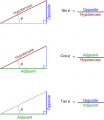
The three trig functions you need to know are sine, cosine and tangent.


1724507929795.png


1724508435359.png

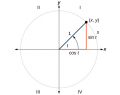
If we draw a circle with radius A, and we call the angle made between the radius and the X-axis, θ (theta), then

sin(θ) = y / A
cos(θ) = x / A
tan(θ) = y / x

I choose a radius A because A represents the amplitude of a sine or cosine wave.

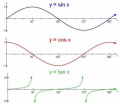
We can write the equation of a sine wave as,
v = A sin(ωt)
or,
v = A sin(2πft)
where,
v = voltage,
A = amplitude
ω = angular velocity
f = frequency
t = time

We can even include a phase shift into the equation:
v = A sin(ωt + φ)

(Note that ωt and φ are in units of radians.)

We encounter sine and cosine waves often in signal processing. We draw analog waveforms on an X-Y graph where signal amplitude is drawn in the Y-direction (vertical direction) and time is indicated in the X-direction (horizontal direction).

1724508077320.png

A useful picture for understanding sine and cosine waves, is to imagine a wheel rotating counter clock-wise at constant speed.

Assume that the wheel rotates at f cycles per second, i.e. f Hz.
Since there are 2π radians in each cycle, the wheel rotates at 2πf radians per second.

We can say that the angular velocity of the wheel is ω (omega) radians per second.
In other words, the angular velocity ω rad/s can be equated to the frequency f Hz using the conversion,

ω = 2πf rad/s

Conversely,
f = ω / 2π Hz


Keep your eye on the point (green dot) on the circumference of the wheel as the wheel turns counter clock-wise (increasing angle θ).
The position of the projection of the point (red dot) on the Y-axis is represented by the sine function.
sin(θ) = y / A
y = A sin(θ)

The position of the projection of the point (blue dot) on the X-axis is represented by the cosine function.
cos(θ) = x / A
x = A cos(θ)

where A is the amplitude of the waveform and also the radius of the circle.

End of Part 1
 

nsaspook

Joined Aug 27, 2009
16,250
A classic: https://www.ersbiomedical.com/assets/images/Radio Shack - Math For The Electronics Student.pdf

https://calculusmadeeasy.org/
Considering how many fools can calculate, it is surprising that it should be thought either a difficult or a tedious task for any other fool to learn how to master the same tricks.

Some calculus-tricks are quite easy. Some are enormously difficult. The fools who write the textbooks of advanced mathematics — and they are mostly clever fools — seldom take the trouble to show you how easy the easy calculations are. On the contrary, they seem to desire to impress you with their tremendous cleverness by going about it in the most difficult way.

Being myself a remarkably stupid fellow, I have had to unteach myself the difficulties, and now beg to present to my fellow fools the parts that are not hard. Master these thoroughly, and the rest will follow. What one fool can do, another can.
 
Last edited:

crutschow

Joined Mar 14, 2008
38,317
You might look for books that cover basic mathematics for electronics.
I have no recommendations, but a Google search revealed quite a few with that subject so one of those may work for you.
 

Papabravo

Joined Feb 24, 2006
22,058

KeithWalker

Joined Jul 10, 2017
3,603
Back in the early 60s, the math I had to learn when studying for an Electronic and Light Electrical Engineering degree include:
Statistics and probability, Laplace transforms, Fourier Transforms and Hyperbolic Functions. I had a very successful career with Hewlett Packard as an electronic measurements specialist and technical consultant. In all that time, I never had the need to use any of those branches of math. I was an expert on spectrum analysis but never had to derive FFTs. There is software on the internet to do all the calculations for you.
My advice is to brush up on your algebra and geometry an get a working understanding of calculus. Then you will have the basic building blocks needed for learning electronics. \

NOTE:
After all this time, I am still very annoyed by the fact that I had to learn so much redundant math and so little electronic theory.
 

Ian0

Joined Aug 7, 2020
13,097
My advice is to brush up on your algebra and geometry an get a working understanding of calculus. T
Interesting that you should mention geometry. When I did my degree, about the only reason for a non-unity power factor was the phase shift of an inductive load, and all the relevant calculations were trigonometry.
Nowadays, non-unity power factors are generally caused by rectifier/capacitor power supplies, and motors are often driven by variable frequency drives with power factor correction.
 

MrChips

Joined Oct 2, 2009
34,628
Trigonometry plays a very significant role. In Part 2 of my series, I will cover calculus, differentiation and integration, complex arithmetic and phasor diagrams, reactance and impedance, RCL circuits, power factor.
 

Papabravo

Joined Feb 24, 2006
22,058
Back in the early 60s, the math I had to learn when studying for an Electronic and Light Electrical Engineering degree include:
Statistics and probability, Laplace transforms, Fourier Transforms and Hyperbolic Functions. I had a very successful career with Hewlett Packard as an electronic measurements specialist and technical consultant. In all that time, I never had the need to use any of those branches of math. I was an expert on spectrum analysis but never had to derive FFTs. There is software on the internet to do all the calculations for you.
My advice is to brush up on your algebra and geometry an get a working understanding of calculus. Then you will have the basic building blocks needed for learning electronics. \

NOTE:
After all this time, I am still very annoyed by the fact that I had to learn so much redundant math and so little electronic theory.
I like to think of Mathematics as food for the mind, precisely because it deals with abstractions. Constructing proofs and transforming one expression into another are useful building blocks for other things. I don't regret any of the Mathematics I had to learn.
 

KeithWalker

Joined Jul 10, 2017
3,603
Interesting that you should mention geometry. When I did my degree, about the only reason for a non-unity power factor was the phase shift of an inductive load, and all the relevant calculations were trigonometry.
Nowadays, non-unity power factors are generally caused by rectifier/capacitor power supplies, and motors are often driven by variable frequency drives with power factor correction.
Geometry gives a great visual understanding of trigonometry.
 

WBahn

Joined Mar 31, 2012
32,703
Indeed, and is the introduction to constructing proofs for most students.
Sadly, not so much any more. Many geometry curriculums have gone out of their way to eliminate as much of the "proofs" content as possible. Often the proofs are simply presented, often in a rather handwavy form, to the students who are then asked to simply use the resulting theorems to solve problems. I've encountered only a few students over the past couple of decades that have had any exposure to formal proofs in which each line of the proof must follow from the preceding line using a single axiom or previously-proved theorem. The exceptions tend to be home-schooled kids.
 
Top