Need Help in LC and diode circuit

Thread Starter

Vihaan@123

Joined Oct 7, 2025
251
Ok I will rework, but only thing I wanted to say is that since i already calculate "t" in the initial posts, was not trying to calculate "t", but wanted to calculate the circuit voltages and currents after the switch is opened. The initial inductor current i think i made a mistake by assuming t=1 sec, i have used that value to simplify the calculations.
 

WBahn

Joined Mar 31, 2012
32,890
Ok I will rework, but only thing I wanted to say is that since i already calculate "t" in the initial posts, was not trying to calculate "t", but wanted to calculate the circuit voltages and currents after the switch is opened. The initial inductor current i think i made a mistake by assuming t=1 sec, i have used that value to simplify the calculations.
The initial inductor current is trivial.

How much current is flowing in the inductor before the switch is closed?

Whatever that current is, that IS the current that is flowing in it initially after the switch is closed because the current in an inductor MUST remain continuous in time!
 

MrAl

Joined Jun 17, 2014
13,711
Perhaps because people keep blindly applying them to non-linear circuits in ways that are completely invalid????


Gee, that thought never entered my mind as I wrote the last paragraph you quoted.
Hello again,

Ok it was just the way you wrote it then that makes it sound like you can never do that, or you can almost never do that. It's like you were saying:
"You can't use Laplace Transforms on this circuit, or any circuit that changes topology".

And also I was not sure I liked the way he did the problem with LT's either but it was interesting, and it looks like LT's were in fact being used correctly, at least considering one way of doing it.
 

WBahn

Joined Mar 31, 2012
32,890
Hello again,

Ok it was just the way you wrote it then that makes it sound like you can never do that, or you can almost never do that. It's like you were saying:
"You can't use Laplace Transforms on this circuit, or any circuit that changes topology".
I'm at a loss as to how it is like I was saying that, when I explicitly stated, "This is effectively four different circuits, depending on if the switch is closed and whether the diode is forward or reverse biased. Each of these four circuits are individually linear, which means that you can apply Laplace transforms to them."

And also I was not sure I liked the way he did the problem with LT's either but it was interesting, and it looks like LT's were in fact being used correctly, at least considering one way of doing it.
If they were being used correctly, then why did they result in a clearly wrong answer?
 

MrAl

Joined Jun 17, 2014
13,711
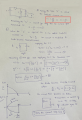
Sorry for the last post which was done in hurry assuming that the circuit is solved, spent time to understand the circuit for the past 2 days, came up with some solution but have few doubts and still not sure if the analysis is complete. Please find attached the work.

View attachment 360337
Hi there,

First I want to say you are doing really well with this, and the reason it takes a little longer is because it involves two independent variables when we usually only deal with one like current or voltage. The two variables are time and voltage, or time and current. That makes these problems a lot harder than the ones with just one independent variable, but once you do a few you start to get the hang of it and what is required.

I would think that before this you did some circuit with just DC voltages and diodes and resistors. That would help to prepare you for these harder problems. If that is not the case, then maybe we should review some of those simpler problems first where you become intimately knowledgeable about how diodes work in circuits.

Ok back to the circuit and your recent submission...

If you look at the attachment, I boxed in one part of your calculation in red. The question is: how did you get an expression with 't' in it when you started with an expression with 'dt' in it. You wrote:
V=L*di/dt then an arrow then I=V/L*t.
It should have been:
di=V/L*dt
or more clearly:
di=V*dt/L
Note that we kept the 'di' and the 'dt' as it was to start with.
Now switching 'di' to just upper case 'i' is not too bad, as long as you remember that 'I' in that case is the FINAL inductor current for the first topology (with just L), which becomes the INITIAL inductor current for the second topology (with both L and C). However, it is not such a good idea to change 'dt' to just 't' because you use 't' as the general time variable or as 't' in the second topology. In other words, 'dt' and 't' are different as they represent different things. 'dt' is the time the inductor is charging, and so 'dt' is the time the switch is on. 't' is the time that starts after the switch is opened.
And I see you were plotting waveforms and that is good because that will allow you to figure out what the diode is doing. The diode determines which topology is in effect, but I think you know now that the inductor voltage flips polarity when the switch opens, and that way you can figure out when the diode starts to conduct, and then later the waveform will show you when the diode stops conducting due to the change in voltage across it at some point in time.

I think maybe we should have went through a different example before this so you can see how the diode changes things. Before this you probably did not have to calculate the time of anything much, you only had to calculate the voltage and/or current, and calculating the time values make it seem more complicated. That's the way power supply rectifier circuits are too when we get storage elements along with the rectifiers.
 

Attachments

MrAl

Joined Jun 17, 2014
13,711
I'm at a loss as to how it is like I was saying that, when I explicitly stated, "This is effectively four different circuits, depending on if the switch is closed and whether the diode is forward or reverse biased. Each of these four circuits are individually linear, which means that you can apply Laplace transforms to them."


If they were being used correctly, then why did they result in a clearly wrong answer?
Hello again,

Your assertion that they were wrong was what prompted me to look at it even more critically.
What exactly did you see that was wrong?
Was it:
1. Wrong result.
2. Wrong application technique.
3. Both of the above.
 

MrAl

Joined Jun 17, 2014
13,711
Sorry for the last post which was done in hurry assuming that the circuit is solved, spent time to understand the circuit for the past 2 days, came up with some solution but have few doubts and still not sure if the analysis is complete.
Hello again,

I reviewed your recent attachment in my previous reply but I wanted to add one little idea you might be able to use to understand the diode a little better.

Since we are talking about an 'ideal' diode where we have:
Vanode=Vcathode (or the drop is 0v)
but in a real diode we have Vanode=Vcathode+0.7v (approximate) and that 0.7v gives us a threshold to allow us to determine when the diode switches 'on', but it gets tricky when we don't have that threshold to work with.
So how about if we use a lower threshold, like 1mv or even 1uv (one microvolt) so that when the anode becomes 1uv greater than the cathode the diode turns 'on' and when the anode becomes 1uv below the cathode voltage it turns 'off'. Thus we would be looking for either an increase of 1uv or a decrease of 1uv, so across the diode we would either have +1uv or -1uv.
Alternately, you can use 0v for when the diode turns 'off' and +1uv for when it turns on.
That might help you start to understand how the diode is working if you still have a problem with that.

Now as to the action of the inductor, if the diode cathode was grounded that would mean when the inductor voltage flips, the diode becomes forward biased by +1uv, and so current flows through the diode.

If that does not make any sense to you then you can ignore it, but having a threshold of some kind might help because you are used to seeing 0.7v, and eventually you won't need this analysis tool anymore.
 
Top