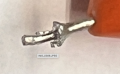
Need help identifying componets

Thread Starter

xtal_01

Joined May 1, 2016
227
The component tester probably doesn't put enough current through it to get it right up on its "knee". If you use your PSU and a suitable resistor to get 10 to 20mA through it you should measure its true value.
Got it ... I will give that a try today.

I see the curve and understand why you say that.

Honestly, never used a zener in any of my projects ... good time to learn how they work.

Thanks
 

Thread Starter

xtal_01

Joined May 1, 2016
227
OK .... I learned all about zeners today! I set up a few resistors (20K, 2.2K, 1K, 470) and was able to watch the curve as it drew more and more power.

I am 99.9% sure this is a 8.2 volt diode ... 1N756A ... thus the 56A on the diode.

And now for something else interesting ...

I starting taking off parts.

A few came off "odd" ... like the solder may have melted to the pad at one time but now only stuck to the part.

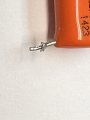
Here is a picture of one of the caps. See how the flared out solder is still on the part, not on the board or sucked up thy the solder wick.

Might just have been a bad joint like you guys said.

I definitely will remelt each of the joints on the remaining parts to make sure I have a good connection.

Mike
IMG_0388.JPEG
 

Tonyr1084

Joined Sep 24, 2015
9,744
Screenshot 2025-01-17 at 2.24.56 PM.png
That's a sign of insufficient dwell time with heat. I'm confident when the joint was first made it most likely flowed all the way through. You won't get a Hershey's Kiss shape (at the top of the lead) unless there was wetting to the pad. When you desoldered it the solder went from frozen state (solid) to plastic state as the heat moved through the board. Once the top of the lead became plastic it pulled out while the core of the solder had become molten. I've seen this many times before, and it's not a sign of a bad joint. Just how it came apart.
 

Tonyr1084

Joined Sep 24, 2015
9,744
Back in post #3 I said this:
What if it's a broken trace on an inside layer.
This is what inner traces look like when you cut the board and look at the traces from a side view (not top or bottom)
Screenshot 2025-01-17 at 2.58.52 PM.png
Some of those inner traces can be ground planes or power planes. They can act as heat sinks making it difficult to solder or to remove solder from those joints. In actuality the drawing above shows all three of the through holes connected via outside traces or via inside traces. Ignore that simplistic feature of the drawing. Just understand that a fracture can occur where you can't see it. Even if you were to micro-section the board it's very unlikely you'll ever find the fracture. Not unless the fracture went all the way around the through hole. On the upper and lower sides of the board is the part you can see, and the only part you can inspect. Boards of this nature can have several internal layers and copper used as heat sink sources making soldering such a board difficult without adequate means of heating the entire board. I know! I've worked on such boards.

All things considered, I still think you've gone at this the wrong way. To fix something you need to know what it does and how it works. You don't have that information. If your client doesn't mind getting the bare board and a pile of components back with no idea what went where or what polarity - - - you're going to be on the hook for finding a replacement board - or for replacement of the whole machine. Suppose it's a control board for an EDM (Electro Discharge Machining) system. Hope you have hundreds of dollars laying around to replace such a machine. If you take on the responsibility for it - you can be held liable if it becomes unrepairable. It may already be unrepairable, but since you touched it with a soldering iron - yup! You own it.
 

MisterBill2

Joined Jan 23, 2018
27,577
It does not look like a multi-layer PCB. Not nearly tight enough to go to that additional expense.
BUT on double sided boards there can easily be a plated thru hole that has failed. So parts might even need to be soldered on both the top and the bottom. And for the holes that do not have a component lead thru, just a short bit of wire thru , soldered on both sides, solves the problem.
 
Top