Need help about Voltage Translator/Scalar

Thread Starter

Mussawar

Joined Oct 17, 2011
157
Hi,
My apologies if it's too basic.
I've an analog signal that varies between 5~10V dc. Want to map it as 0~5V dc.
In simple words, if input varies from 5~10V, output should vary from 0~5V respectively. This will further be fed in to a Micro-controller ADC.
I found that I can translate from 0~10V to 0~5V with resister divider, and vice versa with an op-amp but they are all with reference to zero and this is not the case I'm looking for.
Thank you for any help.
Regards.
 

MrChips

Joined Oct 2, 2009
34,628
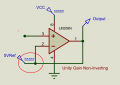
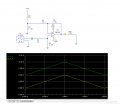
Any op amp can be configured as a summing amplifier. You can configure the op amp as a unity gain non-inverting amplifier and apply a 5V reference signal to the inverting input.

1710339353000.png
 

BobTPH

Joined Jun 5, 2013
11,463
Two resistors of equal value is all you need to translate 0-10V to 0-5V. (a simple voltage divider)

Subtracting 5V gives you an output of -5V to 5V.
 

Thread Starter

Mussawar

Joined Oct 17, 2011
157
Two resistors of equal value is all you need to translate 0-10V to 0-5V. (a simple voltage divider)

Subtracting 5V gives you an output of -5V to 5V.
Hi, Implementing an equal value resistor is pretty simple but the problem is that Input signal is not 0-10V. As I mentioned in question. It varies from 5-10V DC which I want to scale as 0-5V.
 

Thread Starter

Mussawar

Joined Oct 17, 2011
157
Hi M,
Why is the resistor divider method not acceptable, do you have a sketch you could post ?
E
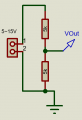
Hi, Voltage divider with equal value resistors is pretty simple by it's useful if input signal is 0-10V, which will give 0-5V output. In my case input is 5-10V. I don't know how to scale it 0-5V.
 

Attachments

Papabravo

Joined Feb 24, 2006
22,058
Hi, Voltage divider with equal value resistors is pretty simple by it's useful if input signal is 0-10V, which will give 0-5V output. In my case input is 5-10V. I don't know how to scale it 0-5V.
Let me say this in words of one syllable or less. You can't use a voltage divider to subtract 5V from your input signal. You need to use the circuit that @MrChips contributed in post #5. When selecting an opamp and considering the power supplies You should consider a rail-to-rail type and ±12V to make sure your input and output voltages remain within the common mode range.
 

Thread Starter

Mussawar

Joined Oct 17, 2011
157
Any op amp can be configured as a summing amplifier. You can configure the op amp as a unity gain non-inverting amplifier and apply a 5V reference signal to the inverting input.

View attachment 317534
Sorry if I'm wrong. Unity gain non-inverting amplifier needs the output to be connected back to non inverting input. Applying 5 volt reference at non-invertig input will be equal to apply 5 volts at output. Doesn't it?
 

Attachments

Thread Starter

Mussawar

Joined Oct 17, 2011
157
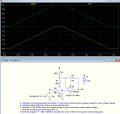
Below is the LTspice sim of an example op amp circuit with a gain of plus one that subtracts the 5V offset:

View attachment 317543
Thanks a lot. Seems perfect what I need. Let me simulate it and put it in practical. Just a couple of questions.
1. Ideally, should any Op-Amp work? I've LM358 in my hand.
2. What if, by any means, input goes below 5V? (i-e 4V). What is expected output voltage?
 

Thread Starter

Mussawar

Joined Oct 17, 2011
157

crutschow

Joined Mar 14, 2008
38,316
1. Ideally, should any Op-Amp work? I've LM358 in my hand.
It requires a single supply op amp if there is only one supply voltage.

The LM358 would work, depending upon the supply voltages.
The plus supply needs to be 2V above the maximum output, or 7V here for a 5V output.
And the low output will be about a volt above the minus supply (or that voltage above 0V if the minus supply is ground), since it's quite limited as to the current it can pull to ground from R2.
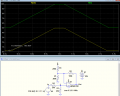
It goes closer to ground if you change R1 and R3 to 200kΩ and R2 to 100kΩ (sim below shows a minimum out of 192mV).

The op amp I used is a rail-rail type with better output sink current capability, so the output can go from 0V to the supply voltage(s).
2. What if, by any means, input goes below 5V? (i-e 4V). What is expected output voltage?
It will follow the input to the minimum, which is determined by the negative supply voltage, and stay there.

What supply voltages do you have available?

1710347209979.png
 
Last edited:

Thread Starter

Mussawar

Joined Oct 17, 2011
157
What supply voltages do you have available?
Thanks,
Currently, in my design, I'm using 24V, 12V and 5V. But any other supply voltage can be added considering it as a requirement. Single supply voltage would be pretty nice choice as readily available supply voltage can be used.
 
Last edited:

crutschow

Joined Mar 14, 2008
38,316
Output will be given to Micro-controller's ADC having 10bit resolution.
Do you want the 10b resolution for the 5-10V signal?
If you just attenuate the signal so that 10V is the ADC's maximum input, then you would have 9bit resolution for the signal.
Is that acceptable?
 
Top