Need a dual pulse timing circuit

sghioto

Joined Dec 31, 2017
8,634
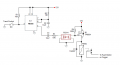
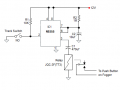
This version is what the TS wants I think.
Train passes track switch, pin3 goes High and relay activates through C1 for appx 300ms turning ON the fogger.
After 10 seconds pin3 goes Low and C1 discharges back through the relay again for appx 300ms turning OFF the fogger.
Now waiting for the next pass of the track switch.
1735587849196.png
 
Last edited:

AnalogKid

Joined Aug 1, 2013
12,143
This type of double-pulse circuit is common, and comes up around twice a year. I have posted 3 or 4 variations, as have others.

1. What power sources are available to run the timing circuit?

2. Do you still want the circuit to drive a relay that drives the smoke machine?

ak
 

MisterBill2

Joined Jan 23, 2018
27,584
Certainly post #21 is the most elegant of the electronic ones. And certainly it will work well with a low powered relay. My post suggesting a second switch could be an alternative if the TS does not have a convenient DC power source handy.
 

AnalogKid

Joined Aug 1, 2013
12,143
Two possible issues. One, the output "pulse" timing is dependent on the coil characteristics and will change significantly from one relay type to another. Two, the timing is dependent on the capacitor value, which might have a tolerance of -20% to +80% (or worse). Not a problem for a one-off home project, but not something I'd take to production.

ak
 

Thread Starter

azfrankp

Joined Dec 29, 2024
11
OK, and that explanation is quite clear to me!! The train enters the tunnel, the smoke starts, ten seconds later the smoke stops. And it is all one sequence, started from a single trigger pulse.

So it could be achieved with a 555 timer triggered by the train, using the present trigger scheme, and the a dual one-shot (CD4528, or similar) one side set to trigger on the rising edge of the 555 pulse, and the other side set to trigger on the falling edge of that 555 pulse. And then a logical "OR" gate to deliver the output of the two as needed.

OR a simple added switch to give a momentary pulse as the train enters the tunnel and a second momentary pulse as it exits the tunnel. That could be from two reed switches and one magnet on the train. The switches wired in parallel. No electronics and no timers.
Idepleted. Circuit approach. Thanks. I thought of your last suggestion with two switches 1st, but the reason I can't make that work is the train is too fast. It is only in the volcano mountain for a couple of seconds or less followed by other interactive features that may occur as early as 3 seconds later which would not allow enough time for the erupting effect. Because it is interective, the train may be stopped for long periods of time preventing a stop smoke switch after that. That situation would cause an eruption until the fog liquid is depleated. The circuit provides the fail safe of turning the smoke off once it turns on. Thanks for your help.
 

AnalogKid

Joined Aug 1, 2013
12,143
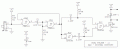
First pass at a re-worked dual-pulse circuit from 2016. This one has three independent timers.

R1-C1 - 10 second delay
R2-C2 - pre-delay output pulse
R3-C3 - post-delay output pulse.

U1A and B form a true monostable that is triggered by the track switch NO contacts. Once triggered it ignores all input activity during its timing period, so no switch debouncing is needed. The leading edge of the monostable output pulse drives one differentiator, and the trailing edge drives the other through an inverter. U1C acts as a combination dual comparator and inverted input OR gate - when either input goes low, the output goes high. There is a way to combine the two output timers into one, but it actually takes more parts.

Click on the schematic for a larger image.

ak


!!DualPulser-11-c.gif
 
Last edited:

MisterBill2

Joined Jan 23, 2018
27,584
I still like the relay/capacitor scheme in post #21. Understand that this is not a "rocket science" life critical application. It is part of a "free entertainment" setup, not even a "pay-per-view", and so probably only the TS would notice an error in performance.
 

Thread Starter

azfrankp

Joined Dec 29, 2024
11
This version is what the TS wants I think.
Train passes track switch, pin3 goes High and relay activates through C1 for appx 300ms turning ON the fogger.
After 10 seconds pin3 goes Low and C1 discharges back through the relay again for appx 300ms turning OFF the fogger.
Now waiting for the next pass of the track switch.
View attachment 339262
I like it the best. Nice and simple. The circuit is not critical. Never thought of using a cap for the pulse effect.

Thanks to all.
 

SaqiSPCB

Joined Jan 3, 2025
1
Using 555 timers for your specific application is possible, but it might get a bit complex since you need to differentiate between two separate push-and-release actions from the same input. A better and simpler approach might be to use a flip-flop circuit in combination with a 555 timer.

Here’s the idea:

  1. Flip-Flop for Toggle: Use a flip-flop (like a CD4013 or any SR latch) to toggle states every time the button is pressed and released. The first press starts the timer, and the second press stops it.
  2. 555 Timer for Delay: Connect the output of the flip-flop to a 555 timer configured in monostable mode. This will generate the 10-second pulse when the first press triggers the start.
  3. Reset Mechanism: Add a small circuit to ensure the 555 resets when the second press occurs, stopping the pulse.

If you prefer to stick with just 555 timers, you’d need at least two: one for toggling (configured cleverly with logic gates) and another for the timing. However, using a flip-flop simplifies things and is more reliable. Alternatively, a small microcontroller (like an Arduino Nano) can handle this task with just a few lines of code. It might save you time and effort if you’re open to programming.
 

Thread Starter

azfrankp

Joined Dec 29, 2024
11
Using 555 timers for your specific application is possible, but it might get a bit complex since you need to differentiate between two separate push-and-release actions from the same input.
Thank you for your input. You may have misread the timing diagram and/or requirements. The two pulse action is from 1 push-and-release input. This problem was solved with a simple circuit supplied earlier in the thread.
 
Top