Facebook
 Google
 GitHub
 Linkedin

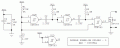
Here is something I did last year for another thread. You can adjust the times to fit your application. You might not need the output transistor. And one of the unused gates can be used to invert the output signal if you need the other logic polarity.
U1B acts as an inverting-input OR gate - if either input is low, the output goes high.
R1-C1 sets the time for the first pulse.
R2-C2 sets the time for the gap between pulses. It is running during the first pulse, holding off the second pulse, so its time is the first pulse time plus the desired inter-pulse gap.
R3-C3 sets the time for the second pulse.
Each pulse time is approx. 0.9 x R x C.
For your application, leave all caps at 2.2 uF (ceramic or metal film preferred).
R1 = 470 K >> 0.9 sec. first pulse
R2 = 1.0 M >> 1.3 sec. gap
R3 = 1.0 M >> 2.2 sec. second pulse
If you don't have a 4093, a variation of this circuit uses a hex inverter, but it adds two small signal diodes to perform the OR function.
UPDATE: I sounds like when power goes off, the power input is open circuit. This means there is no discharge path to reset the capacitors. Place a 10K resistor across Vcc and GND. C2 should discharge through the unused gates input protection circuits. If it doesn't, add a 470K resistor from U1A pin 3 to Vcc.
Here is an updated schematic.
ak

U1B acts as an inverting-input OR gate - if either input is low, the output goes high.
R1-C1 sets the time for the first pulse.
R2-C2 sets the time for the gap between pulses. It is running during the first pulse, holding off the second pulse, so its time is the first pulse time plus the desired inter-pulse gap.
R3-C3 sets the time for the second pulse.
Each pulse time is approx. 0.9 x R x C.
For your application, leave all caps at 2.2 uF (ceramic or metal film preferred).
R1 = 470 K >> 0.9 sec. first pulse
R2 = 1.0 M >> 1.3 sec. gap
R3 = 1.0 M >> 2.2 sec. second pulse
If you don't have a 4093, a variation of this circuit uses a hex inverter, but it adds two small signal diodes to perform the OR function.
UPDATE: I sounds like when power goes off, the power input is open circuit. This means there is no discharge path to reset the capacitors. Place a 10K resistor across Vcc and GND. C2 should discharge through the unused gates input protection circuits. If it doesn't, add a 470K resistor from U1A pin 3 to Vcc.
Here is an updated schematic.
ak
Last edited: