Ahh, if you connect it to a 20v power supply, the supply better be current limited or you'll have a glass passivated open connection with some burned rubble in the middle.
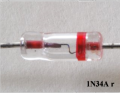
It looks like a point contact diode to me. I'm guessing it's germanium, maybe 1N34A.
If you look closely at the OP's picture, the s-curve in the catwhisker appears to be there, seen "on edge".
It's not a zener. I do believe it's a schottky because there is no reverse recovery time as measured from my scope. This diode looks like an old "cat whisker" from way back in the day. I was curious to see if anyone recognized it.
It's not a zener. I do believe it's a schottky because there is no reverse recovery time as measured from my scope. This diode looks like an old "cat whisker" from way back in the day. I was curious to see if anyone recognized it.
Looks a lot like this one, from the site I referenced in my previous post.
It is curious that you could see no reverse recovery time, because I don't think it looks like a Schottky diode.
How are you measuring Trr?
EDIT: I can't find a Trr spec on any germanium diode.
With 20nS transition times, you won't see the Trr of a small-signal diode. For example, 1N4148 has a Trr of 4nS. I suspect point contact diodes are in that same range, because their junctions are tiny. From Wikipedia:
Point-contact diodes
These work the same as the junction semiconductor diodes described above, but their construction is simpler. A block of n-type semiconductor is built, and a conducting sharp-point contact made with some group-3 metal is placed in contact with the semiconductor. Some metal migrates into the semiconductor to make a small region of p-type semiconductor near the contact. The long-popular 1N34 germanium version is still used in radio receivers as a detector and occasionally in specialized analog electronics.
So my BK 4011 function generator has 20ns rise/fall times. A higher end model like the hp33120a has the same rise/fall times. I wonder what instrument can give me faster rise/fall times to test this sort of thing (trr of diodes)?
So my BK 4011 function generator has 20ns rise/fall times. A higher end model like the hp33120a has the same rise/fall times. I wonder what instrument can give me faster rise/fall times to test this sort of thing (trr of diodes)?
I could probably design a little circuit for you that would allow you to do this. You could still drive it from your function generator.
If you want me to do that:
What power supplies do you have available?
Do you have a stock of transistors and resistors? If not, who would you order from?

 Facebook
 Google
 GitHub
 Linkedin