Facebook
 Google
 GitHub
 Linkedin
I am trying to repair a Nakamichi 620 amplifier, but it is acting strange, and I am running out of ideas.
The problem is; DC at the output. The board is supplied with +-53V and I have usually about -52V at the output.
The strange thing is, that it can sometimes drift all the way to +52V, and in rare occasions, it even centers around 0V and it actually works.
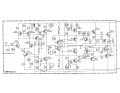
I have tried to separate the input and output stage, by 'cutting' the connection where the collectors of Q007 and Q008 are connected to the output stage, and connecting the feedback resistor R016 to GND. But I still measure -52V at the collectors of Q007 and Q008.
If I connect the input of the output stage via. a 6K8 resistor to GND, and insert a signal via a 10uF capacitor, then the signal arrives at the the output , with a DC offset of a little less than 1V.
I believe that the main problem is at the input stage. Why do I usually measure around -52V at the output of that?
It should be possible to get it to balance, but I am out of ideas, so input are welcome.
Thanks
Tom
The problem is; DC at the output. The board is supplied with +-53V and I have usually about -52V at the output.
The strange thing is, that it can sometimes drift all the way to +52V, and in rare occasions, it even centers around 0V and it actually works.
I have tried to separate the input and output stage, by 'cutting' the connection where the collectors of Q007 and Q008 are connected to the output stage, and connecting the feedback resistor R016 to GND. But I still measure -52V at the collectors of Q007 and Q008.
If I connect the input of the output stage via. a 6K8 resistor to GND, and insert a signal via a 10uF capacitor, then the signal arrives at the the output , with a DC offset of a little less than 1V.
I believe that the main problem is at the input stage. Why do I usually measure around -52V at the output of that?
It should be possible to get it to balance, but I am out of ideas, so input are welcome.
Thanks
Tom