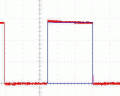
So your rise and fall times tell you it's not being driven hard enough.
Although the MOSFET isn't getting warm you're losing approx 0.4Wh of capacity in the transition.
Your scope is showing a low of -200mV because that's the body diode of the MOSFET catching the back emf of the motor. You need to measure the actual low voltage at the middle of the ON phase to determine on resistance. Also, how did you measure the 3A, with a multimeter? If so the real peak current at 50% duty cycle is 3/.7 = 4.3A.
The scope is telling us rise & fall of 2 and 8uS. For that MOSFET the actual rise and fall times with 100ohm gate resistor as per my earlier post should be around 600-700nS. It's not a major problem, but it's not as efficient as it should/could be - the 1k resistor is far too big, even a 270 is overkill. Whether that loss is material is up to the TS, but for battery powered kit we should always endeavour to minimise losses, it's just good engineering practice. Plus I'm offering educational insight based on 50y experience.
To evaluate whether it is fully on, you need a load. Without a load, voltage doesn't mean much. With a load, the voltage drop will allow you to calculate RDS(on). Noticed you say supply current. If that is the current through the load you can calculate RDS(on).
The motor was indeed connected, and spinning about 50% speed. The motor drives an offset spinning weight, which is why the current is so high, compared to a motor with no load on it, when the current is less than 250mA. The motor is about the same size and type as used in many hand tools, drills, etc. That was the supply current, yes, but the rest of the circuit current is negligable. I am somewhat surprised at the cleanliness of the waveform. With no mechanical load on the motor it is not so clean.....
Yes, it is designed to vibrate, but that's all I can say about the application, as it is a commercial product in development.
hi daba,
Do you have the time to re-run a short test, showing the waveform on the MOSFET Drain?
Which point in the circuit do you have the scope ground connected.?
E
hi daba,
Do you have the time to re-run a short test, showing the waveform on the MOSFET Drain?
Which point in the circuit do you have the scope ground connected.?
E
The IRFZ44N is not ideal, but it will work depending on circumstance.
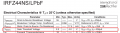
The key parameter is Vgs(th), the threshold voltage. That is spec'd as min 2, max 4v. Vgs(th) is the voltage the gate must see for the MOSFET to just turn on and pass the spec'd current.
For that device, its 250uA. However, that's worst case, many devices will be around 2.5 - 3v. Vgs(th) is better thought of as the voltage below which the the device is guaranteed to be OFF.
It you look at the chart 1 below, you can see that Vgs = 4.5v is the lowest voltage at which the manufacturer will guarantee that it is actually ON. But its not a hard edge. It is usably ON at a lower voltage, with limitations...
Chart 2 shows the transfer characteristic in its linear region, as the gate voltage changes. Although the line stops at Vgs = 4.5 because thats the spec, it clearly carries on down to Id = 250uA at 4v or below. So for an Arduino output at 4.2v (guaranteed on 5v and 20mA current source) there's a good chance that the bulk of devices will be ON and capable of sustaining around an amp or more of drain current and although the on-resistance might be 10x its spec'd 17.5mOhm, it will only be dissipating 0.175ohm x 1A x 1A = 0.175W and that's a rise of only 11degC over ambient. So not ideal, but useable. Counter-intuitatively as the die temperature rises the threshold voltage actually drops, making it easier to turn on!
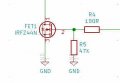
With my 1K series, 10K pull-down, I would have been hitting the gate with 4.5454 V from my arduino 5V output.
With 100R series, and 47K pull-down that will go up to 4.989 V, clearly giving me a better margin, and I'm guessing the gate charge time will be less ....
I'm thinking that to make any sense my measurements would have to be done with a linear static load, rather than the spinning motor. 3A at 16.8V ! Now where did I put those 5.6R 50W resistors .....
My sketch starts the motor at a minimum speed I have set, and then I can increase/decrease at will (4-button transmitter). I didn't took the bulb past 50% duty cycle, didn't want it getting too hot, and I didn't notice the supply current, which I read off my bench power supply.
So I did it again : 2.5 A at about 50% duty cycle. Its a 12V 55W bulb.
I let it run for several minutes, the FET got "warm", but not too hot to touch or hold.

 Facebook
 Google
 GitHub
 Linkedin