Myoelectric controlled Motor (Position).

Thread Starter

Temptation1

Joined May 12, 2018
4
Hey guys.
I'm trying to figure out how can I control the position of a motor using the voltage generated by muscle contraction.
I know the filtration and amplification step, but, trying to connect it to a motor is the part I don't understand.
I thought about using a PID motor but my teacher told me it was easier than that (using only amp. ops).
Any thoughts or ideas?
Thanks in advance.

PD: I cannot use anything besides analog devices.
 

jpanhalt

Joined Jan 18, 2008
11,087
PD: I cannot use anything besides analog devices.
Welcome to AAC.

How do you plan to distinguish between a myoelectric voltage that causes tension (e.g., holding something) and one that causes movement? Is there a difference? Are other sensory signals involved (e.g., proprioception) ? Perhaps that is why motion and position sensors (accelerometers) are used, for example, when mimicking hand motions to control devices.

To do this project fully analog will be a challenge to say the least. What is the basis for that requirement?

EDIT: After re-reading your question, do you simply want to convert an analog signal to control motor speed or position? If that is the case, voltage to PWM analog is quite doable. What voltage range are you able to produce?
 
Last edited:

Thread Starter

Temptation1

Joined May 12, 2018
4
Welcome to AAC.

How do you plan to distinguish between a myoelectric voltage that causes tension (e.g., holding something) and one that causes movement? Is there a difference? Are other sensory signals involved (e.g., proprioception) ? Perhaps that is why motion and position sensors (accelerometers) are used, for example, when mimicking hand motions to control devices.

To do this project fully analog will be a challenge to say the least. What is the basis for that requirement?

EDIT: After re-reading your question, do you simply want to convert an analog signal to control motor speed or position? If that is the case, voltage to PWM analog is quite doable. What voltage range are you able to produce?
Sorry. I din't explain myself correctly.
For the assignment I need to move a motor certain angles in comparison to the angles the biceps makes. For ex: 15°, 30°, 50°, so on.
So PWM? One friend told me to that but I'm not quite sure how to make that (Never saw that topic on my class).
My range is from 0 to aprox 10V (amplified).
 

jpanhalt

Joined Jan 18, 2008
11,087
Sorry. I din't explain myself correctly.
For the assignment I need to move a motor certain angles in comparison to the angles the biceps makes. For ex: 15°, 30°, 50°, so on.
So PWM? One friend told me to that but I'm not quite sure how to make that (Never saw that topic on my class).
My range is from 0 to aprox 10V (amplified).
Oops, I was afraid that was your plan, rather than what I later assumed in my edit. Using only myoelectric potential, you will have a difficult time determining the degree of flexure of the arm. If you do have that correlation, converting voltage to position a motor is quite easy by comparison. Think of how an old fashioned analog voltmeter works. It converts voltage to the position of the needle.

Please show us your results for angle vs. potential.
 

Sensacell

Joined Jun 19, 2012
3,784
With a project like this it's important to segregate the problem in to clearly separate domains:

1) Generate a clean, reliable signal that a motion control device can follow.
This is the hard part, don't even bother with a motor until you have this sorted.
In your case, the output should be an analog voltage.

2) Convert the analog voltage command signal into motion.
This is the straightforward part of the project.
 

DECELL

Joined Apr 23, 2018
96
I'm helping a student do this as we speak. Requirements
Gain of 1000 AC coupled differential amplifier.
Isolation stage- this is not just for safety, it boosts your input CMRR no end. IMRR!
Most EMG energy is 50Hz to 150Hz so bandwidth limit your gain stage.
Follow this with an envelope detector to integrate the muscle activity into a useful signal.
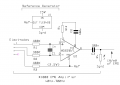
Here is our easy front end amplifier- it has zero gain at DC. It takes few seconds to reach operating point after connecting the victim.

upload_2018-5-14_11-15-7.png
 

Thread Starter

Temptation1

Joined May 12, 2018
4
I'm helping a student do this as we speak. Requirements
Gain of 1000 AC coupled differential amplifier.
Isolation stage- this is not just for safety, it boosts your input CMRR no end. IMRR!
Most EMG energy is 50Hz to 150Hz so bandwidth limit your gain stage.
Follow this with an envelope detector to integrate the muscle activity into a useful signal.
Here is our easy front end amplifier- it has zero gain at DC. It takes few seconds to reach operating point after connecting the victim.

View attachment 152475
Oh. I'm glad I'm using the same Amp Op. Ha!
I was using only to acquire the signal with a 10k Pot on RG but I think I'll use this configuration. Do you recommend to also use another amplifier to have more gain or with this one it's pretty decent?
 

DECELL

Joined Apr 23, 2018
96
I ended up using INA118 beccause I had one knocking about. It works just as well as the AD620.
Tested it last week- works as expected. Its not perfect as a measuring devcie but it will give a strong signal.
make sure you drive the ref pin fron a low impedance with an opamp or rail splitter.
 
Top