My Shortwave Radio Questions and Discussion

MrChips

Joined Oct 2, 2009
35,270
Are there any substitutes for Germanium Diodes?
No.

Why do we use Ge diodes in a crystal radio set?

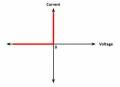
An ideal diode conducts current in one direction but not in the opposite direction.

IDEAL DIODE BEHAVIOUR
1642138648484.png

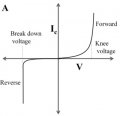
Real diodes are not perfect. The diode current vs voltage equation is an exponential curve. When in reversed bias mode there is a tiny leakage current. When forward biased, the leakage starts to grow (exponentially) with voltage but in the forward direction. Hence it takes a little bit of forward bias voltage to get the current going.

REAL DIODE BEHAVIOUR
diode I-V curve.jpg

It would be ideal if the diode started conducting as soon as we apply forward bias voltage. But it doesn’t in real diodes. With silicon diodes, it doesn’t start until the bias voltage is about 0.6V (called the knee voltage in the diagram).

With germanium diodes, it starts lower, at about 0.3V.
This limits the weakest signal that we are able to detect with a crystal radio set. The Ge diode allows us to detect weaker signals.

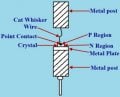
There is a better diode for a crystal radio called a point-contact crystal diode called "cat whisker diode". Hence the original name, crystal radio. But they are very difficult to find.
Cat Whisker.jpg

A common Ge diode is 1N34. If you send me your mailing address via PM I can mail some to you. But you can still purchase everything you need in one low cost kit from Mike’s.
 

Thread Starter

Yanerth

Joined Jan 11, 2022
10
No.

Why do we use Ge diodes in a crystal radio set?

An ideal diode conducts current in one direction but not in the opposite direction.

IDEAL DIODE BEHAVIOUR

View attachment 257637

Real diodes are not perfect. The diode current vs voltage equation is an exponential curve. When in reversed bias mode there is a tiny leakage current. When forward biased, the leakage starts to grow (exponentially) with voltage but in the forward direction. Hence it takes a little bit of forward bias voltage to get the current going.

REAL DIODE BEHAVIOUR

View attachment 257636

It would be ideal if the diode started conducting as soon as we apply forward bias voltage. But it doesn’t in real diodes. With silicon diodes, it doesn’t start until the bias voltage is about 0.6V (called the knee voltage in the diagram).

With germanium diodes, it starts lower, at about 0.3V.
This limits the weakest signal that we are able to detect with a crystal radio set. The Ge diode allows us to detect weaker signals.

There is a better diode for a crystal radio called a point-contact crystal diode called "cat whisker diode". Hence the original name, crystal radio. But they are very difficult to find.
View attachment 257635

A common Ge diode is 1N34. If you send me your mailing address via PM I can mail some to you. But you can still purchase everything you need in one low cost kit from Mike’s.
Thank you for the reply! I checked out Mike's and I think I'll buy a kit from them, it's quite low cost and that's great for me.
 

atferrari

Joined Jan 6, 2004
5,031
The critical moment is when you start to understand the basics and magically discover that with zero further time dedicated to increase knowledge but some more $$$ you could buy incredible better gear becoming a (de luxe class) button pusher. You will then fill the ether with power in the final, knowing / learning less and less.

Started myself with a basic CW xmtr modified for AM voice 80/40. I gave up when nobody seemed interested in the technical side and certain lady sent all my trash to the building's basement where it ended duly crushed by an overstow of things.

Buena suerte

LU2AKB MM
LU5DQE
 

SamR

Joined Mar 19, 2019
5,542
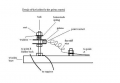
Before there were diodes they used an actual mineral crystal held in a vise like device with an arm holding the "Cats Whisker" to place on different parts of the crystal to find the "Sweet Spot".

This is a diagram of a very crude one. Some were very elaborate Victorian pieces. Quite collectible radio memorabilia pieces.
1642176288985.png
 

Thread Starter

Yanerth

Joined Jan 11, 2022
10
I took another look at Mike's Electronics and am very much surprised, and not to mention pleased, that you can buy individual components, and relatively cheap too. Although international shipping may take up to 40 days, it's amazing that there is a place to buy these hard to find components.

Also, I'm reading all the replies to this thread, even if I don't respond to each one.
 

DickCappels

Joined Aug 21, 2008
10,661
Are there any substitutes for Germanium Diodes?
Yes, small signal Schottky diodes make excellent RF detectors. They are cheap and easy to find.
Examples:
http://www.es.co.th/detail.asp?Prod=028000213
http://www.es.co.th/detail.asp?Prod=017620182

A good germanium diode will probably beat the silicon diodes mentioned in this post, but they are a great way to start because they are readily available. To switch to germainum diode, no other circuit changes are needed.

Edit: You will find that the 1N4148, 1N914, and 1N916 (all very similar) switching diodes make pretty good RF detectors too. And they are cheaper and maybe easier to find than Schottky diodes.

Also THE definitive crystal radio website was created by engineer and entrepreneur Bob Tongue.
http://kearman.com/bentongue/xtalset/xtalset.html
 
Last edited:

Tesla23

Joined May 10, 2009
560
If you can find a galena crystal you can make your own cat’s whisker and find a junction on it. Other semiconductor crystals can work. It’s how things were done at the beginning of radio.
Some years ago when I was trying to interest my kids in electronics, I found galena easy to find - I called a mineral souvenir shop in Broken Hill (NSW, Australia), one of our famous mining towns. They sell mineral crystals to tourists, and the chap on the phone was more than happy to scrape up some little bits of galena and send them to me essentially for the price of postage. So for $5 I got several cups of kidney bean size galena crystals. So if anyone wants to get galena, look for a souvenir shop in a lead mining town.

I put a bit into my old cats whisker holder, but admit I got very frustrated fiddling around trying to get some rectification on a simple curve tracer. I did get some, but it brought back memories of my old crystal set and why I readily dumped the galena for my OA79 germanium diode.
 
Top