My Dalek's dome

cmartinez

Joined Jan 17, 2007
8,783
Hi there, Visual Basic now, I did do Pascal and C++ years ago :(
I suggest you start dusting your C++ skills. Judging from what you've just said, it shouldn't be too hard. But be prepared, you're about to learn an architecture that you're not familiar with, and that will take time and patience. But you won't be alone. We'll be here to help you.
 

Thread Starter

nicktruman

Joined Feb 4, 2019
75
Raspberry Pi and Arduino are two distinct things. The board in that kit is 100% Arduino compatible both with the hardware (Arduino UNO R3) and software (Arduino IDE). “Arduino“ is a very nebulous term at this point because it refers to am organization, it’s hardware, it’s software, and the entire ecosystem that works with the Arduino IDE, some of which is completely unlike the Arudino hardware.

This board, though, will use all the libraries and plug-in hardware that the Arduino-made UNO R3 does.

RPi is a different world, and to confuse matters, the Raspberry Pi RP2040 MCU based boards are now compatible with the Arduino IDE, but that’s not the same as a Raspberry Pi 3 or 4 SBC (Single Board Computer).

You don’t have to worry about buying that kit for your purposes, though.
Thank you, I have bought it, should be with me tomorrow :)
 

MisterBill2

Joined Jan 23, 2018
27,650
My suggestion is rather different, some of the aspects may also apply to the computer versions.
For the sound sensing microphones, use 2 identical tubes, about an inch diameter and long enough to resonate in the range of frequencies you would use to speak to the Dalek. The angle between them would be between 30 and 45 degrees, with the middle of the angle forward centered. Use either cheap electret mics or cheap computer dynamic mics, often available from those who upgrade. For the amplifiers, the cheap cassette tape head amp from either a scrapped car stereo or a scrap boom box. Then the tricky part is having the louder signal, (greater voltage) select the direction for the head rotate motor. That can be done with one or two stages of DC gain after the preamp, each DC gain circuit feeding the coil of a SPDT relay connected to drive the DC directional motor rotating the dome.
The resonant tubes should reduce the noise sensitivity and make it rather directional. And no software to write and no processor burning power constantly.
 

Thread Starter

nicktruman

Joined Feb 4, 2019
75
Raspberry Pi and Arduino are two distinct things. The board in that kit is 100% Arduino compatible both with the hardware (Arduino UNO R3) and software (Arduino IDE). “Arduino“ is a very nebulous term at this point because it refers to am organization, it’s hardware, it’s software, and the entire ecosystem that works with the Arduino IDE, some of which is completely unlike the Arudino hardware.

This board, though, will use all the libraries and plug-in hardware that the Arduino-made UNO R3 does.

RPi is a different world, and to confuse matters, the Raspberry Pi RP2040 MCU based boards are now compatible with the Arduino IDE, but that’s not the same as a Raspberry Pi 3 or 4 SBC (Single Board Computer).

You don’t have to worry about buying that kit for your purposes, though.
Hi Ya’akov, I now have my Arduino Uno and a whole load of bits.. So far I have got some external leds to flash :D
I have bought some little microphones, should be with me later this week.
I found this Arduino project, looks like what i need.. but..
The Dalek's dome with its eye is too heavy for a little stepper motor, it needs some sort of 12v servo or linear actuator. Is this doable? https://create.arduino.cc/projecthub/lbf20012001/sound-location-finder-92e6b0
 

Ya’akov

Joined Jan 27, 2019
10,258
Hi Ya’akov, I now have my Arduino Uno and a whole load of bits.. So far I have got some external leds to flash :D
I have bought some little microphones, should be with me later this week.
I found this Arduino project, looks like what i need.. but..
The Dalek's dome with its eye is too heavy for a little stepper motor, it needs some sort of 12v servo or linear actuator. Is this doable? https://create.arduino.cc/projecthub/lbf20012001/sound-location-finder-92e6b0
It's the right idea and has the principles you need.

What is the mechanical layout of the dome's rotation? Not knowing anything about what you've done, I would probably choose to use a thrust bearing (possibly as simple as a lazy susan bearing and drive the dome with a friction drive against a ring mounted coaxially underneath it and an idler 180° from it to balance the forces.

With this scheme you will need a position sensor mounted concentrically so you can tell when you have reached the desired position. You can use an rotary encoder or an analog position sensor to do that.

First, though, I think you should build a scale model using his code and setup so you can learn and test. Then you can adapt it as you figure our what you want to do. Bear in mind that steppers come in many sizes, and you could use one for this—particularly if you use a thrust bearing to reduce the load to only angular.
 

Thread Starter

nicktruman

Joined Feb 4, 2019
75
It's the right idea and has the principles you need.

What is the mechanical layout of the dome's rotation? Not knowing anything about what you've done, I would probably choose to use a thrust bearing (possibly as simple as a lazy susan bearing and drive the dome with a friction drive against a ring mounted coaxially underneath it and an idler 180° from it to balance the forces.

With this scheme you will need a position sensor mounted concentrically so you can tell when you have reached the desired position. You can use an rotary encoder or an analog position sensor to do that.

First, though, I think you should build a scale model using his code and setup so you can learn and test. Then you can adapt it as you figure our what you want to do. Bear in mind that steppers come in many sizes, and you could use one for this—particularly if you use a thrust bearing to reduce the load to only angular.
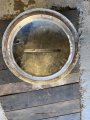
Hi, great minds think alike, I have a monster lazy Susan mounted in the dome . The ruler in the dome is 12" long!
 

Attachments

MisterBill2

Joined Jan 23, 2018
27,650
REally, that looks like a high quality ball bearing with ground races and precise mounting surfaces. But the grease may no longer be to original specifications. How easily does it rotate? That will determine what you need to have to rotate it. But certainly it will not be a hobby RC servo. Do you want the dome to be able to rotate 360? or just left and right?
Does that bearing have gear teeth? That is an option with many of them.Otherwise a toothed belt and a gearmotor can work well. But all that depends on how easily it turns.
 

Thread Starter

nicktruman

Joined Feb 4, 2019
75
REally, that looks like a high quality ball bearing with ground races and precise mounting surfaces. But the grease may no longer be to original specifications. How easily does it rotate? That will determine what you need to have to rotate it. But certainly it will not be a hobby RC servo. Do you want the dome to be able to rotate 360? or just left and right?
Does that bearing have gear teeth? That is an option with many of them.Otherwise a toothed belt and a gearmotor can work well. But all that depends on how easily it turns.
Hi, it turns easily, but will have the weight of the “eye” hanging on the front, that to needs an actuator!
I think turning left/right 90 degrees will suffice.
The mobility scooter inside is powered by 2 12v bike batteries
1128BEC8-CDDD-4392-9606-553658B1795A.jpeg
 

MisterBill2

Joined Jan 23, 2018
27,650
A bit of overhung weight should not affect a bearing that diameter very much. Worse case you would oil it instead of grease, to reduce the effort. You might be able to simulate a drive gear with some roller chain anchored to the extended bolts on the dome bearing, and then a 10 tooth sprocket on your gear motor.
 

Thread Starter

nicktruman

Joined Feb 4, 2019
75
It's the right idea and has the principles you need.

What is the mechanical layout of the dome's rotation? Not knowing anything about what you've done, I would probably choose to use a thrust bearing (possibly as simple as a lazy susan bearing and drive the dome with a friction drive against a ring mounted coaxially underneath it and an idler 180° from it to balance the forces.

With this scheme you will need a position sensor mounted concentrically so you can tell when you have reached the desired position. You can use an rotary encoder or an analog position sensor to do that.

First, though, I think you should build a scale model using his code and setup so you can learn and test. Then you can adapt it as you figure our what you want to do. Bear in mind that steppers come in many sizes, and you could use one for this—particularly if you use a thrust bearing to reduce the load to only angular.
Hi there
Really hoping you can help me..
I am trying to get the sound detection circuit working, I can see lights flash on the stepper driver but the stepper does not move. The connections for my stepper and driver are different from the sound detection stepper.
I have bought these sound modules: https://www.amazon.co.uk/dp/B07JZBL8L5?ref_=pe_27063361_487360311_302_E_DDE_dt_1
and I have attached the code I am running
Really grateful for any assistance! (as will be my Dalek - Damian - who is now all in primer ready for body workIMG_6651.JPEG)
 

Attachments

Ya’akov

Joined Jan 27, 2019
10,258
no, just the one stepper and driver. I just can't work out how to connect it all up
OK, if you can give me a bit, I will work up the same circuit here and see what is going on. It might take a little while but I do have the sound sensors and stepper driver. I think I might know what's up but let me actually make it work then I can explain it.

I will try to work on it some today but it might not be until tomorrow that I have news.
 

Thread Starter

nicktruman

Joined Feb 4, 2019
75
OK, if you can give me a bit, I will work up the same circuit here and see what is going on. It might take a little while but I do have the sound sensors and stepper driver. I think I might know what's up but let me actually make it work then I can explain it.

I will try to work on it some today but it might not be until tomorrow that I have news.
Thank you! really apreciated. My stepper has 2048 steps per rev, so i changed that in the code and now the stepper vibrates but does not move. It seems the "code" uses pin 12 as a direction pin and 13 to move, my driver seems to just have 4 step zones, inputs 1-4
If i look at the serial monitor and touch a mike I get
Turning Left
then the other
Turning Right
So the mikes are working as they should
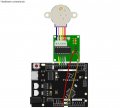
This is my driver
ULN2003 stepper motor driver
A ULN2003 Stepper Motor Driver is used to convert weak signals into more powerful control signals in order
to drive the Stepper Motor. In the illustration below, the input signal IN1-IN4 corresponds to the output signal
A-D, and 4 LEDs are integrated into the board to indicate the state of these signals. The PWR interface can
be used as a power supply for the Stepper Motor. By default, PWR and VCC are connected.
 

Ya’akov

Joined Jan 27, 2019
10,258
Thank you! really apreciated. My stepper has 2048 steps per rev, so i changed that in the code and now the stepper vibrates but does not move. It seems the "code" uses pin 12 as a direction pin and 13 to move, my driver seems to just have 4 step zones, inputs 1-4
If i look at the serial monitor and touch a mike I get
Turning Left
then the other
Turning Right
So the mikes are working as they should
This is my driver
ULN2003 stepper motor driver
A ULN2003 Stepper Motor Driver is used to convert weak signals into more powerful control signals in order
to drive the Stepper Motor. In the illustration below, the input signal IN1-IN4 corresponds to the output signal
A-D, and 4 LEDs are integrated into the board to indicate the state of these signals. The PWR interface can
be used as a power supply for the Stepper Motor. By default, PWR and VCC are connected.
The stepper driver you have needs the Stepper library. You have to combine the calls to the library with the code for the sound detection. So, instead of the two pins, you will need to make that two functions like step_direction() and step_move() that use the library calls to do what the program thinks the pins do.

It's really not too hard, but it may be daunting for a beginner. I will try to get a chance to make it work, ASAP.
 

Thread Starter

nicktruman

Joined Feb 4, 2019
75
The stepper driver you have needs the Stepper library. You have to combine the calls to the library with the code for the sound detection. So, instead of the two pins, you will need to make that two functions like step_direction() and step_move() that use the library calls to do what the program thinks the pins do.

It's really not too hard, but it may be daunting for a beginner. I will try to get a chance to make it work, ASAP.
Thank you!!!
 

BobTPH

Joined Jun 5, 2013
11,554
If a stepper motor vibrates instead of moving, one if the phases is wired backwards. Try reversing the leads for either, but not both of the phases.
 

Ya’akov

Joined Jan 27, 2019
10,258
If a stepper motor vibrates instead of moving, one if the phases is wired backwards. Try reversing the leads for either, but not both of the phases.
He only has two wires going to the driver board, it's simply not wired correctly because the code was written for some hardware that had a "direction" and "step" pin.
 
Top