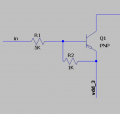
With no base-emitter current a BJT does not conduct (is open).
With sufficient base-emitter current (typically 1/10th of the collector current) the BJT will be fully on (saturated).
That's the basics.
Hello Audioguru,when we put this resistor we make some voltage divider Between VDD_3 and V_in,
so our Emitter based junction is forward biased.
but if the collector will be at low voltage also then base collector junction will also be reversed biased .
i cant see how this R2 resistor closes the flow of current?
if collector is lower then base we will have all the conditions for the hole current to flow.
UPDATE:
Yes i understood the principle when there is no voltage and the Vin is floating the there is no current
and emitter voltage will be the base voltage SO Vbe=0 thus EMITTER BASE juction will not be forward biased thus transistor is off and no current flow.
Yef, you wrongly asked, " Why Q1 has a resistor connected between base and collector" but it is not connected to the collector, instead it connects between base and emitter to make sure that the transistor is turned off when the base is floating.
for the first step We need to have Vb>Vc so the base collector juction will be reversed biased.
Our Vb is a voltage divider between 3V and Vin(which is 0)
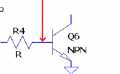
So we get some collector voltage lower then Vb,this collector voltage goes to the next step shown in the arrow bellow and meets R4.Q6 is an NPN transistor and we need Vb>Ve and Vc>Vb to have base emmiter junction forward biased and base collector junction reverse biased(flow from P to N is aforward biased no matter is its electrons of holes)
Why do we need the R4 resistor between the biasing voltage and the base connection, why cant we just plug voltage into the base(like they do in Q4)?
Thanks .
Hello Audioguru ,current flow could be limited on if we have a current divider
i know we have a base current an Collector current and I_E=I_b+Ic but i cant see how less current will flow into the base With placing R4?
how exactly we get a current divider in the photo shown bellow?
Yef, please read about and understand that the base-emitter junction of a transistor is a diode that has a small maximum allowed current. If there is no series current-limiting resistor then the transistor lets out its magic smoke.
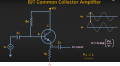
regarding the circuit block shown in the end, i have recognised it as a emitter follewer amplifier,with the ampliying properties shown in the end.
But the whole circuit shown in the first post has no AC signal its ALL DC.
How to understand the functionality of this block in DC perspective?
Or i am wrong and the AC gain properties do have a role in here?
Thanks.
Your entire circuit is a switching circuit. It is not a linear amplifier.
When Vin= 1 then Q1, Q2 and Q6 are turned off then Q3 and Q4 are turned on. Q5 is turned off.
When Vin= 0 then Q5 is turned off.
The output emitter-followers pull up when turned on and can turn on loads connected to ground.
Q5 applies some of Vdd_400 (minus base current in R8) to the load when Q5 turns on.
The load turns itself off when it is no longer powered.
R8 obviously provides base current to Q5 when Q4 is turned off. When Q5 has base current then it turns on but it cannot fully turn on due to base current in R8 producing substantial voltage drop..
Diode D2 conducts when an inductive load produces a high positive flyback voltage when Q5 turns off because a reverse emitter-base voltage damages transistors.
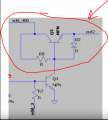
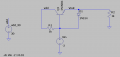
Hello, I have tried to simulate this switch,its suppose to switch 200V on and off ,but the output equals the input.
As shown bellow.
where did i go wrong?
Thanks.
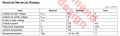
You show a 2N3904 transistor with 200V between its collector and base but its absolute maximum allowed voltage is only 60V.
The simulation program and you did not read the datasheet.
It is a silly circuit since R1 is smoking with (200V squared)/5k ohms= 8W of heating.
The transistor in your large circuit uses the collector-base resistor to partially turn on the emitter-follower, and uses a common-emitter transistor to pull the base to near ground to turn off the emitter-follower.
Hello AudioGuru,by reading the datasheet I have changed to 30Volts.but still i have Vout=Vin behavior.
Even when i changed resistor 5k to 300 its still shows Vou=vin behavior.
how to change R and diode so i will get 30V switching on and off?
The transistor is an emitter-follower. When you wrongly feed +1V to its base then it can NEVER turn on since its emitter will be about +0.3V with a low current load.
The simulation program does not understand why there is no load so it shows the input voltage and output voltage the same.
In your original circuit that you used two transistors Q2, Q4 as switches to control Q3, Q5, and Q2, Q4 didn't provide any voltage or current for Q3, Q5, but now you used Vin to replaced a switch, so what's the problem?
Hello AudioGuru,bellow We see the full AC properties of an emitter follower is as shown bellow.
Also i have tried to add 1Kohm load to the output to the simulation its still shows only about0.4V at most no switching oon and of 24V
You said:
" will NEVER turn on since its emitter will be about +0.3V with a low current load "
What simulation test you propose me to do in order to see if it has suffient condition to open?
how to test saturation issue and currents.i dont know how to see if i got the correct conditions given R1 connection
The datasheet link shown bellow.
Thanks https://pdf1.alldatasheet.com/datasheet-pdf/view/246437/RENESAS/2N3904.html
The transistor is an emitter-follower. When you wrongly feed +1V to its base then it can NEVER turn on since its emitter will be about +0.3V with a low current load.
The simulation program does not understand why there is no load so it shows the input voltage and output voltage the same.

 Facebook
 Google
 GitHub
 Linkedin



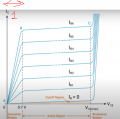
 i understood the principle when there is no voltage and the Vin is floating the there is no current