Multi-tap transformer newb questions

Thread Starter

Stephen Flynn

Joined Sep 29, 2015
43
Hi, I'm getting back into electronics after a couple years break. Up till now I have never played with anything that required more than 9v battery :)

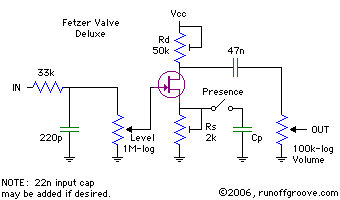
I plan to make a small solid state guitar amplifier. My plan is to use a generic chip amp power amplifier (at this stage unsure which..maybe Lm1875?), or even a prebuilt car audio power amp. My plan is to use something like a fetzer valve circuit from runoffgroove as the preamp.

I was able to buy this transformer at my local store. One the Primary side it says 0, 110 and 220 - i'm in Indonesia - so 220v it is...that straight forward

A few questions about the secondary side and general questions about grounding etc.

1. I need to have 9v power rail for preamp, and a +- 24v supply (for sake of argument) for power amp. Is it possible to get dual supply from this transformer??

2. Do I need 2 x rectifier?
3. Do I need 2x transformer?
4. Where Do I tie both grounds from preamp and the power amp, or keep seperate?
5. I plan to build a wood case..how do I ground everything?
6. do i need a voltage regulator to get my 9v rail? or can this be done via a simple voltage divider?
7. what size/rating caps and resistor do I need for rectifier?
8. I have a supply of Diode with marking 6A10 MIC...are these suitable, if not what should i buy?

Any advice appreciated
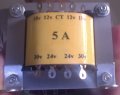

transformermultitap.jpg
 

crutschow

Joined Mar 14, 2008
38,508
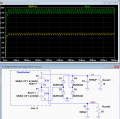
Here's a circuit to get full-wave rectified voltages for both the 24V and 9V supply from the 12V windings using a single bridge rectifier.
Basically the 4 diodes act as a full-wave bridge rectifier for the high voltage output and the two diodes to ground act as a center tap, full-wave rectifier for the low voltage output.
If interested, here's a further explanation of the circuit.

You will want to use a regulator, such as an LM317, for the 9V.

upload_2017-10-16_12-39-6.png
 
Last edited:

crutschow

Joined Mar 14, 2008
38,508
4. Where Do I tie both grounds from preamp and the power amp, or keep seperate?
You keep them separate but combine the together at one point at the power supply common.
5. I plan to build a wood case..how do I ground everything?
You just have the circuit common as the ground.
It doesn't have to be connected to anything else.
7. what size/rating caps and resistor do I need for rectifier?
Depends upon the current draw from each of the supplies.
8. I have a supply of Diode with marking 6A10 MIC...are these suitable
They should work fine.
 

Thread Starter

Stephen Flynn

Joined Sep 29, 2015
43
Here's a circuit to get full-wave rectified voltages for both the 24V and 9V supply from the 12V windings using a single bridge rectifier.
Basically the 4 diodes act as a full-wave bridge rectifier for the high voltage output and the two diodes to ground act as a center tap, full-wave rectifier for the low voltage output.
If interested, here's a further explanation of the circuit.

You will want to use a regulator, such as an LM317, for the 9V.

View attachment 137388
Thanks very much..this is exactly the type of information I need. So I can get a half supply of whichever winding I choose...then dial down LM 317 (with trimpot or specific resistor) to specifically what I require for the lesser/lower voltage rail?? Genius..
Just one more dumb question ..why 12v?? Why have 2 of you guys who responded recomended..my initiial thought was to immediately choose the 24v to get 12v then LM 317 to get 12 down to 9v. My second thought would be to drop the amp W output and make it simple 18V , to also get my 9V.
I don't pretend to understand why this works, but I will breadboard your schematic once I have my mains socket, fuse and transformer mounted in the case. This will make more sense when i get a DMM and actually measure the voltages from various taps.
Transformers are still a bit of a mystery to me at this stage. The more I read the more confused I get, as there is plenty of conflicting information, and actually very little about projects that require 2 rails with different voltages. I'm probably searching with the wrong terms. Come to the conclusion that most people who build an gainclone amplifier are not interested in putting a preamp in front of the power amp, and if they do they generally would use a design that incorpates everthing on a single voltage and use suitable opamps etc that are properly designed and rated. Whereas my first amp build will be "frankensteining" 2 separate circuits. The 9v preamp being something generally designed to go into a working guitar amp as a pedal on the front end. Another question, is ther anything that needs be modified here on the fetzer valve circuit to ensure that all the AC signal is getting into the power amp. Do you think this would be appropriate for my needs??

Regards and much thanks
Steve
 

crutschow

Joined Mar 14, 2008
38,508
why 12v?? Why have 2 of you guys who responded recomended..my initiial thought was to immediately choose the 24v to get 12v then LM 317 to get 12 down to 9v.
Because the higher voltage windings have a higher winding resistance and give less current for a given transformer rating.
You never want to use a higher voltage transformer tap than needed for the desired voltages.
Transformers are still a bit of a mystery to me at this stage.
So what don't you understand?
 

Thread Starter

Stephen Flynn

Joined Sep 29, 2015
43
So what don't you understand?
So many things I don't understand ...heres a few questions about the transformer in the picture I supplied above. This is like ground zero cluelessness
1. If it's putting out 12v AC, and I need 24v DC for my LM1875 amp...how does 12v become 24V??
2. I believe I can run LM1875 two modes a) single supply 24v, or +-24V. Is it possible to do this, and still get a 9v rail from this transformer as well? What advantage does single supply have over split +- rail (lots i don't understand about amplifiers as well) :)
3. Could I (if I had a need)...use all the taps supplied on this transformer and get 12v, 18v, 24v, 30v power rails from this transformer?? And the max current for each, just be percentage/ratio of the 5A max??
4. Does the filtering somehow increase the voltage??
5. What does centre tap mean? Where is the centre tap on multi tap device?
5. Could you recommend a book or an online source that explains in detail about transformers. Or are there any free notes from manufacturers that are good reading??

My interest in electronics is/has been really only concerned with audio circuits designed for electric guitars. It feels like its been "paint by numbers" without really understanding the why?? I,m pretty good at soldering, swapping out caps, making cable, wiring guitars, building effects pedals..but not really ever learnt anything about electronics..just trial and errors modding to see what sounds good, or what doesn't. I would love to understand and be able to design my own circuits.
I really appreciate your assistance with this piece of the amp building puzzle.
cheers
 
This https://www.google.com/url?sa=t&rct...df/5c007.pdf&usg=AOvVaw3-oycQkmf0vMLPJPNa-yoK should answer some of your questions.

The way I read your transformer is:
6 -12-CT-12-6 and 0-24, 0-30
18-12-CT-12-18 and 24-24, 30-30

So, you get 6 VAC between the 18 and 12 taps. and you get 24 VAC between the two 24 windings etc. 5A is each winding. With the 24 winding, you can add or subtract them to get 24+30 or 30-24. Similarly, you can get 8 VAC between the 12 and and the 18 taps.
 

AnalogKid

Joined Aug 1, 2013
12,131
The way I read the transformer is this:

30 - 24 - 18 - 12 - center tap (0 V) - 12 - 18 - 24 - 30

You should be able to confirm this with a ohmmeter. For example, if the resistance from 30 to 30 is twice the resistance from either 30 to 0, then there is only one secondary winding with lotsa taps. If there is no connection (open circuits) between the 12's and 18's and the 24's and 30's, that is not a big problem but it does change things.

Once we're sure about the winding(s), the circuits are pretty straight forward. In fact, you probably can start with some small power supply modules from ebay to make your project start a bit easier.

The 6A10 is an excellent diode. It is overkill for the preamp but there's no harm there. It might be too small for the power amp depending on how much power you are trying to achieve, but it is ok to start the design with.

That is one hell of a transformer for general purpose analog stuff. Wish I had a dozen of them about 20 years ago.

ak
 

crutschow

Joined Mar 14, 2008
38,508
1. If it's putting out 12v AC, and I need 24v DC for my LM1875 amp...how does 12v become 24V??
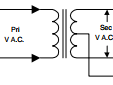
My circuit uses a bridge between the two 12V taps, so there is 24V between the two taps, since a tap is just a connection on the single secondary winding (below).
upload_2017-10-22_9-0-20.pngCT
2. I believe I can run LM1875 two modes a) single supply 24v, or +-24V. Is it possible to do this, and still get a 9v rail from this transformer as well? What advantage does single supply have over split +- rail
You can do that.
But using a lower AC voltage to get a lower DC voltage means less power dissipation (loss) in the regulator.
3. Could I (if I had a need)...use all the taps supplied on this transformer and get 12v, 18v, 24v, 30v power rails from this transformer?? And the max current for each, just be percentage/ratio of the 5A max??
Yes, you could do that, as long as the total current rating is not exceeded.
4. Does the filtering somehow increase the voltage??
In a way.
A rectifier with a capacitor filter output will charge to near the peak voltage of the sinewave, which is 1.4 times the AC RMS voltage.
5. What does centre tap mean? Where is the centre tap on multi tap device?
The center-tap is just a connection at the midpoint of the secondary winding.
The other taps are taken a various points on the winding above and below the center-tap.
The highest voltage is the ends of the winding.
(This assumes a single secondary winding).
5. Could you recommend a book or an online source that explains in detail about transformers.
Nothing particular.
But a google search should give plenty of sources.
 

Thread Starter

Stephen Flynn

Joined Sep 29, 2015
43
The way I read the transformer is this:

30 - 24 - 18 - 12 - center tap (0 V) - 12 - 18 - 24 - 30

You should be able to confirm this with a ohmmeter. For example, if the resistance from 30 to 30 is twice the resistance from either 30 to 0, then there is only one secondary winding with lotsa taps. If there is no connection (open circuits) between the 12's and 18's and the 24's and 30's, that is not a big problem but it does change things.

Once we're sure about the winding(s), the circuits are pretty straight forward. In fact, you probably can start with some small power supply modules from ebay to make your project start a bit easier.

The 6A10 is an excellent diode. It is overkill for the preamp but there's no harm there. It might be too small for the power amp depending on how much power you are trying to achieve, but it is ok to start the design with.

That is one hell of a transformer for general purpose analog stuff. Wish I had a dozen of them about 20 years ago.

ak
Hi, thanks. I just put my dmm leads across the terminals.
30 - 30 = 3.1 Ω : 30 - CT = 1.5 Ω
24 - 24 = 2.6 Ω : 24 - CT = 1.3 Ω
18 - 18 = 2.2 Ω : 18 - CT = 1.1 Ω
12 - 12 = 1.5 Ω : 12 - CT = .8 Ω

18 - 12 = .6 Ω
12 - 18= .6 Ω

30-24 = .6 Ω
24-30 = .6 Ω
Pretty much confirmed what you said above. Yes this transformer appears well, constructed to my untrained eye, It's definitely fairly heavy..cost $8 at my local electronics store here in bengkulu, sumatra. Ebay not really an option here, for many complicated reasons. I have a supply of perf and proto boards.
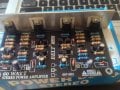
I was able to buy this amp yesterday..pre soldered. It appears to be OCL using tip 31A transitors - cost $4. No documentation came with, and I can find no link or info about this based on model number?? If I were to use this, then I only have focus on prototyping the power supply and a suitable preamp.
IMG_8196.JPG IMG_8198.JPG
 

AnalogKid

Joined Aug 1, 2013
12,131
For each channel, your amplifier has an input differential pair with only a resistor for emitter current instead of a true current source. This is followed by a voltage amplifier stage (the single transistor off to the side, next to the electrolytic cap), which is followed by the output stage. Because both power transistors are the same polarity (NPN in your case), it is not a true complimentary output stage. Instead, it is quasi-complimentary, with one Darlington pair and one Sziklai pair. In very round numbers, something like this schematic, but without Q4 and with TIP31's for Q7 and Q8:


https://en.wikipedia.org/wiki/Darlington_transistor
https://en.wikipedia.org/wiki/Sziklai_pair

ak
 
Last edited:
Top