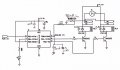
Motor control and overcurrent protection

Thread Starter

sumeryamaner

Joined May 29, 2017
117
You say that the landing gear takes ~10 seconds to extend/retract. And in certain circumstances the motor stalls or binds for a short time mid-deployment. And it is more important to extend the landing gear than protecting the motor from burning up.

So I would consider a partial software solution. Do not check for a stall until after an ~8 second delay. Or some such value determined by experimentation.

That way, intermediate behavior is ignored and the check for full deployment only takes place at the end of it's expected time.
Thank you very much for this excellent suggestion.
Actually I do not want to burn the motor. I can land the plane without the landing gear extended. :) This risks only the propeller most of the time. A burnt out motor is much more expensive and more difficult to replace.

This timing solution has also some drawbacks. Let's say I have set 9 seconds as limit and I only check the current after 9 seconds. During normal operation this will be OK. But let's say that I have accidentally put the switch to the extended position in the air. After 2 seconds I have noticed this mistake and put the switch back to the retracted position. First the gear will begin to extend. After 2 seconds it will begin to retract and the 9 seconds timeout will start over. After 2 seconds it will be fully retracted and the motor will stall. The stall will continue for 7 seconds and the motor will probably burn out.

I am trying to find a way to reliably sense the full extended and full retracted position but until I am able to do so I need the current monitoring.
 

djsfantasi

Joined Apr 11, 2010
9,237
So modify the algorithm.

Check every second until the specified limit, then check continuously.

If this still causes problems, when a stall condition is detected, check every x seconds (maybe 0.5 seconds) to see if the stall condition had persisted.

You can also get more granular, if you use a software switch debounce algorithm.
 

dendad

Joined Feb 20, 2016
4,639
How about this mod?
Use a 300mA Polyswitch in place of the current sense resistor ( or even a smaller one. Test to suit. ) and look at it to see when it goes into overload at the stall.
You will need to add a series resistor to the analog in, with a bypass, and use an LED as a voltage clamp.
Also, an 100nF cap close to the micro power terminals may help your hanging problems. But that too may be over volts pulses going into the analog in. You do need a series R and a clamp like I've shown anyway.

LGRetractor.jpg
 

Thread Starter

sumeryamaner

Joined May 29, 2017
117
Now I noticed that I made a very very stupid mistake. I am really sorry.
The first examples of the PCB had been produced using toner transfer method by me. They worked fine. Then I let the PCBs be produced professionally. The new PCBs were the same as the previous ones. At least I thought so.
But...

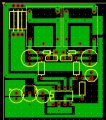
This is the working PCB

111.jpg

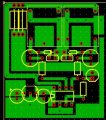
And this is the professional one...
222.jpg

Can you see my stupidity?!
 

crutschow

Joined Mar 14, 2008
38,526
It might be a good idea to have diodes (4 required) across the relay bridge contacts to protect them from the motor inductive kickback, which can cause arcing and pitting of the contacts.
 
Last edited:

Thread Starter

sumeryamaner

Joined May 29, 2017
117
It might be a good idea to have diodes (4 required) across the relay bridge contacts to protect them from the motor inductive kickback, which can cause arcing and pitting of the contacts.
The motors have double capacitors (not shown in the schematic) between their contacts and the motor cases. They are small motors (6V / 300 mA). Should I change the PCB to accomodate those diodes?
 

crutschow

Joined Mar 14, 2008
38,526
The motors have double capacitors (not shown in the schematic) between their contacts and the motor cases. They are small motors (6V / 300 mA). Should I change the PCB to accomodate those diodes?
Do you mean from each motor terminal to the case?
That may be sufficient.
Do you have an oscilloscope to look at the transient across the relay contacts?
 
Top