Motional EMF from an Electron Flow Perspective

Status
Not open for further replies.

Lool

Joined May 8, 2013
116
I don't follow your answer. It makes no sense. I want one number which tells me "How many ping pong balls does it take to fill up a container with a height 1 meter?". Your answer is too complicated for my 10 year old son to understand and I dont want to study all that stuff about volumes and ball size and dimensions. Just give me one number so I can complete my simple theory of ball storage for my 10 year old son.

At first I thought it was 6.8x10^18 ping pong balls, but now i dont think that number is right.
 
Last edited:

Thread Starter

Gerry Rzeppa

Joined Jun 17, 2015
170
I don't follow your answer. It makes no sense. I want one number which tells me "How many ping pong balls does it take to fill up a container with a height 1 meter?". Your answer is too complicated for my 10 year old son to understand and I dont want to study all that stuff about volumes and ball size and dimensions. Just give me one number so I can complete my simple theory of ball storage for my 10 year old son.
Okay, the number is 25. If you limit yourself (and your boy) to cylinders that are about 40mm in diameter, the number of balls needed to fill any such cylinder will be pretty close to the length of the cylinder (in mm) divided by 40mm. Though I'm pretty sure that your boy will be able to picture a wider tube that holds, say, three balls (instead of just one) per layer, and that a 1 meter cylinder of that diameter would hold three times as many balls (75).

[Note that both answers result in a definite figure, and that while the second answer introduces a "third dimension" into the model, it abandons neither the first two dimensions, nor the terminology, nor the principles of the simpler model. It simply builds on the former model. And is almost as easily pictured, demonstrated, etc. In short, "Theory B," in this case, is an extension of "Theory A," not a replacement.]
 

Lool

Joined May 8, 2013
116
OK good. I'm sure my boy can understand 25 balls and we can start planning our storage of ping pong balls.

OK, then the charge is 25 electrons. Have fun with your theory.
 

RdAdr

Joined May 19, 2013
214
Did he? ... Unfortunately, Feynman doesn't understand this and launches into a long-winded philosophical discussion of "why" questions. I stopped watching soon after that; it was nothing but frustrating. Feynman may have been a genius in some ways, but he's obviously at a loss when it comes to communicating, clearly and concisely, with the average man. (And yes, I've read Six Easy Pieces, etc).
....
In other words, these specialists have developed an extremely impressive and internally consistent system that, unfortunately, does not (and cannot) eliminate obvious nonsense because they've forgotten that words without pictures are just words. Ditto for mathematical expressions. Any theory, however impressive and self-consistent, that can't be pictured (and thus explained to the average man at a level of abstraction appropriate for the average man), is suspect.

Ok. You feel that you could have done a better job responding this question than him? Place yourself in his shoes and I will place in the shoes of the interviewer (a man which didn't studied physics or mathematics). And you have a crowd of people that didn't studied physics or mathematics. And also you can't use pictures. You are in a chair and responding at an interview. Not on a forum. Also as soon as you see the question, you must start typing. No time to think about the question. You are in front of the interviewer and he waits for an answer right away.

I ask you: How does magnets work?
 

Thread Starter

Gerry Rzeppa

Joined Jun 17, 2015
170
Ok. You feel that you could have done a better job responding this question than him?
I didn't say I could answer the question more accurately or more completely than Feynman; only that I understood better (a) what was being asked, and (b) what kind of answer would have been most helpful to the interviewer and his audience.

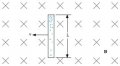
But we digress. I started this thread so I could better understand, as the title indicates, "Motional EMF from an Electron Flow Perspective." The sticking point seems to be how one should interpret and apply the standard description of a conducting rod moving through a uniform magnetic (in purple, below):


The magnetic force acting on a free electron in the rod will be directed upwards. As a result, electrons will start to accumulate at the top of the rod. The charge distribution of the rod will therefore change, and the top of the rod will have an excess of electrons (negative charge) while the bottom of the rod will have a deficit of electrons (positive charge). This will result in a potential difference between the ends of the rod.

It seems to me that paragraph is saying there is some kind of relationship between charge density (excess/deficit of electrons) and voltage (potential difference). Question: Do you agree that's what the paragraph says? If so, what is that relationship? If not, please re-word the paragraph so it's more clear and accurate. Thanks.
 

RdAdr

Joined May 19, 2013
214
We disgress.

I didn't say I could answer the question more accurately or more completely than Feynman; only that I understood better (a) what was being asked, and (b) what kind of answer would have been most helpful to the interviewer and his audience.
a) You make an assumption that Feynman did not knew what was he being asked. I think he understood perfectly what was he being asked.

b) Your kind of answer was talking about the magnetic field. And the interviewer would have asked: "What do you mean by a magnetic field? What is that?"

You say that you understood better what kind of answer would have been most helpful. But this "answer" of yours contains only one layer: the magnetic field. If you understood better what kind of answer would have been most helpful, this "answer" of yours must contain all layers.

This is the same as saying to someone how to make a cake. You say to him: "first, you must have flour". And then you leave.

Question: What do you mean by a magnetic field? What is that? Thanks.
 
Last edited:

Lool

Joined May 8, 2013
116
RdAdr,

Just be warned that Gerry is a troll. He has been given answers to all of his questions. No answer you give him will be satisfactory. He has no background to understand any answer. Just like for the interviewer in the Feynman video, you must answer the way Feynman did. Then he will go away. He did not even listen to the full explanation of Feynman. He does not want to listen and he will turn off, or ignore any information that might show him the way out of the tunnel he lives in.

I doubt very much that a "boy" is really the motivation for his questions. He has a pet theory that he is trying to make work. He can't make it work because it is untenable, but he does not have the wherewithal to realize his views are untenable.
 

BR-549

Joined Sep 22, 2013
4,928
Because when we describe potential, it's easier to say "voltage" than it is
to say "X amount of charge in Y amount of area at Z distance".

Because the amount of charge can interact(see-saw) with the area(see-saw) of
charge and the distance(see-saw)........and still keep the same voltage.
 

Thread Starter

Gerry Rzeppa

Joined Jun 17, 2015
170
Because when we describe potential, it's easier to say "voltage" than it is to say "X amount of charge in Y amount of area at Z distance". Because the amount of charge can interact(see-saw) with the area(see-saw) of charge and the distance(see-saw)........and still keep the same voltage.
If that response was directed to me, I'm going to need a little more context to make sense of it. Thanks.
 

Thread Starter

Gerry Rzeppa

Joined Jun 17, 2015
170
Perhaps this thought will help.

Voltage is often likened to pressure, and an hydraulic analogy is often used to help beginners understand what "electrical pressure" is like. The problem is that water under pressure looks a lot like water not under pressure. My approach is closer to a pneumatic analogy where we think of our rod in the magnetic field like this:

air 1.jpg

The left picture shows the rod at rest and the right picture shows it moving through the field, with the piston showing the effect of the magnetic field on the little blue air molecules (which are analogous to individual electrons). Seems like a good analogy for a beginner to me. Especially since one of the fundamental guiding principles we've given him is that electrons do not like to be close to one another. It also seems to me that we ought to be able to somehow relate electrons per cubic inch (or per proton, or something) to voltage (electrical pressure) in the same way that we intuitively relate "molecules per cubic inch" to air pressure. After all, that's how an electrical potential difference is described in the oft-quoted purple paragraph:

The magnetic force acting on a free electron in the rod will be directed upwards. As a result, electrons will start to accumulate at the top of the rod. The charge distribution of the rod will therefore change, and the top of the rod will have an excess of electrons (negative charge) while the bottom of the rod will have a deficit of electrons (positive charge). This will result in a potential difference between the ends of the rod.

The pneumatic drawing on the right analogously illustrates both the "excess of electrons" at the top and the "deficit of electrons" at the bottom quite nicely, I think.
 

#12

Joined Nov 30, 2010
18,224
RdAdr,

Just be warned that Gerry is a troll. He has been given answers to all of his questions. No answer you give him will be satisfactory. He has no background to understand any answer. He does not want to listen and he will turn off, or ignore any information that might show him the way out of the tunnel he lives in.

I doubt very much that a "boy" is really the motivation for his questions. He has a pet theory that he is trying to make work. He can't make it work because it is untenable, but he does not have the wherewithal to realize his views are untenable.
I don't know whether Gerry realizes that one definition of a Troll is a person that has been told over and over, in dozens of different ways, by at least a dozen people, but that process accomplishes nothing. Several people are worn out with this, this isn't the first thread with over 100 posts, and still, nothing has changed. We might as well be barking at the moon.

ps, Blue moon this month (for the astronomers, or those still barking). :p
 

BR-549

Joined Sep 22, 2013
4,928
As I said, no one has seen an electron. Almost all theories premise that charge is a point source.
A point has no area. Modern science considers charge density, but not electron density.

I would guess that even capacitor researchers use charge density and not electron density.

Modern science prefers to think of current as moving charge instead of moving electrons.

A coulomb of charge is considered a point source. Although it's impossible for 2 electrons to be close together.

That's the way it's taught and studied.

Even though an electron has a set voltage, the POTENTIAL between the two can be increased, just by moving them closer to each other, therefore more voltage POTENTIAL without increasing number of charge.

If I had a string(line) of 10 electrons, equal distant and equal potential. If I reach up there and squeeze the first two together........this end of the string will have more potential than the other end.

With the same number of charge(or electrons).

So to describe a voltage source with electrons, we need the electron number and area to know the potential at a certain distance.

There are other things to consider.

Available area. The area for the electron density changes too. This is resistance.

To account for all the electron "accumulation" as it were, would not be easy and require long suffering.

If we use charge without area, the PHYSICAL layout density(not charge density) can be ignored.

Believe me, I understand what you want, but we will have to wait to know for sure.
 

Thread Starter

Gerry Rzeppa

Joined Jun 17, 2015
170
Even though an electron has a set voltage, the POTENTIAL between the two can be increased, just by moving them closer to each other, therefore more voltage POTENTIAL without increasing number of charge. If I had a string(line) of 10 electrons, equal distant and equal potential. If I reach up there and squeeze the first two together........this end of the string will have more potential than the other end. With the same number of charge(or electrons). So to describe a voltage source with electrons, we need the electron number and area to know the potential at a certain distance.
That sounds a lot like what I've been thinking (and trying to say). It takes energy to move electrons closer to each other than they want to be. That energy is released when they they are allowed to return to a more evenly-distributed arrangement. Therefore, we should be able to discern how much energy is stored in a particular configuration -- all other things being equal -- by examining the concentration of electrons in a given area or space.

Believe me, I understand what you want, but we will have to wait to know for sure.
Unfortunately, I've never been good at waiting! :)

Modern science prefers to think of current as moving charge instead of moving electrons.
Yes. But electricity is invariably described (at least to beginners) the other way around. Examples from around the web appear below. I understand that a beginner's picture needs to be less complex and complete than an expert's; but the latter should be an elaboration and extension of the former, not a complete reversal and/or replacement.

"Electricity: A physical phenomenon associated with stationary or moving electrons."

"Electric current in a solid conductor is the mass movement of free electrons (electrons that are not tightly bound to an atom) from a negatively charged area to a positively charged area."

"A generator is simply a device that moves a magnet near a wire to create a steady flow of electrons."

"This is the key to how and why a battery works: one of the materials "likes" to give up electrons, the other likes to receive them."

"As the electrons zip along through the filament of a light bulb, they are constantly bumping into the atoms that make up the filament. The energy of each impact vibrates an atom -- in other words, the current heats the atoms up. Bound electrons in the vibrating atoms may be boosted temporarily to a higher energy level. When they fall back to their normal levels, the electrons release the extra energy in the form of photons (light)."

"When the motor’s switch is flicked on, electrons flow through the coil, turning it into an electromagnet. The attractive and repulsive forces of the permanent magnets around it make the electromagnet spin."

"When the string vibrates, it disturbs the magnetic field around the guitar pickup and that, in turn, makes electrons flow in the coil."

"The simplest vacuum tube, the diode, contains only an electron emitting cathode and an electron collecting plate."

"A cathode ray tube (CRT) is a vacuum tube with one or more electron guns and a means to accelerate and deflect the electron beams(s) onto a fluorescent screen to create the images."

"The amplifier first pushes electrons into the speaker cable, then pulls electrons back out of the cable."

"Electrons moving through the voice coil of a speaker create a magnetic field that reacts with the magnetic field from a permanent magnet fixed to the speaker's frame, thereby moving the cone of the speaker."
 

BR-549

Joined Sep 22, 2013
4,928
I know, ...we study and analyze charge, but picture the physical as electrons.

I'm hoping someone will realize they can be painted and observed.

All of the free electrons will be on the same frequency. This frequency will be higher and discrete from the other electrons. We should be able to beat them, with the appropriate shine, to get a visible resultant.

Particles are like little repeaters, they can receive on one frequency, beat and emit on another.

All we need is a tunable high frequency shine. Much higher than the visible or hard x-ray.

We have to wait.
 

Thread Starter

Gerry Rzeppa

Joined Jun 17, 2015
170
Here's a paper I've found very interesting and helpful:

A Qualitative Approach to Electricity by Hermann Haertel
http://files.eric.ed.gov/fulltext/ED287730.pdf

From the introduction:

"The body of physics knowledge condensed in textbooks and simplified for the different school levels is usually described as a consistent quantitative system carefully prepared and standardized according to units, syntax, methods, etc. This quantitative system is surrounded by isolated qualitative models meant to help students to understand isolated phenomena, to give a background for causal relations, and to model certain processes.

"In contrast to the quantitative side, the qualitative one is not treated with equal care. For many aspects, the underlying ontology is only presented implicitly or is not presented at all. The statement of Hertz, 'The physics of electromagnetism is Maxwell's equations,' expresses clearly the attitude of overemphasizing the quantitative side and even denying the existence of qualitative models and questions about the underlying ontology as part of physics.

"When qualitative models are presented, their limits and questions about these limits are, in most cases, left aside. Inconsistencies are overlooked or hidden under shallow explanations with the excuse that, as a rule, students would never detect these inconsistencies and would only be confused by any further and more detailed explanation. Worse yet, there may even be a belief that students should not worry about the inconsistencies; truth is within the equations themselves."
 

Lool

Joined May 8, 2013
116
This will not help you at all. The point you are trying to make is a load of crap.

All good engineers and physicist use quantitative and qualitative models and think in terms of various viewpoints.

Good teachers use both methods and good student use both methods.

Bad students go around quoting various sources trying to justify why then can't get the concepts correct. They try to sound clever while their inability to perform betrays them. They look for the easy way out and blame everyone else when they still can't cut it.
 

Thread Starter

Gerry Rzeppa

Joined Jun 17, 2015
170
All good engineers and physicist use quantitative and qualitative models and think in terms of various viewpoints. Good teachers use both methods and good student use both methods.
I fully agree. That's why I don't stop at just pictures and words -- I want (and need) the numbers too. Case in point. Let's say we want to develop a little computer simulation of that rod in the magnetic field; something like the image below, only animated, where the rod actually moves through the field:

rod in magnetic field 2.jpg

We know how "L" and "v" and "B" are related to potential, so we can let the user assign values to those variables and we can display, numerically, the induced potential as the simulation progresses. What we're missing (and what the programmer is going to need to know) is the numerical relationship between those variables and number/density of electrons so he can properly simulate the movement of the electrons (as a varying color gradient, perhaps, or where each blue dot represents so many gazillion electrons). I don't think it's unreasonable to ask about such (obviously) missing pieces.
 

Lool

Joined May 8, 2013
116
We know how "L" and "v" and "B" are related to potential, so we can let the user assign values to those variables and we can display, numerically, the induced potential as the simulation progresses. ... I don't think it's unreasonable to ask about such (obviously) missing pieces.
We answered you as best we can. You were not satisfied with the answers, thus revealing that you don't have the background to understand the impediments to answering your question definitely and in a form that satisfies you.

Hence, just as Feynman responded to the uninformed interviewer, we have to say. Yes, it is not unreasonable to ask such a question. In fact, it is a good and proper question. But, we can't answer in terms of anything you are familiar with. You are unaware of the key impediment which was mentioned several times by more than one person, including myself. The potential is ill-defined in the sense you are asking the question, for this particular example. The induced EMF from time changing flux is a non-conservative force. This means that the potential you would measure is path dependent. If you were to place a meter there to measure it, assuming you had one that is good enough to not corrupt the measurement, the voltage reading would change as you move the meter and leads around. You might leave the meter fixed, and let the leads move, or you might attach the meter to an arm so that it moves with the bar, so the connection is not broken.

Assuming you place the meter to measure one particular loop emf, the question becomes meaningful, but the answer for the EMF (what you would probably call "potential") does not depend on the charge accumulation. Rather the charge accumulation depends on the EMF and circuit geometry. But, again, this makes no sense to you. You do not have an familiar experience to compare this too. We tried and failed to convey the answer to you, and we are forced to revert to Feynman's example. Feynman was no dummy, and he is answering as an older man with years of teaching experience. He knows, from past failures, how the "why question" is an unending cycle that only ends when the student is given a comparison to experience he already has intuition about.

In the case of electrostatics (no flux change), you would not have this impediment. Potential would be very well defined, and you would be in a more familiar situation that you might have some hope to understand. We tried that too, and tried to tell you that the amount of charge depends on geometry which leads to the theory of capacitance. Hence, the answer to your question, "how much charge for 1 volt?" is Q=CV, and since V=1 V, then Q=C Coulombs.

Yes, for the very specific example you give, you can calculate anything you want using a computer and Maxwell's equations, provided you specify everything clearly. However, this does not help you understand anything. Knowing, the number corresponding to the charge is a unique thing about this situation, not a general number that can be applied to various cases. The charge distribution as a surface charge is certainly useful to know about and contributes to a better overall understanding of circuits, provided that you don't abuse the knowledge and attribute the wrong meaning to it. The surface charge density turns out to just be equal to the normal component of D=εE. This is discussed in one of your references that tries to tell you how to make geometrical approximations that give you a rough idea of the answer. Normally, this calculation is difficult and requires a computer. That reference also talks about an exact solution provided in a book by Sommerfeld. I happen to have this book and this is a very nice simple solution for a long coaxial cable. I can post a scan of the pages of this solution (if anybody cares about it), but again, this is a very specific example and the answer does not carry over to other cases. Sommerfeld points out exactly what I said, the answer can be related to the capacitance of a coaxial line.

I doubt any of this information can shed any light for you, but maybe it will help some other person that stumbles on this thread someday.
 

Thread Starter

Gerry Rzeppa

Joined Jun 17, 2015
170
Yes, it is not unreasonable to ask such a question. In fact, it is a good and proper question. But, we can't answer in terms of anything you are familiar with...
It sounds like you're saying the purple paragraph should be reworded as follows (your implied additions in bold):

The magnetic force acting on a free electron in the rod will be directed upwards. As a result, an incalculable number of electrons will start to accumulate at the top of the rod. The charge distribution of the rod will therefore change in a way that is not calculable and the top of the rod will have an incalculable excess of electrons (negative charge) while the bottom of the rod will have an incalculable deficit of electrons (positive charge). This will result in a potential difference between the ends of the rod equal to LvB, which (surprise!) can be easily and precisely calculated.

I'm content to leave it at that, if you are. Life is full of things that can't be calculated.

But I hope you can see that this is an exact instance of what that Haertel described above with the words, "Worse yet, there may even be a belief that students should not worry about the inconsistencies [in qualitative descriptions]; truth is within the equations themselves."


Clearly, a
qualitative description that requires that many quantitative caveats, and that includes extreme and easily calculated precision in one place while denying computability altogether in others, needs work. Seems to me you physicists need either (a) a new description of motional EMF for beginners, or (b) some numbers/formulas to fill in those obvious blanks.
 
Last edited:

Thread Starter

Gerry Rzeppa

Joined Jun 17, 2015
170
Perhaps some of you are wondering why I'm so surprised (or, some might say, so stubborn about) the fact that there's no "easy" answer to my question. This is why: I was led to believe there was (or at least ought to be) an easy answer. Consider:

1. The figure below shows a conducting rod of length L being moved with a velocity v in a uniform magnetic field B:


So far, so good. I can easily picture a conductive rod, I can easily picture a length L in some convenient unit of measure, I can likewise easily picture a velocity v in some other common units, and I can picture a magnetic field having played with magnets as a kid. Everything, so far, simple and familiar. Let us continue:

2. The magnetic force acting on a free electron in the rod will be directed upwards.

Okay, admittedly a little more esoteric now, but still related to everyday experiences. I've used magnets to push other magnets around with that mysterious invisible force, so if I picture electrons as teensy spherical magnets with only a negative pole, I'm still on easy street. Now:

3. As a result, electrons will start to accumulate at the top of the rod.

Again, easy to picture, easy to understand.

4. The charge distribution of the rod will therefore change, and the top of the rod will have an excess of electrons (negative charge) while the bottom of the rod will have a deficit of electrons (positive charge).

Duh. Nothing hard about that.

5. This will result in a potential difference between the ends of the rod equal to LvB.

Now right there it gets a little more difficult, but only because the description is defective: the various relationships between the electrons and the length and the velocity and the strength of the field have not been described. Obviously, some words are missing. Words like, "The potential difference will depend, in part, on the length of the rod because..." Ditto for the velocity and the strength of the field. But add those in and we're back on easy street. After all, the formula only has three variables and the only operation we need is multiplication.

So everything is easy to picture and easy to understand to this point. Which makes me think that the answer to the unanswered question -- What's the relationship between those displaced electrons and the potential difference? -- should be equally easy. Just another formula with a couple of variables and no advanced operators (like the E=LvB of the preceding paragraph), I would imagine.

After all, when I ask about the relationship between electrons and current I get an answer that is easy to picture and understand (6.2x10^18 electrons per second past a point). Why should the corresponding answer about the relationship between electrons and voltage require advanced mathematics, computer-based calculations, and concepts like "path-dependence" and "circuit geometry"? And why should that relationship be something that physicists "can't describe in terms of anything I am familiar with" -- especially when the rest of the system has already been described in simple and familiar terms?

It just doesn't ring true, folks. It lacks the consistency and elegance that attends any great (or even good) theory. Who would ever suspect, looking at Ohm's Law, that current is easy to picture and describe in electron terms, and resistance is easy to picture and describe in electron terms, but voltage, in electron terms, is beyond the understanding -- not to mention the imagination -- of the average man?


Last edited:
Status
Not open for further replies.
Top