Motional EMF from an Electron Flow Perspective

Status
Not open for further replies.

Lool

Joined May 8, 2013
116
I have. I find Drude's model wrong but useful. Sommerfield is better because he recognizes that nothing is really continuous. The "Nearly Free Electron Model" reminds me of Br-549's hairnet -- in places (I don't want to insult him). But Band Theory and the Tight Binding Model seem to me more reasonable in their descriptions. Bottom line: It's clear nobody knows what's really happening, and almost all of these theorists are very bad at (a) drawing pictures, and (b) explaining their thoughts in plain English. Goodness! Einstein had less trouble explaining relativity to the average man. But enough of that.
All you need is the theory of capacitance. That gives you the relation between charge and voltage. Heck, I learned the basics of capacitance at age 15 before I learned any significant math. I think I had a year of algebra at that point in time. If you find it hard, well then it's hard for you. But, all we can do is point you in a direction. My finger is pointing in the direction of "learn the theory of capacitance". You'll have to figure out what book or resources are suited for you. I'm sure the ones I like will not be ones you will like, but that's why there are many books written - so that everyone can find one that appeals to them.

The theory of capacitance will not give you all you need because you have many more than one misconception plaguing you. But, that is one you specifically asked for when you stated you want to know the relation between voltage and charge.

I'm done trying to explain because all my explanations have failed, however, I can still point when I think it might help you to know which direction to walk in.
 

Lool

Joined May 8, 2013
116
The left setup has a dielectric (air), but the "plates" have too little surface area and are too far apart for any capacitor-like behavior
Look here at what you said. This is proof that you are so far away from competence, that it is silly.

You don't even realize that here you stated exactly what we have been trying to tell you. Yes, the plates have too little surface area and are too far apart, which means the capacitance is very small. The fact that you say it can not have capacitor-like behavior is a statement equivalent to what we always say in circuit theory. It means that parasitic capacitance is small and hence no significant charge builds up. So, now you have said that charge is not significant without even realizing it. You don't realize it because you do not understand the theory of capacitance.
 

Thread Starter

Gerry Rzeppa

Joined Jun 17, 2015
170
You don't even realize that here you stated exactly what we have been trying to tell you. Yes, the plates have too little surface area and are too far apart, which means the capacitance is very small... It means that parasitic capacitance is small and hence no significant charge builds up.
That last sentence should read: "...parasitic capacitance is small and hence there is no significant change in the dielectric: the air molecules between points A and B are not deformed enough to store any potential energy. Note that this is not because there's insufficient charge buildup, but because the plates are too small and too far apart for this device to behave like a capacitor."

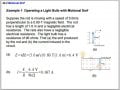
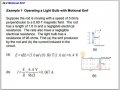
Here's a page from some course material on Motional EMF:

light bulb 1.jpg

Diagram (a) is equivalent to my leftmost diagram -- which you claim is like a capacitor with no significant charge buildup. Yet the potential difference between the top "plate" and the bottom "plate" -- which is the direct result of the surplus of electrons at the top and the deficit of electrons at the bottom -- is 6.4 volts; a significant enough accumulation of electrons, as we see in part (b) of the exercise, to drive 0.067 amps through a 96-ohm light bulb. With no mention of capacitance anywhere.

It seems to me you're still intent on rewording that oft-quoted paragraph on motional EMF to read (your implied changes in bold):

The magnetic force acting on a free electron in the rod will be directed upwards. As a result, electrons will start to accumulate at the top of the rod, but not in any significant way. The charge distribution of the rod will therefore change, but not in any significant way, and the top of the rod will have an insignificant excess of electrons (negative charge) while the bottom of the rod will have an insignificant deficit of electrons (positive charge). This will result in an insignificant potential difference between the ends of the rod.

Even if you have to use some slight-of-hand with capacitance to justify those changes.
 
Last edited:

Lool

Joined May 8, 2013
116
That last sentence should read: "...parasitic capacitance is small and hence there is no significant change in the dielectric: the air molecules between points A and B are not deformed enough to store any potential energy. Note that this is not because there's insufficient charge buildup, but because the plates are too small and too far apart for this device to behave like a capacitor."
Incorrect again. Capacitance can and does relate free charge to voltage. You know a capacitor can exist in vacuum. Air is essentially the same as vacuum when it comes to capacitors, also.

Again, you have no understanding of capacitance. You are an amateur now trying to teach someone with a PhD. in electrical engineering, who is in his 50s and studying electronics from age 13 to the present day, studying every day almost without exception. You seem to have a view that you are smarter than everyone else, no one else's experience counts for anything, nobody else can explain things clearly and hence you ignore everyone else and still keep asking the same silly questions over and over and over again, despite the fact that you have been given the answers over and over and over again. This stuff was all figured out by many brilliant scientists in the 19th century, all you have to do is go read what they wrote. It's all there.

If you want to make progress, assume you are wrong and everybody else is right. Once you understand things yourself, then you can critique other people's failings. At least then you will have a leg to stand on.

I think our moderator Wendy summarized it best. You are trying to make everything fit into a theory of electrostatics, but as I said the theory of circuits is more appropriate here. Both theories are special cases of a more accurate electromagnetic field theory, but are quite suitable in some problems. The other problem is that even though you are trying to fit everything into electrostatics, you don't even understand this, as capacitance theory is a subsection of electrostatics, and you have that all wrong in your conceptualization.


I fear there is no hope for you. Give it up and let the kid learn on his own. he will be much better off.
 
Last edited:

Thread Starter

Gerry Rzeppa

Joined Jun 17, 2015
170
Incorrect again.
Which way am I to take the paragraph below -- with or without the bold additions? Why?

The magnetic force acting on a free electron in the rod will be directed upwards. As a result, electrons will start to accumulate at the top of the rod, but not in any significant way. The charge distribution of the rod will therefore change, but not in any significant way, and the top of the rod will have an insignificant excess of electrons (negative charge) while the bottom of the rod will have an insignificant deficit of electrons (positive charge). This will result in an insignificant potential difference between the ends of the rod.

And how, in the light of that paragraph (either version), do we explain the experimental results below?

light bulb 1.jpg

See the problem? You keep telling me I'm wrong, which means I must be misunderstanding both that purple paragraph and the sample exercise above -- but you don't tell me what's wrong with that paragraph (without the bold additions) and you don't tell me why I should consider the 6.4 volts in the exercise "insignificant." Meanwhile, BR-549 says my blue gradient drawings are "close enough for anybody" (post #153) and that my latest description, corrected to eliminate any mention of protons or individual atoms, is "excellent" (posts #156-7). Whom should I believe? Why?
 

Lool

Joined May 8, 2013
116
Which way am I to take the paragraph below -- with or without the bold additions? Why?

The magnetic force acting on a free electron in the rod will be directed upwards. As a result, electrons will start to accumulate at the top of the rod, but not in any significant way. The charge distribution of the rod will therefore change, but not in any significant way, and the top of the rod will have an insignificant excess of electrons (negative charge) while the bottom of the rod will have an insignificant deficit of electrons (positive charge). This will result in an insignificant potential difference between the ends of the rod.
Take it without the bold. Why? Because it is correct as originally written. All of your references are correct. Some of what you do with the information is seriously flawed. I did my best to explain why. Every question you asked has been answered in some form. Maybe not the best form, but the information is there if you want to review it and re-review it as you collect more information. Call me a bad teacher if you want. That's fine. But, your flaws are there nonetheless which means you are a bad student too. Accept that fact, and you might get somewhere. If you assume all your conclusions are correct, you have no chance to make progress.

When you take correct information and carry it to an absurd conclusion, then you have to question your reasoning, not your starting information.
 

Lool

Joined May 8, 2013
116
... and you don't tell me why I should consider the 6.4 volts in the exercise "insignificant."
I never said the voltage was insignificant. I said the charge accumulation is insignificant for understanding how energy gets to the lightbulb, and how power is continuously supplied to the lightbulb.

Meanwhile, BR-549 says my blue gradient drawings are "close enough for anybody" (post #153) and that my latest description, corrected to eliminate any mention of protons or individual atoms, is "excellent" (posts #156-7). Whom should I believe? Why?
I agree with BR-549. Previous to BR saying you are correct about this, I said you are essentially correct about those thing. He helped you even refine it a little better which is great.

Just because you got one part correct does not mean all your conclusions are correct.
 
Last edited:

Lool

Joined May 8, 2013
116
I can think of one further thing to say which might help. This is about as simple as I can make it. This comment has no serious theoretical content, but it might shed some light if you are receptive.

Think of this as a logical structure as follows. You showed 3 drawings; left middle and right. The left drawing shows a situation primarily governed by something we will call "Theory A". The middle situation, is primarily governed by something we will call "Theory B". The middle, has some aspects of Theory A, but it is dominated by Theory B. The right picture is also dominated by Theory B, but it has more of Theory A in it than the middle picture.

The whole problem here is that you have not considered Theory B. You are getting Theory A correct, but because of lack of knowledge of Theory B, you are totally blind about how your reasoning has gone astray. Until you learn about Theory B, you will be lost.
 

Thread Starter

Gerry Rzeppa

Joined Jun 17, 2015
170
The left drawing shows a situation primarily governed by something we will call "Theory A". The middle situation, is primarily governed by something we will call "Theory B". The middle, has some aspects of Theory A, but it is dominated by Theory B. The right picture is also dominated by Theory B, but it has more of Theory A in it than the middle picture... Until you learn about Theory B, you will be lost.
So I set up three physical devices like this and hook a scope (with reversed leads) across points A and B on each device:
rails 1.jpg
I explain how electrons don't like being next to each other and how electrons are pushed upward by the magnetic field when we move the rod one way, and downward when we move the rod the other way. I explain that electrons can't get across the gap in left device and thus pile up on top; how they can move freely around the whole loop in the center device and thus don't pile up anywhere; and how some (but not all) of them can get through the resistor in the right device, so we get some (but not all) of them piling up on top while some (but not all) make around the whole loop.

Then I tell him that the scope shows us time along the horizontal axis and voltage on the vertical axis. And that we can think of voltage as the difference in concentration of electrons at points A and B at any point in time. I tell him we can't see the electrons themselves (because they're too small) but we can see how crammed-up they are at any moment on the scope. And whether they're crammed-up on the top or the bottom of each device. Then we move the rods quickly back and forth and he sees, on the scope, the varying concentrations of electrons we just talked about. He also sees the effects of moving the rods faster or slower, and of changing direction more or less often.

Question: How does "Theory B" change that description, and how does it help the kid better understand what's happening?

I said the charge accumulation is insignificant for understanding how energy gets to the lightbulb, and how power is continuously supplied to the lightbulb.
Now I replace the resistor in the third device with a small light bulb, and tell the kid to try to keep it lit for at least a minute. He succeeds, but his arms are aching when he's done. I ask him what went through the bulb and he says, "The electrons that went through the resistor the last time." Then I ask him where the energy came from to light the bulb, and he says, "From my arms. Duh."

Question: How does "Theory B" change that exercise, and how does it help the kid better understand what just happened?
 

Lool

Joined May 8, 2013
116
You keep vacillating. You describe something that you feel works. So why dont you go away and use it? You don't go away because you know something deeper is missing and you are correct that there is something deeper missing. You are presenting the kid a dead end theory that is not fundamentally correct and that can't solve many problems the way circuit theory can.

So, if you are happy with your above model then use it and go away and stop asking more questions, such as "What is the relation between charge concentration and voltage?"
 
Last edited:

Thread Starter

Gerry Rzeppa

Joined Jun 17, 2015
170
I woke up this morning with this picture in my head:
rails 2.jpg
It's the same three devices as before, only now (assuming the resistor is really huge) we can switch from case 1 to 2 to 3 simply by adjusting the pot.

Now as you know, I'm thinking the potential/voltage difference between points A and B is always the result of (or is proportional to, or can be discerned by examining) the difference in electron concentration at those two spots. But you seem to be saying that the potential/voltage difference between points A and B is the result of different things (or concepts or principles) in each case: electron concentration on the left; a little bit of electron concentration but mostly something else in the middle; and a different mixture of the two on the right. I don't think William of Occam would go for that. And it seems odd (to me) that simply adjusting a pot in such a simple circuit would draw in a whole other set of principles.

You describe something that you feel works. So why don't you go away and use it?
Because the model is incomplete. I need to define current, voltage, and resistance in "electron concentration and flow" terms. I've got the pictures and the words for all three. And I've got the figures for current: 1 amp is 6.28x10^18 electrons moving past a given point in 1 second. The figures for resistance I can derive from current and voltage once I've got the figures for voltage. So fill in the blanks and I'm outta here: "1 volt is an electron concentration differential of ______ electrons per ______."

The "theory" is simple, and is based entirely on the mutual replusion of electrons: energy is expended pushing electrons closer together, and is released when they are allowed to separate again. So we can tell how much energy is "stored up" (in circuits like tube guitar amps) simply by examining how closely packed the electrons are. Now I realize that sentence is similar to the "forbidden sentence" in the NEETS manual, but I think it's different (and an improvement) because it includes the "per ___" part to make it clear that we're talking, not about a mere number of electrons, but about how tightly packed (or concentrated) the electrons are.

Amdahl describes this concentration in terms of protons: "Sometimes you get a situation where there are more electrons somewhere than there are protons. The extra electrons will want to move to some spot with excess protons to equalize the charges. Protons are too bulky to move. The difference in charges between the two spots is called voltage. Voltage is measured in volts. Voltage is the reason electrons move."

The problem is he doesn't put a number on it. I was hoping somebody here could. Hence, the final question, repeated here for everyone's convenience: "1 volt is an electron concentration differential of ______ electrons per ______."
 

BR-549

Joined Sep 22, 2013
4,931
Shirley you jest.

You insisted on the open circuit example for explanation when I told you to use a loop at the beginning of this thread.

And I told you that current changes everything.

I'm done with this one.
 

RdAdr

Joined May 19, 2013
214
Here's a typical description of Motional EMF (from http://teacher.nsrl.rochester.edu/phy122/Lecture_Notes/Chapter32/chapter32.html, edited for brevity; there are many similar descriptions on various sites):

The figure below shows a conducting rod of length L being moved with a velocity v in a uniform magnetic field B:

View attachment 88136

The magnetic force acting on a free electron in the rod will be directed upwards. As a result, electrons (the blue dots) will start to accumulate at the top of the rod. The charge distribution of the rod will therefore change, and the top of the rod will have an excess of electrons (negative charge) while the bottom of the rod will have a deficit of electrons (positive charge). This will result in a potential difference between the ends of the rod equal to LvB.

Now looking at that description, I can easily see how a longer rod will result in a greater potential difference -- we've got more electrons for the force to act on, and thus more electrons will tend to accumulate at the top of the rod:

View attachment 88137

My problem is that I would also expect a wider rod to have a similar effect:

View attachment 88138

Yet the formula (LvB) says width has nothing to do with it.

So my question is: Why doesn't the width of the rod affect the induced potential difference?
The potential difference between two points is defined as the line integral from point x to point y of E*dl.
For a straight path, like the rod, the longer the line, the larger the potential difference. And E is given by vB. Thus the potential difference is LvB.
So width doesnt play any role in this.

We can also integrate along the width, but the potential difference between two points along the width would be 0 because the electric field is perpendicular on the path taken (E points downwards, while our path is on the x direction => cos(90)=0).

Now you can ask. Why the potential difference between two points is defined like this. And this reminds me of what Feynman responded when asked how magnets work:

To understand this concept of potential difference you must go back to basics. At mechanics. Where the gravitational potential is defined.
There you must make the link between energy and force.
 

Lool

Joined May 8, 2013
116
Feynman was so much smarter than we here in this forum. He knew how to answer someone about questions of this nature.

His answer is, "If you were a student, I could tell you further ... but i really cant do a good job, - any job, ... because I don't understand it in terms of anything else that you are more familiar with."

If we were only smart enough to tell the OP this right away, we could have avoided this utterly useless and pitiful thread.
 
Last edited:

Thread Starter

Gerry Rzeppa

Joined Jun 17, 2015
170
Feynman was so much smarter than we here in this forum. He knew how to answer someone about questions of this nature.
Did he? Let's see what went wrong in the discussion in the video above; we don't have to look very far. The interviewer describes the experience everyone has had with magnets, and then asks a question:

"What is it -- the feeling -- between those two magnets."

Which is poorly worded. What he meant to say -- and a genius like Feynman should have realized this -- was "What is it (ie, what's the name of the thing) that causes this the repulsion and attraction between magnets that we all feel." Instead, Feynman asks for clarification:

"What do you mean, 'What is the feeling we get between those two magnets...' "

And the interviewer then cleans up his initial question -- sufficiently, I think:

"Well, there's something there, isn't there?"

To which Feynman should have replied, "Yes. We call it a magnetic field." Or something like that. Then they would have had an agreed-upon name for the thing the interviewer wanted to discuss and they could proceed. Unfortunately, Feynman doesn't understand this and launches into a long-winded philosophical discussion of "why" questions. I stopped watching soon after that; it was nothing but frustrating. Feynman may have been a genius in some ways, but he's obviously at a loss when it comes to communicating, clearly and concisely, with the average man. (And yes, I've read Six Easy Pieces, etc).

His answer is, "...i really cant do a good job, - any job, ... because I don't understand it in terms of anything else that you are more familiar with."
Grammarians will tell you that this is a perfectly acceptable sentence in the context of their specialty:

"The green ideas sleep furiously."

And they'll even parse it for you, and give names to the component parts (noun phrase, verb, adverb, etc). But the average man knows at a glance that it's nonsense -- even though the grammar is impeccable -- simply because he can't picture "green ideas" or anything "sleeping furiously"). In other words, these specialists have developed an extremely impressive and internally consistent system that, unfortunately, does not (and cannot) eliminate obvious nonsense because they've forgotten that words without pictures are just words. Ditto for mathematical expressions. Any theory, however impressive and self-consistent, that can't be pictured (and thus explained to the average man at a level of abstraction appropriate for the average man), is suspect.

If we were only smart enough to tell the OP this right away, we could have avoided this utterly useless and pitiful thread.
I disagree. You may have gotten me to go away sooner (I did, after all, quickly turn off the Feynman video), but you would not have provided a satisfactory answer. So here's a chance to do something better than Feynman:

This description of a rod moving in a magnetic field...

The magnetic force acting on a free electron in the rod will be directed upwards. As a result, electrons will start to accumulate at the top of the rod. The charge distribution of the rod will therefore change and the top of the rod will have an excess of electrons (negative charge) while the bottom of the rod will have an deficit of electrons (positive charge). This will result in a potential difference between the ends of the rod.

...clearly says that the potential difference between the two ends of the rod is directly related to the difference in the number of electrons at the two ends of the rod. Since potential differences are measured in volts, the obvious question is: How many extra/missing electrons does it take to get a potential difference of 1 volt?"
 

Lool

Joined May 8, 2013
116
This thread reminds me of the famous scene from the movie Billy Madison, and perhaps this video is much more appropriate than the one of Feynman. Everyone in this forum is now dumber from having read this thread.


Lool

Joined May 8, 2013
116
the obvious question is: How many extra/missing electrons does it take to get a potential difference of 1 volt?"
I will answer your dumb question after you answer my dumb question.

"How many ping pong balls does it take to fill up a container with a height 1 meter?"

If you can answer that with a number and get it right, I will give you the number you are looking for using the same logic.
 

Thread Starter

Gerry Rzeppa

Joined Jun 17, 2015
170
"How many ping pong balls does it take to fill up a container with a height 1 meter?"
It depends on the other dimensions of the container. Let's say the container is cylindrical, and just big enough around to hold one ball. Since a ping pong ball is about 40mm in diameter, we get 1000mm divided by 40mm, which is 25. A similar but more complex question, "How many ping pong balls fit in a 747 (model 400) airplane?" yields 22,870,000, I'm told (assuming a passenger space of 876 cubic meters, and a cargo space of 159 cubic meters).

Note that my answers above (a) supply, in terms consistent with the wording of the question, what is missing in the question, and (b) show how, with a couple of examples, the figures work out.

The key term in my question about electrons and voltage is "extra" or "excess". I'm not at all suggesting that a mere number differential can account for voltage (after all, the earth has many more electrons than, say, the negative terminal of a fresh battery). The difference is that the battery contains "extra" electrons -- electrons that aren't happy where they are and that want to get out. Energy was expended to get them in that state; energy will be released when they are free to distribute more evenly. I would think that the number of electrons per proton, or per cubic inch, or something other expression like that could serve to describe the degree to which those electrons are unhappy and thus the potential stored by those electrons under those conditions.

PS. I think it was Carl Sagan who said, "There are naive questions, tedious questions, ill-phrased questions, questions put after inadequate self-criticism. But every question is a cry to understand the world. There is no such thing as a dumb question."
 
Last edited:
Status
Not open for further replies.
Top