Motion detector solenoid lol

MisterBill2

Joined Jan 23, 2018
27,620
I suggest determining how much standby current that processor requires.
Several times the TS has mentioned that the whole system would be battery powered, originally with a single 9 volt battery. The single CMOS (MC14538) draws much less than ONE Milliamp total in the untriggered mode. How much current does that processor module require? Even the 555 draws more power.
If the package was mains powered then it would not mater much, but for battery power the current requirement does matter.
 

MisterBill2

Joined Jan 23, 2018
27,620
Micros in sleep mode can draw less than a microamp.
Does that proposed processor even have a sleep mode?
Would it work in the desired application??
Would a beginner know how to set the sleep mode up, even??
And certainly the processor module, all by itself, will occupy more space. and the TS has mentioned "small" a couple of times.
Then consider the learning curve with said processor package.
If the TS can read the data sheets they will know all that is needed to know to use the single IC.
 

djsfantasi

Joined Apr 11, 2010
9,237
Does that proposed processor even have a sleep mode?
Would it work in the desired application??
Would a beginner know how to set the sleep mode up, even??
And certainly the processor module, all by itself, will occupy more space. and the TS has mentioned "small" a couple of times.
Then consider the learning curve with said processor package.
If the TS can read the data sheets they will know all that is needed to know to use the single IC.
Can the TS insert a chip into a socket, containing a program pre-loaded by another member? No learning curve necesssry.
 

MaxHeadRoom

Joined Jul 18, 2013
30,688
Most likely the OP may not be familiar with micro programming, otherwise a small (re-)programmable 8pin ($2.00) 12F1840 et-al should do it adequately.
Most have a sleep mode.
Half the size of a MC14538 !
 

MisterBill2

Joined Jan 23, 2018
27,620
Probably that will be the most complex way to do it, also physically much larger and certainly more expensive. And more subject to external electrical noise. BUT Absolutely it will be the "Nuts and Volts" approach.
 

MaxHeadRoom

Joined Jul 18, 2013
30,688
Probably that will be the most complex way to do it, also physically much larger and certainly more expensive. And more subject to external electrical noise. BUT Absolutely it will be the "Nuts and Volts" approach.
"Probably that will be the most complex way to do it" ? ? :confused:
"also physically much larger " ? ? :confused:
"and certainly more expensive." ? ? :confused:
 

djsfantasi

Joined Apr 11, 2010
9,237
Check out ExpressPCB. Pretty easy to learn for a first timer. And it has built in checks. But you have to use them to make the board (or copy the design manually)
 

MisterBill2

Joined Jan 23, 2018
27,620
No need for a printed circuit board for the one-IC scheme. Point to point wiring on a piece of 0.1 inch perforated board will be adequate One change will be if the solenoids require more current than the MPSA13 transistors can handle, there may be a need to use different ones. The original design can be assembled on a perforated board 1.1inch by 1.8 inch, if the original parts are used. That is what I call smaller.
I am guessing that the motion sensor will not be mounted on the same board, nor would the solenoids or battery be mounted on that board. Of course, his also assumes good soldering skills.
 

Thread Starter

Erock12

Joined Dec 26, 2023
20
No need for a printed circuit board for the one-IC scheme. Point to point wiring on a piece of 0.1 inch perforated board will be adequate One change will be if the solenoids require more current than the MPSA13 transistors can handle, there may be a need to use different ones. The original design can be assembled on a perforated board 1.1inch by 1.8 inch, if the original parts are used. That is what I call smaller.
I am guessing that the motion sensor will not be mounted on the same board, nor would the solenoids or battery be mounted on that board. Of course, his also assumes good soldering skills.
Can you messaged me directly again?
I have a couple questions
 

k1ng 1337

Joined Sep 11, 2020
1,038
No need for a printed circuit board for the one-IC scheme. Point to point wiring on a piece of 0.1 inch perforated board will be adequate One change will be if the solenoids require more current than the MPSA13 transistors can handle, there may be a need to use different ones. The original design can be assembled on a perforated board 1.1inch by 1.8 inch, if the original parts are used. That is what I call smaller.
I am guessing that the motion sensor will not be mounted on the same board, nor would the solenoids or battery be mounted on that board. Of course, his also assumes good soldering skills.
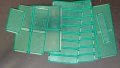
I use these. They are durable and fire rated. Search for Plated Through Hole or similar boards. They are hard to solder so I use copper wire jumpers for the tracks.

IMG_20231229_131304205.jpg
 

MisterBill2

Joined Jan 23, 2018
27,620
A single secrtion from the narrower strip on the right would be a nicer version of what I had suggested. And the wires can all be on the component side because the circuit is so simple.
What supplier do those come from???
 

ronsimpson

Joined Oct 7, 2019
4,704
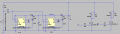
The green trace jumps up for 1S on every rising edge.
The purple trace jumps up for 1S on every falling edge.
1703946633306.png
I was not certain if the motion signal is a switch (open/closed) or a voltage 0/5V.
R1 makes the switch work. R4 is for input protection.
V1 is the motion signal.
CD4538 is dual. Two functions in each IC.
R3,C2 sets the time constant. R6&C1
V4 is the power supply.
MOSFETS reduce the power draw a little.
1703946861076.png
RonS.
 

MisterBill2

Joined Jan 23, 2018
27,620
The MC14538 has schmidt-trigger circuits on at least it's rising edge inputs. BUT the trigger set-point is different among differing producers of that device. I am aware of this difference because that IC was used in a standard product that I was responsible for at one place.
I also have questions as to what the actual output of he motion detector really is. There are quite a few different PIR motion detectors available and they are not all the same.. So really we have all been considering that it was a standard binary output. That might not be the case at all.
We need a clarification from the TS.
The simulation of the circuit in post #59 verifies that the MC14538 will provide the specified performance.
Thank You, Ron Simpson!!
 
Last edited:
Top