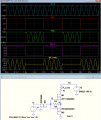
MOSFET not behaving as expected

Thread Starter

SalmanKn

Joined Mar 15, 2023
13
Hello All,
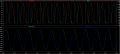
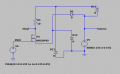
I do not understand why the MOSFET conducts for the negative cycle of applied input even though there's no voltage applied at the gate (PWM configured). Another thing why is the voltage at the point just above the MOSFET similar to input even though there's current flowing through the load. Shouldn't the voltage at that point be less than applied input because some voltage is dropping across the load? What am I missing?
 

Attachments

crutschow

Joined Mar 14, 2008
38,336
I do not understand why the MOSFET conducts for the negative cycle of applied input even though there's no voltage applied at the gate
Notice that arrow on the MOSFET symbol.
That shows the forward direction for the parasitic drain-source substrate diode, which becomes forward biased for a negative drain-source voltage N-MOSFET.
Shouldn't the voltage at that point be less than applied input because some voltage is dropping across the load?
Only when current is going through the load, giving an IR drop.
 

Thread Starter

SalmanKn

Joined Mar 15, 2023
13
Notice that arrow on the MOSFET symbol.
That shows the forward direction for the parasitic drain-source substrate diode, which becomes forward biased for a negative drain-source voltage N-MOSFET.
Only when current is going through the load, giving an IR drop.
The current is actually going through the load but there's no drop.
 

Alec_t

Joined Sep 17, 2013
15,106
Yes, but that does not solve the issue of conducting in negative cycle. I tried that.
Works ok in my sim.
Your plots are using voltages relative to ground, but your FET source is not at ground potential. That's why you get the results you're seeing.
Move the ground symbol to the FET source and your results will magically be as you'd expect.
The sim will run faster if you use 'real' diodes instead of those default ones.
 
Hi Salman,

With PWM, MOSFETs can conduct without gate voltage due to gate capacitance. Consider threshold voltage and gate charge. Load current causes voltage drop, but MOSFET area may still show input voltage due to parasitic elements. This can lead to unexpected behaviour.
 

Thread Starter

SalmanKn

Joined Mar 15, 2023
13
Works ok in my sim.
Your plots are using voltages relative to ground, but your FET source is not at ground potential. That's why you get the results you're seeing.
Move the ground symbol to the FET source and your results will magically be as you'd expect.
The sim will run faster if you use 'real' diodes instead of those default ones.
So I've got it working for the positive cycle but for the negative cycle, the source is almost always at lower potential than the gate which results in continuous conduction for the negative cycle. Is there any way I can control conduction just like in positive cycle?
 

Attachments

crutschow

Joined Mar 14, 2008
38,336
Keeping the MOSFETs off during the negative half cycle requires a little magic. ;)
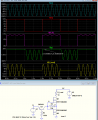
Below is an example circuit:
Basically you need to connect the gates to 10V to turn them on, and then open circuit the signal to the gates so that the gate-source resistor keeps the MOSFET gate-source voltage at 0V to turn them both off .
This circuit uses a high voltage PNP BJT in a common-base configuration to perform that function.
It applies the 10V control signal to the MOSFET gates when on, but basically open circuits the connection to the gates when off.
This allows the gates to go below 0V (green trace), thus letting R2 keep the MOSFETs' Vgs at zero (purple trace), and keeping M2 off during the negative half cycle.
For the negative half cycle, the source is maintained near the negative voltage by conduction through M1s substrate diode.

The gate stays at 0V for the positive half cycle, since that keeps M1 off.

The BJT as well as the MOSFETs must have a voltage rating higher than the peak value of the sinewave supply.

1697664814324.png

A high-voltage P-MOSFET could be used in place of the BJT if desired.
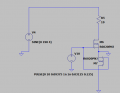
For that you could eliminate R3 and connect the gate directly to ground, with source as input and drain as output (below).
 

Attachments

Last edited:

Thread Starter

SalmanKn

Joined Mar 15, 2023
13
Keeping the MOSFETs off during the negative half cycle requires a little magic. ;)
Below is an example circuit:
Basically you need to connect the gates to 10V to turn them on, and then open circuit the signal to the gates so that the gate-source resistor keeps the MOSFET gate-source voltage at 0V to turn them both off .
This circuit uses a high voltage PNP BJT in a common-base configuration to perform that function.
It applies the 10V control signal to the MOSFET gates when on, but basically open circuits the connection to the gates when off.
This allows the gates to go below 0V (green trace), thus letting R2 keep the MOSFETs' Vgs at zero (purple trace), and keeping M2 off during the negative half cycle.
For the negative half cycle, the source is maintained near the negative voltage by conduction through M1s substrate diode.

The gate stays at 0V for the positive half cycle, since that keeps M1 off.

The BJT as well as the MOSFETs must have a voltage rating higher than the peak value of the sinewave supply.

View attachment 305285

A high-voltage P-MOSFET could be used in place of the BJT if desired.
For that you could eliminate R3 and connect the gate directly to ground, with source as input and drain as output (below).
Thank you, this really is magic. If I understand correctly, this makes the potential difference between gate and source zero unless a signal is applied a the gate?
 
Top