Modelling RCL circuits using differential equations

Thread Starter

holz1100

Joined Apr 27, 2016
18
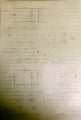
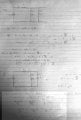
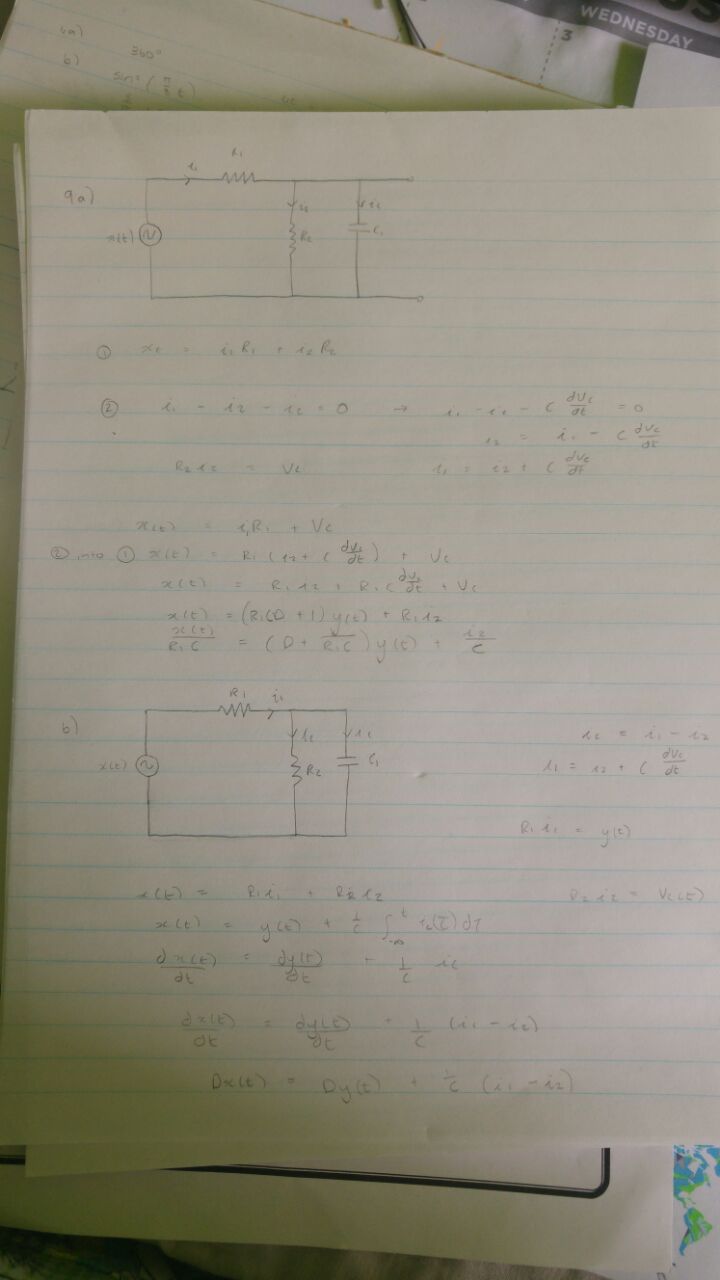
I am doing a signals and systems course and one section includes the modelling of circuits using differential equations. I am really confused and struggling to do the tutorial questions below. I've included my working for the first two but I'm really stuck and would appreciate any help on how to do these types of question

 

wayneh

Joined Sep 9, 2010
18,104
I started following your work but it's just too hard to read. Sorry bit I'm too lazy to sort it out. Maybe if you go line by line with commentary.
 

drc_567

Joined Dec 29, 2008
1,156
The thing to do is to find the current going through R1. That is the main current in this circuit. Just write the KVL around the complete loop ... solve for I.
 

WBahn

Joined Mar 31, 2012
32,823
I echo that your work needs to be clearer. A lot of it is just poor image quality (though we've definitely seen worse). Keep in mind that many (most?) of us are dealing with aging eyes.

So go for high contrast and make every character clear. Also, take time to make your work easy to follow.

What is your final result for part (a)? It seems to just stop.
 

MrAl

Joined Jun 17, 2014
13,702
Hi,

Yes it's a little haphazardly written. Clarification by the OP would be a good idea for sure. BTW the "D" is sometimes used to indicate a derivative when it is obvious what variable is the independent variable.

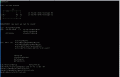
Here is an attempt to clean it up a little bit with some more enhancements, and a possible text rendering. Hopefully the OP will gain some insight into posting questions from this. See images for a better view and if you see any corrections please note them. Ignore the ending backslash in that one line that was a typo "dVc/dt\" should be just "dVc/dt".
One of the main problems in trying to decipher the hieroglyphics was the teeny tiny subscripts where it was hard to tell the difference between a '1' and a '2' or whatever it might be.

Code:
CIRCUIT:

x(t) is the source

[FONT=Courier New]
           i1
  +---R1--->---+---+
  |            |   |   i2 flows down through R2
x(t)          R2  C1   i3 flows down through C1
  |            |   |
  +------------+---+[/FONT]


EQUATIONS (as well as can be read):

[1]  xt=i2*R1+i2*R2
[2]  i1-i2-i3=0  -->  i1-i2-C*dVc/dt=0
  i2=i1-C*dVc/dt
  R2*i2=Vc  i1=i2+C*dVc/dt


  x(t)=i1*R1+Vc
[2] into [1]  x(t)=R1*(i2+C*dVc/dt)+Vc
  x(t)=R1*i2+R2*C*dVc/dt+Vc
  x(t)=(R1*C*D+1)*y(t)+R2*i2
  x(t)/(R1*C)=(D+1/(R1*C))*y(t)+i2/C


  i2=i1-i2
  i1=i2+C*dVc/dt\
  R1*i1=y(t)
  R2*i2=Vc(t)

x(t)=R1*i1+R2*i2  R2*i2=Vc(t)
x(t)=y(t)+(1/C)integral[-inf to t] ic(T) dT
d(x(t))/dt=dy(t)/dt+(1/C)*ic
d(x(t))/dt=dy(t)/dt+(1/C)*(i1-i2)
Dx(t)=Dy(t)+(1/C)*(i1-i2)
 

Attachments

Last edited:
Top