Minimal Electronics Skills Needed for a Job

DickCappels

Joined Aug 21, 2008
10,661
At this point, you should look for an employer that is willing to hire you. You can learn on the job, or at least study while there and then go off and find a better job.
 

Thread Starter

RUSTYWIRE

Joined Aug 28, 2023
113
For starters: DC theory, AC theory, semiconductor/device theory, digital, troubleshooting/analytical skills, math, physics, fabrication.
Suppose a person took those classes , got a certificate from a trade school and applied for a job at a company.
How much would a beginner job in the U.S. pay for that level of education with no work experience?

Thanks
 

WBahn

Joined Mar 31, 2012
32,905
Suppose a person took those classes , got a certificate from a trade school and applied for a job at a company.
How much would a beginner job in the U.S. pay for that level of education with no work experience?

Thanks
Probably not a lot, but it's going to vary quite a bit due to a lot of factors.

Keep in mind that, in many cases, you are going to be competing with students that are looking to gain work experience, possibly as interns or just direct-hire. They are not interested in great pay and their expectations are often determined by what they could get as student employees on campus, which is pretty close to minimum wage. They aren't trying to make money, they are trying to gain skills and establish a network of contacts for when they graduate.

Another thing to keep in mind is what is it YOU are trying to get out of the position. When I was an undergraduate I applied for a co-op position with Martin Marietta that was paying $16/hr. Another student in the physics department got it. Instead, I landed a position with the National Bureau of Standards (which became the National Institute of Standards and Technology while I was there) at the princely wage of $6.50/hr and had to work part-time at Taco Bell to make ends meet. The other guy and I compared notes when we finished and we both quickly realized that I got the much better deal. He was nothing but a gopher and did virtually no engineering/science stuff while he was there. I did some gopher stuff, but nearly all of my time was spent doing highly technical work and eventually ended up with me being responsible for the design of two measurement systems and being lead author on a paper. I did a total of three co-op terms and did some additional work for them as a contractor after graduation. The other guy was offered a second stint at Martin Marietta but turned it down.
 

Thread Starter

RUSTYWIRE

Joined Aug 28, 2023
113
So in other words, you don't make much money in electronics at a beginner level knowing:
DC theory, AC theory, semiconductor/device theory, digital, troubleshooting/analytical skills, math, physics, fabrication.

Probably better off at Home Depot or Walmart stocking shelves as far as wages go.
 

WBahn

Joined Mar 31, 2012
32,905
So in other words, you don't make much money in electronics at a beginner level knowing:
DC theory, AC theory, semiconductor/device theory, digital, troubleshooting/analytical skills, math, physics, fabrication.

Probably better off at Home Depot or Walmart stocking shelves as far as wages go.
You mentioned going to trade school and getting some kind of certificate. I don't know that you will gain much depth of knowledge (or much of any depth) in some of those areas. Whatever you make with some certificate, as a beginner with no experience, is almost certainly going to be significantly less than what you would make with an engineering degree (with no experience). It is assumed (not always correctly) that the beginning engineer has enough education behind them to be able to learn and progress much more quickly. Again, that's a common assumption that frequently doesn't play out that way. But when making hiring decisions, companies tend to go with the perceived odds.

If all you are interested in is the wages, there are almost certainly lots of things you could do to make more money, at least in the short-term. Keep in mind that we are talking about entry level positions that are intended to be stepping stones to bigger and better things. Stocking shelves is seldom a job intended to go anywhere (though it certainly can under the right circumstances). Entry-level, stepping-stone positions often don't pay well precisely because there are many people wanting them and willing to do them cheap because of the non-pay things they hope to get from them.
 

Thread Starter

RUSTYWIRE

Joined Aug 28, 2023
113
You mentioned going to trade school and getting some kind of certificate. I don't know that you will gain much depth of knowledge (or much of any depth) in some of those areas. Whatever you make with some certificate, as a beginner with no experience, is almost certainly going to be significantly less than what you would make with an engineering degree (with no experience). It is assumed (not always correctly) that the beginning engineer has enough education behind them to be able to learn and progress much more quickly. Again, that's a common assumption that frequently doesn't play out that way. But when making hiring decisions, companies tend to go with the perceived odds.

If all you are interested in is the wages, there are almost certainly lots of things you could do to make more money, at least in the short-term. Keep in mind that we are talking about entry level positions that are intended to be stepping stones to bigger and better things. Stocking shelves is seldom a job intended to go anywhere (though it certainly can under the right circumstances). Entry-level, stepping-stone positions often don't pay well precisely because there are many people wanting them and willing to do them cheap because of the non-pay things they hope to get from them.
I'm not interested in being an engineer and going to school for 4 or 5 years full time then applying for a job.
It seems according to the answers I'm getting is that it takes a tremendous amount of knowledge to get any
kind of a decent job in electronics. Probably supply and demand has something to do with this and I would
guess that there is an oversupply of qualified job applicants who know a lot. Too many applicants for one job
which would bring the wages down.

I am not just interested in wages. I'm balancing wages with knowledge level.
I was just looking at that aspect of wages for a job with those skills I listed and how valuable they really are in
todays real world. It seems that people with those educational skills are a dime a dozen according to what is being
described here. Maybe hobbyist is the best goal for learning for self satisfaction whatever that would entail.
 

DickCappels

Joined Aug 21, 2008
10,661
Suppose a person took those classes , got a certificate from a trade school and applied for a job at a company.
How much would a beginner job in the U.S. pay for that level of education with no work experience?

Thanks
You would need to leverge you work experience all of the time.I don't know you personal situation but you might take a minimum wage job at the minimum wage but stay in there and work hard for a few years and you might be surprised. Rags to riches stories do come true, especially for those who work hard.
 

Beau Schwabe

Joined Nov 7, 2019
186
" educational skills are a dime a dozen " - They are but how you apply them is something that can't be taught in school. I have spent years teaching myself and for the most part I am self taught. I have been in positions where I have hired and fired people. What I see from kids right out of college is that they are book smart, but fail when it comes to solving a new problem that isn't in the book. In my opinion, this is what separates different levels of salary. Can you just do the basic work? or are you willing to go above and beyond and often work outside of your comfort zone to solve a problem?

I started out as a UPS unloader for $8 an hour in the summer of 88' ... I later got my foot in the door as a technician at $12 an hour.( about $25k a year) ... later I was at a church event and I was "talking shop" with a guy cooking hamburgers. He said I should put a resume together and drop it by his office. Little did I know he was one of the lead designers at National Semiconductor. While there I was making $45k a year... The next Job I took on was still doing IC layout design, but at $80k a year. It wasn't until during COVID that I was making right at 6 figures at $100k a year. Now? Almost twice that amount, but I am doing "Whole Stack" software and electronics design. I have designed complete bespoke data encrypted systems from the ground up from a bi-directional real time Web Interface down to the PCB circuit board wiggling I/O bits controlled from the Web Interface. Including the code inside of the micro controller on the PCB. That said, it's only part of a larger monitoring communication network I also developed with thousands of connected Nodes.

So you see it's a process and you never stop learning along the way. I'm doing things now that didin't exist when I would have been going to school to 'learn' how to do it. Go to school for the fundamentals and learn how to apply them. The rest will fall into place if you have the right motivation.
 

Thread Starter

RUSTYWIRE

Joined Aug 28, 2023
113
" educational skills are a dime a dozen " - They are but how you apply them is something that can't be taught in school. I have spent years teaching myself and for the most part I am self taught. I have been in positions where I have hired and fired people. What I see from kids right out of college is that they are book smart, but fail when it comes to solving a new problem that isn't in the book. In my opinion, this is what separates different levels of salary. Can you just do the basic work? or are you willing to go above and beyond and often work outside of your comfort zone to solve a problem?

I started out as a UPS unloader for $8 an hour in the summer of 88' ... I later got my foot in the door as a technician at $12 an hour.( about $25k a year) ... later I was at a church event and I was "talking shop" with a guy cooking hamburgers. He said I should put a resume together and drop it by his office. Little did I know he was one of the lead designers at National Semiconductor. While there I was making $45k a year... The next Job I took on was still doing IC layout design, but at $80k a year. It wasn't until during COVID that I was making right at 6 figures at $100k a year. Now? Almost twice that amount, but I am doing "Whole Stack" software and electronics design. I have designed complete bespoke data encrypted systems from the ground up from a bi-directional real time Web Interface down to the PCB circuit board wiggling I/O bits controlled from the Web Interface. Including the code inside of the micro controller on the PCB. That said, it's only part of a larger monitoring communication network I also developed with thousands of connected Nodes.

So you see it's a process and you never stop learning along the way. I'm doing things now that didin't exist when I would have been going to school to 'learn' how to do it. Go to school for the fundamentals and learn how to apply them. The rest will fall into place if you have the right motivation.
[/QUOTE
Someone could actually make a lot of money in any other field if they are dedicated so electronics doesn't have a monopoly on good money.
You really have to be in love with electronics like a fanatic to achieve a job paid $200,000 a year. that's not me.

Actually the most recent question I had was trying to understand what the significance of this much knowledge in getting a job in electronics
as another poster stated that these subjects are considered basic knowledge:
DC theory, AC theory, semiconductor/device theory, digital, troubleshooting/analytical skills, math, physics, fabrication.

To me that seems like quite a lot but evidently it is chicken feed compared to what is needed in the real world.
I guess the days of Marconi are over (that's a joke). Someone even said you have to understand
programming and software as a beginner. Walmart is starting to look good and just electronics as a hobby for me.
 
Last edited:

strantor

Joined Oct 3, 2010
6,875
It seems according to the answers I'm getting is that it takes a tremendous amount of knowledge to get any
kind of a decent job in electronics. Probably supply and demand has something to do with this and I would
guess that there is an oversupply of qualified job applicants who know a lot. Too many applicants for one job
which would bring the wages down.
Yes this is part of what you face, but in ever-increasing proportion it is becoming less an issue of your competitors having a "tremendous amount of knowledge" and more an issue of them being "qualified" and cheap. The "supply and demand" aspect is global; I refer to outsourcing/offshoring.

Are you living in America? If so, I would only encourage you to pursue this career path if it is something you are passionate about. If you're in it for the money, consider that for every job opportunity you find listed there several more that would also exist if the work wasn't already being done by someone in Mumbai for a fraction of the cost. Companies are always looking for ways to cut cost, which means moving more jobs overseas and making the domestic opportunity pool shallower as time goes on.

It is ironic that you mention this:
I wonder at what threshold of skill, say with older guitar amplifiers, old stereos etc.,
(discreet through hole components, even tubes) that a person can declare and feel
that they are ready to do the real world work?
My step father used to work at Peavey Electronics. He lost his job there a few years ago but he spent over a decade there and watched the company go down the drain. It used to be a busy factory but they started shutting down a little at a time, moving small parts of production overseas, then large parts, then small parts of engineering, then large parts. There is almost nothing left of Peavey now and what remains is being hammered by competition from "knock-off" brands that are not lower quality (probably because they come off the same assembly line).

So if you want a domestic job repairing guitar amps, you'll have to get in line behind all the displaced workers from that factory with decades of experience, who are themselves in line behind Chinese children with "qualifications."


I wish I could offer a more uplifting perspective but you might actually be better off working at home depot like you said. But if this is something that actually does interest you, I do recommend that you pursue it. When you get done stocking shelves at home depot, go home and try repairing busted stereos. If you find it fulfilling, branch out, learn more, build skill, gain confidence. Then you can offer to repair devices for others. You might be able to supplement your home depot paycheck doing something that you enjoy. If you can manage it, maybe one day you can leave the day job behind and do it full time. That's pretty much how I went about it.

You can break into this game without the paper pedigree but (I think, from my own experience) it's easier to do so by writing your own book than by begging some company to let you write a chapter of their book when you have no proof that you can even spell.
 

dl324

Joined Mar 30, 2015
18,357
So in other words, you don't make much money in electronics at a beginner level knowing:
DC theory, AC theory, semiconductor/device theory, digital, troubleshooting/analytical skills, math, physics, fabrication.

Probably better off at Home Depot or Walmart stocking shelves as far as wages go.
You should make better than minimum wage because it's considered a skilled profession. Stocking shelves doesn't require any specialized knowledge, but the jobs may be union and that will bump wages (at the expense of consumers). It seems that time-in-job is more important in unionized jobs than skills.

When I started my first job after getting my ASEET, I was making around $10/hour (my other offer was around $8/hour). Minimum wage at the time was $2.30 according to this chart (for tipped workers like me, it was $1.25):
https://www.dol.gov/agencies/whd/minimum-wage/history/chart
1694271308381.png
I was making $20/hour by the early 80's. You won't get that kind of wages or increases now...
 

Thread Starter

RUSTYWIRE

Joined Aug 28, 2023
113
Yes this is part of what you face, but in ever-increasing proportion it is becoming less an issue of your competitors having a "tremendous amount of knowledge" and more an issue of them being "qualified" and cheap. The "supply and demand" aspect is global; I refer to outsourcing/offshoring.

Are you living in America? If so, I would only encourage you to pursue this career path if it is something you are passionate about. If you're in it for the money, consider that for every job opportunity you find listed there several more that would also exist if the work wasn't already being done by someone in Mumbai for a fraction of the cost. Companies are always looking for ways to cut cost, which means moving more jobs overseas and making the domestic opportunity pool shallower as time goes on.

It is ironic that you mention this:

My step father used to work at Peavey Electronics. He lost his job there a few years ago but he spent over a decade there and watched the company go down the drain. It used to be a busy factory but they started shutting down a little at a time, moving small parts of production overseas, then large parts, then small parts of engineering, then large parts. There is almost nothing left of Peavey now and what remains is being hammered by competition from "knock-off" brands that are not lower quality (probably because they come off the same assembly line).

So if you want a domestic job repairing guitar amps, you'll have to get in line behind all the displaced workers from that factory with decades of experience, who are themselves in line behind Chinese children with "qualifications."


I wish I could offer a more uplifting perspective but you might actually be better off working at home depot like you said. But if this is something that actually does interest you, I do recommend that you pursue it. When you get done stocking shelves at home depot, go home and try repairing busted stereos. If you find it fulfilling, branch out, learn more, build skill, gain confidence. Then you can offer to repair devices for others. You might be able to supplement your home depot paycheck doing something that you enjoy. If you can manage it, maybe one day you can leave the day job behind and do it full time. That's pretty much how I went about it.

You can break into this game without the paper pedigree but (I think, from my own experience) it's easier to do so by writing your own book than by begging some company to let you write a chapter of their book when you have no proof that you can even spell.

OK Thanks

So that's another aspect of this, the cheap overseas electronics "talent" taking American jobs. I have noticed, on youtube, that a lot
of the electronics instruction there comes from India which seems to be nurturing an increasing population of electronics
engineers and I guess technicians too. Of course everyone knows about China building those factories that took jobs
away from the U.S. Just about every product I see has "Made in China" on it, including at Home Depot by the way.

Yes I am interested in electronics but there is a trade off between time, money and interest. I don't really have time as if I am
independently wealthy or spend my spare time after working at Home Depot or Walmart to tinker around too much and
electronics seems to be a very time consuming activity just by its nature of building, testing, constructing even as a hobby.
I do like the scientific and fun part of electronics that follows the field of physics, but it seems, from what knowledgeable
people are telling me here, (as I already said), that it takes a great amount of knowledge to actually make money doing it
in the modern time we live in. The story you tell about Peavey I bet is the story of many American electronics companies
and as I also said electronics techs and even engineers seem to be a dime a dozen. Too bad and too sad, unless a person
wants to do it just for fun. The Arduino phenomena seems to make the dime a dozen aspect of electronics even more
pronounced. Highly educated electronics engineers probably have a decent chance at a nice job in an American company,
but adding all this information I am getting on this forum, that is the situation if you want to spend 4 or 5 years going
to school full time. Maybe thats OK for some young person living at home with mon and dad, but for an older adult
it is not feaseable unless they are obessed with electronics and give up everything else or are, as I said independently wealthy.
Even then there is that overseas competition (like you said with Peavey) so it looks bleak to me, unless I am missing something.
Correct me if my conclusion is not accurate, (Anyone) but I think it is.
 
Last edited:

nsaspook

Joined Aug 27, 2009
16,333
It's all about experience today for the money you make. There are plenty of US based semiconductor engineering and tech jobs making good money (if your willing to move) with all the new fabs TSMC being built but there is a vast gap between what you learn in school and could earn vs what you need to know (and earn management trust) to keep tools worth 10's of millions, working on sites worth billions, that's pays a lot more. In this industry people can be selected without specific job experience based on past experience working on complex systems that use similar types of base knowledge with similar ranges of technical responsibility for repairs. Many of the new hires are former Navy nuclear electronic or electrical technicians with at least 6 years of military service and at least one deployment on the reactor. They do have the needed background in DC theory, AC theory, semiconductor/device theory, digital, troubleshooting/analytical skills, math, physics and some actual work experience in the field.
 

strantor

Joined Oct 3, 2010
6,875
Correct me if my conclusion is not accurate, (Anyone) but I think it is.
It's pretty accurate from my perspective. Someone with a more optimistic perspective might tell you about new plants being built and new jobs being created every day, which while true, is not (in my opinion) a fair representation of the situation in the grand scheme.
 

nsaspook

Joined Aug 27, 2009
16,333
It's pretty accurate from my perspective. Someone with a more optimistic perspective might tell you about new plants being built and new jobs being created every day, which while true, is not (in my opinion) a fair representation of the situation in the grand scheme.
https://www.investopedia.com/semiconductor-industry-finding-too-few-workers-7566249
https://www.semiconductors.org/amer...onductor-industry-and-throughout-u-s-economy/

It's the typical thing that's happened in the past (60's space race), it will take a while to spin-up. New plants being built and new jobs being created every day but the future workers at those places need to adapt to the future requirements of added education in lieu of experience for entry level jobs.
Many times that means moving and taking a risk that younger folks are more likely to see as an adventure instead of a life changer affecting established work experience and family needs for stability.
 
Last edited:

Thread Starter

RUSTYWIRE

Joined Aug 28, 2023
113
Yes this is part of what you face, but in ever-increasing proportion it is becoming less an issue of your competitors having a "tremendous amount of knowledge" and more an issue of them being "qualified" and cheap. The "supply and demand" aspect is global; I refer to outsourcing/offshoring.

Are you living in America? If so, I would only encourage you to pursue this career path if it is something you are passionate about. If you're in it for the money, consider that for every job opportunity you find listed there several more that would also exist if the work wasn't already being done by someone in Mumbai for a fraction of the cost. Companies are always looking for ways to cut cost, which means moving more jobs overseas and making the domestic opportunity pool shallower as time goes on.

It is ironic that you mention this:

My step father used to work at Peavey Electronics. He lost his job there a few years ago but he spent over a decade there and watched the company go down the drain. It used to be a busy factory but they started shutting down a little at a time, moving small parts of production overseas, then large parts, then small parts of engineering, then large parts. There is almost nothing left of Peavey now and what remains is being hammered by competition from "knock-off" brands that are not lower quality (probably because they come off the same assembly line).

So if you want a domestic job repairing guitar amps, you'll have to get in line behind all the displaced workers from that factory with decades of experience, who are themselves in line behind Chinese children with "qualifications."


I wish I could offer a more uplifting perspective but you might actually be better off working at home depot like you said. But if this is something that actually does interest you, I do recommend that you pursue it. When you get done stocking shelves at home depot, go home and try repairing busted stereos. If you find it fulfilling, branch out, learn more, build skill, gain confidence. Then you can offer to repair devices for others. You might be able to supplement your home depot paycheck doing something that you enjoy. If you can manage it, maybe one day you can leave the day job behind and do it full time. That's pretty much how I went about it.

You can break into this game without the paper pedigree but (I think, from my own experience) it's easier to do so by writing your own book than by begging some company to let you write a chapter of their book when you have no proof that you can even spell.
The reason I brought up guitar amplifiers is because of the older, discreet circuits with larger components.
I know there are newer SMD guitar amps and equipment but having components you can actually see
without a microscope is a plus for me. It's already difficult enough learning and working with the complexity
of electronics but if you can't even see what you are working on, forget it. Any other electronic devices
that use larger components, like old stereos and audio equipment, older ham equipment etc., is more
what I would be interested in, even boards with older chips but the SMD doesn't inspire me, just too tiny
and everything fused into one microscopic membrane that looks like a photograph seems ridiculous to
deal with. Maybe there is some repair market for the old nostalgic equipment. Actually I did work at the
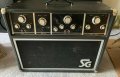
Gibson amplifier factory in California (I think it was called "SG" Amps) where I soldered wires on to circuit
boards and stuffed boards with components, all assembly no actual electronic circuit knowledge required.
That's back when I was looking at electronics as a possible career. I went on to another career after that.
Now I have been just contemplating what it would take to get back into this as a geezer and is why
I started this thread to get some advice from others in the field, which I do appreciate.
Thanks to all board members for recomendations and advice.
 

Attachments

Last edited:

DickCappels

Joined Aug 21, 2008
10,661
I spent my teen years into retirement in Silicon Valley, and have worked at several startups. During tough times in the valley, many of the startups would fail and so would some of the larger companies. Imagine...General Electric made (what I considered) exotic transistors only a few miles from my father's house.

This cycle continued until I left in 2001, and I am sure it continues today. My magic formula was to get hired, (in the early years) start attending school, and learn enough from the engineers around me and by self-study to make myself attractive to other companies.

Mentors have been very helpful to me over the years. I am saddened to realize that at my age I am not likely to encounter any new ones.
 

nsaspook

Joined Aug 27, 2009
16,333
Top