Millivolt systems in heating and valves and thermostats...

Thread Starter

Externet

Joined Nov 29, 2005
2,626
Hello.
Can someone explain slowly, how these things work ? Millivolts sounds like for 'millipower' capable mechanisms all coming from a pilot flame, and actuate valves ?
I have search engines too. Prefer a slow explanation.
Are these used in other applications ?
 

Thread Starter

Externet

Joined Nov 29, 2005
2,626
Thanks.
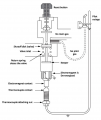
Some parts I understood from high school; but the "cold junction" baffles me. If that is a junction, as in 'short-circuit' red-to-blue, why is there still a mV reading ?
Are the red and blue plain copper wires to the right side of the cold junction as in any connection or they must be different (say Cu and Al)? And the red-to-orange and blue-to-orange junctions are dissimilar metals behaving as thermocouples themselves ?

Can these thermopiles be connected in series/parallel, all fed from the same hot source ? Say a bunch of them on an exhaust pipe ?

It is named 'millvolt' but what is its power capability? How many milliwatts are those like Q313 thermopiles capable ? Like in a solar panel; there has to be a MPP point, right ?

Educate me, please. The conections at a Seebeck effect cell-to-copper wiring i what I do not have clear.

1724516069023.png
 
Last edited:

crutschow

Joined Mar 14, 2008
38,323
The voltage from a thermocouple is low, but the current is high enough (likely several 100 mA) to activate the very low resistance electro-magnet.

I remember seeing an impressive demo in my colleges physics lab that had a one turn electromagnet directly connected to a thermocouple heated by a Bunsen burner.
The single turn was about a 1/2" square copper buss wound in a round iron core with one open end.
When cold, there was no discernable magnetic field, with the keeper on the core easily removed.
When the flame was lit, it became impossible to remove the keeper, due to the high current in that single turn of bus bar.
Don't know what the buss current level was, but it had to be large value.
 
Last edited:

nsaspook

Joined Aug 27, 2009
16,251
Thanks.
Some parts I understood from high school; but the "cold junction" baffles me. If that is a junction, as in 'short-circuit' red-to-blue, why is there still a mV reading ?
Are the red and blue plain copper wires to the right side of the cold junction as in any connection or they must be different (say Cu and Al)? And the red-to-orange and blue-to-orange junctions are dissimilar metals behaving as thermocouples themselves ?

Can these thermopiles be connected in series/parallel, all fed from the same hot source ? Say a bunch of them on an exhaust pipe ?

It is named 'millvolt' but what is its power capability? How many milliwatts are those like Q313 thermopiles capable ? Like in a solar panel; there has to be a MPP point, right ?

Educate me, please. The conections at a Seebeck effect cell-to-copper wiring i what I do not have clear.

View attachment 330001
It's basically like a solar cell that you can stack them in series or parallel.
https://www.allaboutcircuits.com/te...-effect-seebeck-voltage-seebeck-coefficients/

A simple explainer for the Seebeck effect.

Think ENERGY.
 
Last edited:

sparky 1

Joined Nov 3, 2018
1,218
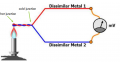
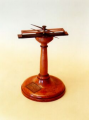
The discussion might be limited to Thermoelectric. The underlying principles in this case are a subset of charge separating mechanisms. The properties of thermocouples and electromagnetic contacts used proportion. These were covered in summary above, leaving the history and discovery of those properties are the details and variants that were not covered here are some before Seebeck, one is Ampere. Classifying materials with good Seebeck coefficiets led to Thermoelectric. The picture shows how a flame could be placed under one end of the dissimilar metals resulting in compass movement.

1724538032486.png

One source below shows variants after Seebeck. The heading Thermoelectric is still referred to in physics today. The reverse effect of cooling needs some discussion regarding reverse current as it is related and has spin offs in battery, solid state refrigeration, manufacturing processes involving nano technology, mems, computer memory cooling, medicine delivery, micro positioning, there are many others.

After Seebeck, It was found that ice water cooling had an opposite effect. Later shown that by reversing the current the free electrons moved in the opposite direction. This was also quantified that dissimilar metals could be arranged to have a difference in thermal gradient that is also proportional to the potential difference of charges.

History of Thermoelectrics (northwestern.edu)

In TEG generators both hot and cold is much more efficient where gradient is at least wide enough to harvest thermoelectric.
 
Last edited:

Ian0

Joined Aug 7, 2020
13,097
Thanks.
Some parts I understood from high school; but the "cold junction" baffles me. If that is a junction, as in 'short-circuit' red-to-blue, why is there still a mV reading ?
Are the red and blue plain copper wires to the right side of the cold junction as in any connection or they must be different (say Cu and Al)? And the red-to-orange and blue-to-orange junctions are dissimilar metals behaving as thermocouples themselves ?

Can these thermopiles be connected in series/parallel, all fed from the same hot source ? Say a bunch of them on an exhaust pipe ?

It is named 'millvolt' but what is its power capability? How many milliwatts are those like Q313 thermopiles capable ? Like in a solar panel; there has to be a MPP point, right ?

Educate me, please. The conections at a Seebeck effect cell-to-copper wiring i what I do not have clear.

View attachment 330001
The cold junction is labelled wrongly. It is in series with the hot junction because it is the difference between them that creates the voltage.
There is also a voltage created at each of the points where the "dissimilar metals" join the orange wire to the meter.
If both terminals where the orange wires connect are at the same temperature, these cancel out.

A car manufacturer tried the thermocouples attached to the exhaust to charge the battery. I think it was BMW. I don't think it was successful.
And there were gas powered radios.
The main problem is that the wires are also good conductors of heat, so the heat from the hot junction rather quickly warms up the cold junction and the temperature difference is lost. For it to work, it needs a big heatsink on the cold junction.
 

Mullins

Joined Dec 31, 2021
210
I have never seen it in person but my parents tell me that there was a radio that worked with a flame I really think it worked with thermocouples.
 

Reloadron

Joined Jan 15, 2015
7,857
Something to consider is the difference between a Thermopile and a Thermocouple. A thermopile may output 300 mV or more and consist of maybe 10 thermocouples in series in a single housing, sheath or tube. Enough to pull in a magnetic valve in gas fired applications like monitoring the pilot in older gas fired furnaces. Just keep in mind a Thermopile and Thermocouple are not quite the same animal. :)

Ron
 

sparky 1

Joined Nov 3, 2018
1,218
Notice the higher temperature range has the differential with thermoelectric generators. TEG.

The word thermopile is a derivative from voltaic pile 1840 which was in series.

Some of the materials with better Thermoelectric properties are: Bismuth, Tellerium, Antimony, Now they are including Magnesium. Notice what the higher temperature range for sufficient temperature differential with the better thermoelectric generators.
In all honesty, the cost of all the needed parts at this time is not feasible. This technology in some industrial settings is near term.
The process that allowed Mg to work is called spark plasma sintering and annealing, I think this was made available by a semiconductor company. The printable panel may become possible which is exciting.
Mg3(Sb,Bi)2-based materials and devices rivaling bismuth telluride for thermoelectric power generation and cooling - ScienceDirect
 
Last edited:

MisterBill2

Joined Jan 23, 2018
27,186
the "millivolt"system used for residential heating systems may use an array of MANY thermo-couples. That produced enough power to run a blower as well as the main gas valve. The system I saw, back about 1955, probably had over a hundred thermocouples in series. They were all in a large ring inside a converted coal furnace. The ring was some cast refractory material. The concept was quite good, in that if the electric power failed the furnace would still function quite well. But obviously serious attention was required with every connection.
 

MaxHeadRoom

Joined Jul 18, 2013
30,562
For many years the 4-20ma communication protocol was very popular in many cases and still often seen in use.
It involves varying the resistance in a fixed-voltage closed loop to alter the current flowing through the signal line — representing a transmit value etc, e.g. a sensor reading, etc..
 

MisterBill2

Joined Jan 23, 2018
27,186
For many years the 4-20ma communication protocol was very popular in many cases and still often seen in use.
It involves varying the resistance in a fixed-voltage closed loop to alter the current flowing through the signal line — representing a transmit value etc, e.g. a sensor reading, etc..
The 4-20 milliAMP system has nothing at all in relation to the milliVOLT system used to power and control off-line heating systems, Max!!
Milly Yamp is not in the furnace business!!!
 

MaxHeadRoom

Joined Jul 18, 2013
30,562
Really !
I am talking about the transfer of information of this kind.
https://www.predig.com/indicatorpage/back-basics-fundamentals-4-20-ma-current-loops

Quote from above link:

In the world of process control, there are a myriad of different types of process inputs. Thermocouples and RTDs provide direct temperature reading while digital signals such as Modbus® provide exacting control over process variables and display. Analog signals, where information about the process is transmitted via varying amounts of voltage or current, are the predominant type of input in industries requiring process control today. Of all possible analog signals that can be used to transmit process information, the 4-20 mA loop is, by far, the dominant standard in the industry.

As major as the 4-20 mA loop standard has become in the process control industry, many do not understand the fundamentals of its setup and use.
 

MisterBill2

Joined Jan 23, 2018
27,186
REally, and totally seriously, the current loop system is not even remotely similar to the millivolt power system used in the Millivolt heating systems.
I have no idea as to if Max was attempting humor or being serious, but the two technologies are in different realms.
 
Top