Microphone Mute Button - Phantom Power

Thread Starter

tkramer

Joined Jan 5, 2026
1
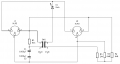
I am trying to make a mute button for a phantom powered microphone using a latching DPDT switch and an LED indicator for when the mic is muted. The LED will be powered by the mixer's phantom power. I need a few more eyes on this project. Does my attached schematic make sense?

2026-01-05 11_44_27-Phantom Mute Switch.fzz_ - Fritzing - [Schematic View].png
 

Ian0

Joined Aug 7, 2020
13,097
There's usually about 6.8kΩ driving pins 2 and 3 at the mixer end, so the voltage across R7 and R8 will be about 6V, That would only give 185uA through the LED, which will light up but rather dimly.
Normally muting is simply accomplished by shorting pins 2 and 3.
 

Braccae

Joined Apr 30, 2017
11
Shorting pins 2 and 3 makes a loud bang, a better solution is shown in this schematic.
mute.png
C1,C2 = 6.3V. R2,R3 1% tolerance.
LED must be low power type (2mA) to keep within the phantom power standard.
This is basically a very low lowpass filter, R1 resistor ensures that the voltage across the caps stabilizes,
so it doesn't cause a loud noise when the switch is operated.
C1,C2 can be up to, 2200µF or higher, then reduce R1 to 20, 24k.
 
Last edited:

MisterBill2

Joined Jan 23, 2018
27,159
There is a better circuit, which I have seen, called a "cough switch". But the website that had it seems to have vanished.
Rather thatn a switch with all of those noisy contacts, a simple variable resistor to shunt the two signal lines.
 

xox

Joined Sep 8, 2017
936
There's usually about 6.8kΩ driving pins 2 and 3 at the mixer end
So I guess it goes without saying then, if there is only a maximum of 7mA available, there simply isn't any way to power an LED without an external circuit (short of tapping into the 48V behind the 6.8K resistor within the mixer itself). Bummer!
 

MisterBill2

Joined Jan 23, 2018
27,159
Back in the mid 1980's era I found that a few of the "high brightness LEDs will light up with a very low current. BUT it would take some research and experimenting to find the right ones, and that might not be bright enough for the particular application.
 

MisterBill2

Joined Jan 23, 2018
27,159
If the microphone is a low impedance type, 50 to 200 ohms, use a 0.47 MFD capacitor in series with a 4700 ohm resistor across pins 2 and 3,the microphone's balanced output. Then use a SPST switch across the resistor to mute the audio. The resistor will keep the capacitor charged to any residual voltage and the capacitor will absorb all of the audio output when the resistor is bypassed.
 
Top