Metal detecting bin / trashcan

Thread Starter

reluctor

Joined Mar 12, 2019
3
Hello all,

In an attempt to prevent the unintended transmission of my knives and forks into the compost bin, I struck upon the idea of installing a small metal detector to one of the walls of the bin. A search on ebay resulted in an inexpensive kit being delivered, which I promptly made and tested; disappointingly the range proved to be no more than a centimetre, rendering it unsuitable for my project.
My question is whether it would be possible to use the perimeter of the bin's opening to wind a coil around, and if so what the exact number of turns etc. should be, or otherwise how I might calculate them, the coil ending up as part of a simple oscillator-type metal detector circuit, preferably similar to the design in the kit, a diagram of which I attach below. The opening is roughly a rectangle with sides 15 and 20 centimetres.
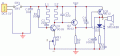

kit metal detector circuit.gif
courtesy http://www.talkingelectronics.com/projects/200TrCcts/MetalDetectors/MetalDetectors-1.html
 

drc_567

Joined Dec 29, 2008
1,156
... One approach would be to examine the original inductor sensing element, and try to measure its elemental dimensions ... the wire diameter, loop diameter, and number of turns, then plug the numbers into the circular loop inductor calculator below, thereby approximating a numerical value for L1 in circular form.
https://www.allaboutcircuits.com/tools/coil-inductance-calculator/
The next step would be to try to reproduce the inductance value for a circular loop in the form of a rectangular loop using the appropriate dimensions and measurements.
A rectangular loop inductance calculator is given here:
https://www.allaboutcircuits.com/tools/rectangle-loop-inductance-calculator/
... Assume that the relative permeability for both calculators is 1.
... Do you happen to have an oscilloscope to investigate the actual operation of your circuit? It is possible that some tuning may be necessary in order to accomplish your objective.
 
Last edited:

BR-549

Joined Sep 22, 2013
4,931
What is the compactor bin material? Will anything around the rim of the bin, inside or outside, interfere with the compactor operation? How about a structure 1 or 2 inches that extends the rim of the bin? Would that interfere with operation?

Can a rectangular loop be swung or positioned or hung within 1-2 inches of rim?

I would start out with the same number of turns as the parent circuit. Once you get it it oscillating.....you might need to increase power, depending on your tableware.

Equipment should be used to tune it in. You want to detect non-resonance on both sides equally well.
 

pmd34

Joined Feb 22, 2014
529
Hi reluctor! Nice idea! As drc says its all in the inductance. I guess the easiest thing is to actually pick up an inductance meter. That way you can actually measure L1, and when you make your own coil see how close you can actually match it in real life. Theory will only get you so far... in theory...

These sort of circuits, tend to be resonant, so any small changes (in the inductance) are actually magnified, so you will need to get quite a good match if it is to work.
 

Colin55

Joined Aug 27, 2015
519
Expecting to pick up a spoon at 10cm is a very big requirement. Even a hand held wand used by the police is good for just 3cm.
You can design something with greater sensitivity but preventing false triggering is going to be almost impossible.
Even metal detectors in food monitoring are only good for a few cm.
The project you bought will work at 10cm but you have to wind the coil as explained in my notes then gradually increase the diameter and reset the circuit with new component values as the slightest increase in diameter changes the inductance enormously.
 

Thread Starter

reluctor

Joined Mar 12, 2019
3
Thank you for all of your replies.

Now I'm confused. It's ok, it's my normal state. The title says trashcan, but the post says compost.
I should have been clearer - the bin is used only for food waste - no metallic wrappers etc. are allowed in.

What is the compactor bin material? Will anything around the rim of the bin, inside or outside, interfere with the compactor operation? How about a structure 1 or 2 inches that extends the rim of the bin? Would that interfere with operation?
The bin is made entirely from PP, with the lid and handle being the only parts necessary to take into consideration as regards the placement of the coil:

compost bin.jpg

Currently the bin is adjacent to a dishwasher, and underneath a stainless steel sink with plumbing nearby.

Even metal detectors in food monitoring are only good for a few cm.
The project you bought will work at 10cm but you have to wind the coil as explained in my notes then gradually increase the diameter and reset the circuit with new component values as the slightest increase in diameter changes the inductance enormously.
My hope was that the cutlery, passing roughly through the middle of the coil as it entered the bin, would produce a greater change in the inductance than if I were to locate it, for example, at its bottom, where the cutlery might not reach, this idea admittedly not being based on any theoretical understanding; I also wondered if the performance could be improved if the coil were to be wound helically around and along the bin, as in a solenoid. As regards the choice of wire, would the ordinary stranded sort suffice?

... Do you happen to have an oscilloscope to investigate the actual operation of your circuit? It is possible that some tuning may be necessary in order to accomplish your objective.
My only piece of test equipment is a multimeter, but if experimenting proves unfruitful what sort of oscilloscope would I need to purchase?

Must be some wild parties going on at your house!
The fate of the spoons will remain undisclosed.
 
Last edited:

AnalogKid

Joined Aug 1, 2013
12,130
This sounds like a job for a traffic light sensor. Big loop of wire going to an L-C oscillator circuit, going to a frequency discriminator. Car drives by, inductance changes, frequency changes. No matter what the metallic environment around the coil is, it probably is stable. What you are looking for is the shift in freq as the knife goes *through* the loop. Seems very doable to me.

ak

ps. About 20 years ago, in Dinky-little-town-in-the-wilderness, Alaska, I spent an hour in a bar sitting next to the guy who holds the patent on the modern inductive traffic sensor.
 

Thread Starter

reluctor

Joined Mar 12, 2019
3
This sounds like a job for a traffic light sensor. Big loop of wire going to an L-C oscillator circuit, going to a frequency discriminator. Car drives by, inductance changes, frequency changes. No matter what the metallic environment around the coil is, it probably is stable. What you are looking for is the shift in freq as the knife goes *through* the loop. Seems very doable to me.

ak

ps. About 20 years ago, in Dinky-little-town-in-the-wilderness, Alaska, I spent an hour in a bar sitting next to the guy who holds the patent on the modern inductive traffic sensor.
Where's an Alaskan bar when you need one...as it happens the other approach I had been considering was to use a microcontroller connected to an inexpensive magnetometer, of the sort found in mobile phones, to detect the cutlery. An internet search led me to a forum where one member claimed to be able to use such an arrangement to detect their car from a distance of a few metres, in order to operate a garage door.
 
Last edited:

AnalogKid

Joined Aug 1, 2013
12,130
We're talking about extremely small changes in a magnetic field. There are tons of low-noise amplifiers out there, so useful sensitivity translates to stability in the magnetic characteristics of the local environment. For example, if the trash can is near an all-steel exterior door, the moving door will disrupt the sensing and give a false alarm.

ak
 

drc_567

Joined Dec 29, 2008
1,156

" ... Do you happen to have an oscilloscope to investigate the actual operation of your circuit? It is possible that some tuning may be necessary in order to accomplish your objective.
My only piece of test equipment is a multimeter, but if experimenting proves unfruitful what sort of oscilloscope would I need to purchase? "

... The sense inductor that is shown on the linked page for the basic detector circuit comes out to be 278 μH using the circular coil inductance calculator. Assuming that same sense inductor is the one used in your original purchased circuit, then using 17 turns of 0.25 mm wire wrapped around the opening of the bin yields 261 μH. It looks like it will be necessary to add a variable capacitor to the main tank circuit ... parallel to C3 ... in order to adjust the radio frequency oscillation and achieve the zero beat condition between the two oscillating components.
... A scope might assist in confirming the sense circuit and tank circuit oscillation frequencies. An expensive oscilloscope would not be necessary ... one of the computer add-on scopes might serve the purpose ... but cannot provide much useful purchase guidance .. other than the frequency range is likely 200 kHz ... give or take 50 kHz.

... The numbers above are just calculations and are subject to any slight variations due to actual layout and construction. However, if you add the extra variable capacitor you should be able to reach the desired signal result with minimal effort.

... can't tell for sure if the caps in your detector circuit are listed in units of pico-farads or nanofarads. If pico, then the operating frequency is about 640 kHz. ... If nano, the frequency is 20 kHz. ... guessing they are picofarads.
 
Last edited:
Top