Faraday Cage - why doesn't a metal enclosure block this signal

Thread Starter

ischonfeld

Joined Jun 22, 2019
63
My [limited] understanding of a Faraday cage is that if the holes are significantly smaller than the signal wavelength, it will block the signal.

So if I wrap my cell phone in foam (insulate it from the next layer) and wrap that completely in aluminum foil, why doesn't that block the signal? And it doesn't.

Does the foil need to be grounded? Does the cage [foil] need to be a certain thickness based on the wavelength that needs to be blocked?

Inquiring minds (my wife in particular, but now me too) want to know.

Thanks.
 

nsaspook

Joined Aug 27, 2009
16,249
My [limited] understanding of a Faraday cage is that if the holes are significantly smaller than the signal wavelength, it will block the signal.

So if I wrap my cell phone in foam (insulate it from the next layer) and wrap that completely in aluminum foil, why doesn't that block the signal? And it doesn't.

Does the foil need to be grounded? Does the cage [foil] need to be a certain thickness based on the wavelength that needs to be blocked?

Inquiring minds (my wife in particular, but now me too) want to know.

Thanks.
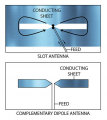
For a Faraday cage to be effective at X frequency, ANY discontinuities larger than some fraction of X wavelength (long skinny gaps that might be hidden in folds of foil) in the electrical galvanic contact sealing on the conductive shielding material might leak RF energy as slot antennas.
1740859562642.png


If you are diligent (NO holes, NO cracks, NO seams) about how well you wrap them and close every seam tightly with several small folds on the seams, it will work much better.

The general rule is with foil wraps, if the device is perfectly dry after being on the bottom of a bucket of water, then the RF seal will likely be just as tight. ;)
 

MisterBill2

Joined Jan 23, 2018
27,159
My first question is WHY???? Next, how are you measuring the amount of reduction of the signal strength?? Cell phone receivers are quite sensitive, and so a 60 dB reduction will still allow signal thru. And if you can get data out, the shied is not adequate.
 

DickCappels

Joined Aug 21, 2008
10,661
Aluminum foil is very poor stuff for this kind of use, mainly because it oxidizes quickly when exposed to air. When you overlap the foil, you are not creating a short, it is more like the slot nsaspook mentioned.
 

DC_Kid

Joined Feb 25, 2008
1,242
Go to one of those dollar stores and get a cookie tin container, put phone inside and place on the lid, then call the phone.
It's really a game of attenuation.

AL foil is an excellent blocker of UV 200-400nm. Deposition of AL atoms onto glass makes for good notch filter to keep UV from passing through. However, the mode of filter is different, a reflector vs absorber, both are attenuators, but only one gets warm.

It's a concept we see often in very sunny places where people place dark screens over their exterior home windows in effort to keep out sunlight. Yes, it in in fact a light blocker, also helps to keep UV out, but what most dont realize is that the light and UV are mostly absorbed by the screen material, heating it up substantially, this heat then radiates onto the glass, warming the glass and eventually putting more heat into the home then without the screens at all. The best way to screen ext windows for the purposes of keeping light and UV out, is to use aluminum mesh that has very thin white color coating.
 
Top