Mesh Current Anyaylsis

Thread Starter

rcturbos

Joined Jan 31, 2017
1
Hello I am struggling a on a few problems however I was also able to solve a few of them . I was able to figure out number one just fine.

ON two I dont know if he gave us the wrong answer but my answer is close but not exact. Then on the last one I have no idea.

So on #2 I ended up doing the sum of

Ia= -5v + 2ia + 1(ia-ib) +3(ia + ib) =0

ib= 2ib +3 ib - 2(ib - ic) + 1(ib-ia) = 0

ic= -2v +2(ic-ib) + 3(ic-ia)=0

After I get matrices inputted I get:
ia= .679
ib=.194
ic=.729

When I multiply it out it's close but not his exact anwser of 2.17

Then on three I dont know how to solve with 3 meshs like that only two so any help is appreciated.
 

Attachments

shteii01

Joined Feb 19, 2010
4,644
For number three the simple way to do it is to find equivalent resistance of 2, 1, 4, 5 resistors. That way you will have only two loops. The current source will be in parallel with a resistor. Find voltage in that parallel resistor. Then apply the special feature of parallel branches, which is the fact that all parallel branches have same voltage across them. So. Whatever voltage is across the resistor is the same voltage across the current source.
 

shteii01

Joined Feb 19, 2010
4,644
Also. Why the eF are you not using a simulation. You can build the circuit in simulation, stick current meters in every branch and see where your calculated current match the simulated current.
 

thumb2

Joined Oct 4, 2015
122
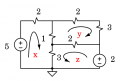
This is the reasoning I applied for your exercise:

MESH.png

How would you write the equations following the directions of the currents ?
But whatever current direction you choose, you just have to respect the signes.

PS: I used Cramer method, obtaining the correct result.
 
Last edited:

MrAl

Joined Jun 17, 2014
13,704
Hello I am struggling a on a few problems however I was also able to solve a few of them . I was able to figure out number one just fine.

ON two I dont know if he gave us the wrong answer but my answer is close but not exact. Then on the last one I have no idea.

So on #2 I ended up doing the sum of

Ia= -5v + 2ia + 1(ia-ib) +3(ia + ib) =0

ib= 2ib +3 ib - 2(ib - ic) + 1(ib-ia) = 0

ic= -2v +2(ic-ib) + 3(ic-ia)=0

After I get matrices inputted I get:
ia= .679
ib=.194
ic=.729

When I multiply it out it's close but not his exact anwser of 2.17

Then on three I dont know how to solve with 3 meshs like that only two so any help is appreciated.
Hi,

In your second circuit, you have two sources labeled "5V" and "2V", but you also have a voltage labeled "V".
Are these two sources both independent sources or is one of them (or both of them) dependent on V ?
For example 2V could mean 2*V which would then make it a dependent source, not a 2 volt independent source.
 

RBR1317

Joined Nov 13, 2010
715
The usual method to handle a current source in mesh analysis is to identify mesh currents for all of the apparent meshes, but apply the voltage law only to the topological meshes (the meshes that remain when sources are zeroed) and create a constraint equation for the current source (as the difference between two of the mesh currents).
Screenshot from 2017-02-01 21-24-43.png
Screenshot from 2017-02-01 21-22-02.png
 

RBR1317

Joined Nov 13, 2010
715
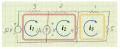
When using mesh currents the method has a few rules: Mesh currents always circulate in the same direction, then the mesh equations always have the same framework (as shown). When filling in the framework, keep the resistance values separate: it keeps a direct link to the circuit and makes it easy to check for errors. I like to keep the voltage sources separate on the other side of the equation from the mesh currents, so follow the mesh in the opposite direction of the current to get the sign of the voltage source. If you follow the simple rules, then writing mesh equations is just a mechanical process that does not require much thought.
_Doug_2.png
Screenshot from 2017-02-02 11-44-29.png
 

WBahn

Joined Mar 31, 2012
32,840
No, the mesh currents do not all have to be in the same direction, but the advantage of doing so was explicitly stated, namely a highly self-consistent framework. So consistent that it is usually possible to write down the mesh equations as simultaneous equations by inspection AND do quick sanity checks such as verifying that only the diagonal terms on the left are positive and that they are symmetric about the diagonal.
 

shteii01

Joined Feb 19, 2010
4,644
No true at all. :rolleyes: I didn't use the same direction for all currents (in my post, z is in opposite direction respect to x & y).

Regards,
thumb2
You are correct.
However.
The respected universities teach to setup mesh currents to go in the same direction. I am graduate of one such university, Purdue University, I was taught to setup the mesh currents in the same direction. That is the method that I used to solve problem number two. That is how I found answer that agrees with the answer that instructor provide to OP.
 
Top