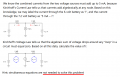
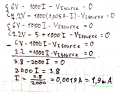
Can anyone explain how to solve this problem without simultaneous equations as pointed in the question? I can solve it only with simultaneous equations: But i really have no point how to solve it another way
Hi. No i didn't read about impedance yet. I'm going through the textbook gradually so I'm here right know https://www.allaboutcircuits.com/textbook/direct-current/chpt-10/mesh-current-method/. Have read the topic recently and wanted to make the worksheet on this topic. Looks like worksheet doesn't match the level of the current point of textbook?
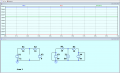
the red line shows the current through R1 and R2 from positive terminal of the V1 (conventional current). V2 oppose it, so the total voltage in the series resistors will be 7.2-6= 1.2V 1.2/2000 = 0.6mA. The blue line shows the current through R3 and R4, V3 and V4 have 0V so nothing oppose the current from permanent source of current 5m. It splits to 2.5mA since R3 and R4 connected in parallel to this source of current. Hmmmmmm got it in the exactly the moment after had finished previous sentence and tried to figure out what for the green line and what it denote in the provided scheme . This is the difference between the red and blue lines! 2.5mA - 0.6mA = 1.9 mA. But wait, in the question's scheme the source of current directed in the opposite side. How is it interrelates? Why the difference in current between batteries and current source directed against each other exactly the same as current through the R1 from the question's scheme?
Can anyone explain how to solve this problem without simultaneous equations as pointed in the question? View attachment 344102 I can solve it only with simultaneous equations: View attachment 344104 But i really have no point how to solve it another way
To some degree it is a case of semantics regarding what constitutes using simultaneous equations.
Consider the following approach (which many students would take naturally because they haven't become comfortable with setting up and solving systems of simultaneous equations).
Call the voltage at the middle junction Vo.
Ohm's Law tells us that
I1 = (6 V - Vo) / 1 kΩ
I2 = (7.2 V - Vo) / 1 kΩ
where I1 is the current left-to-right in the left resistor (the I that is defined in the problem) and I2 is the current right-to-left in the right resistor.
KCL at the middle junction tells us that
I1 + I2 = 5 mA
[ (6 V - Vo) / 1 kΩ ] + [ (7.2 V - Vo) / 1 kΩ ] = 5 mA
(6 V - Vo) + (7.2 V - Vo) = (5 mA)·(1 kΩ) = 5 V
13.2 V - 2·Vo = 5 V
Vo = (13.2 V - 5 V) / 2 = 4.1 V
I1 = (6 V - Vo) / 1 kΩ = (6 V - 4.1) / 1 kΩ = 1.9 mA
Did I use simultaneous equations?
Different people will answer that differently. Some will focus on "simultaneous equations" as being a particular technique of algebraic manipulation and say that I did not, while others will point out that I set up three equations that had to be satisfied simultaneously and, thus, I solved a set of simultaneous equations regardless of the manipulation technique I used to do so.
As an aside, let's see a little game that I could have played to get at I1 without solving for Vo (there are multiple ways to do this, but this one just jumped out at me because of the specifics of this problem's values).
I1 = (6 V - Vo) / 1 kΩ
I2 = (7.2 V - Vo) / 1 kΩ
But since we know that we want I1 and don't really care about Vo or I2, let's write I2 as follows:
I2 = (6 V + 1.2 V - Vo) / 1 kΩ = [(6 V - Vo) / 1 kΩ] + [1.2 V / 1 kΩ] = I1 + 1.2 mA
From here, the answer falls out immediately
I1 + I2 = 5 mA
I1 + I1 + 1.2 mA = 5 mA
I1 = 1.9 mA
Has the two resistances been different, playing this game would have been more difficult and probably wouldn't have even suggested itself to me.
As an aside, let's see a little game that I could have played to get at I1 without solving for Vo (there are multiple ways to do this, but this one just jumped out at me because of the specifics of this problem's values).
I1 = (6 V - Vo) / 1 kΩ
I2 = (7.2 V - Vo) / 1 kΩ
But since we know that we want I1 and don't really care about Vo or I2, let's write I2 as follows:
I2 = (6 V + 1.2 V - Vo) / 1 kΩ = [(6 V - Vo) / 1 kΩ] + [1.2 V / 1 kΩ] = I1 + 1.2 mA
From here, the answer falls out immediately
I1 + I2 = 5 mA
I1 + I1 + 1.2 mA = 5 mA
I1 = 1.9 mA
Has the two resistances been different, playing this game would have been more difficult and probably wouldn't have even suggested itself to me.

 Facebook
 Google
 GitHub
 Linkedin