Facebook
 Google
 GitHub
 Linkedin
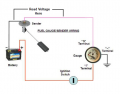
So my frame of reference her is a 1971 Camaro, with a standard GM 0-90 ohm rheostat style fuel level sender, but I suspect the conceptual circuit I'm about to describe is probably universally applicable.
My aftermarket fuel gauge has a built in buffer/dampener circuit such that the needle doesn't respond to quick transient type of float arm movement... i.e., going around a turn, short term acceleration/deceleration, etc.
But given enough time, like steadily going up or down a hill, a sustained period of acceleration/deceleration, the needle will react to it.
It works "ok", but I'd like to see if I could get the more steady behavior of newer cars.
I searched around for something commercially available, but everything I see is just another glorified add-on dampener circuit.
What I"m envisioning is the following, but I'm a mechanical engineer, not electrical.
A device that only samples the fuel level when on straight/level ground and not in the presence of acceleration/deceleration. So my mind immediately goes to a mercury switch. It would interrupt the signal wire to the gauge when not in a straight/level steady-state condition.
The only problem is, when I disconnect the signal wire by hand, the gauge needle goes to empty, so that would be annoying.
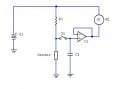
So the other aspect of this device is that when it reads the fuel level, it saves that reading. Then when the device interrupts the signal wire, it sends the last known good reading to the gauge (that way the gauge stays on the current needle position), until such time that the car is back in straight/level steady state... at which point it takes another sample reading of the fuel level and communicates to the gauge.
Any thoughts on how this could be done? Or if there is such a device commercially available or could be adapted to this application?
Thanks!
My aftermarket fuel gauge has a built in buffer/dampener circuit such that the needle doesn't respond to quick transient type of float arm movement... i.e., going around a turn, short term acceleration/deceleration, etc.
But given enough time, like steadily going up or down a hill, a sustained period of acceleration/deceleration, the needle will react to it.
It works "ok", but I'd like to see if I could get the more steady behavior of newer cars.
I searched around for something commercially available, but everything I see is just another glorified add-on dampener circuit.
What I"m envisioning is the following, but I'm a mechanical engineer, not electrical.
A device that only samples the fuel level when on straight/level ground and not in the presence of acceleration/deceleration. So my mind immediately goes to a mercury switch. It would interrupt the signal wire to the gauge when not in a straight/level steady-state condition.
The only problem is, when I disconnect the signal wire by hand, the gauge needle goes to empty, so that would be annoying.
So the other aspect of this device is that when it reads the fuel level, it saves that reading. Then when the device interrupts the signal wire, it sends the last known good reading to the gauge (that way the gauge stays on the current needle position), until such time that the car is back in straight/level steady state... at which point it takes another sample reading of the fuel level and communicates to the gauge.
Any thoughts on how this could be done? Or if there is such a device commercially available or could be adapted to this application?
Thanks!