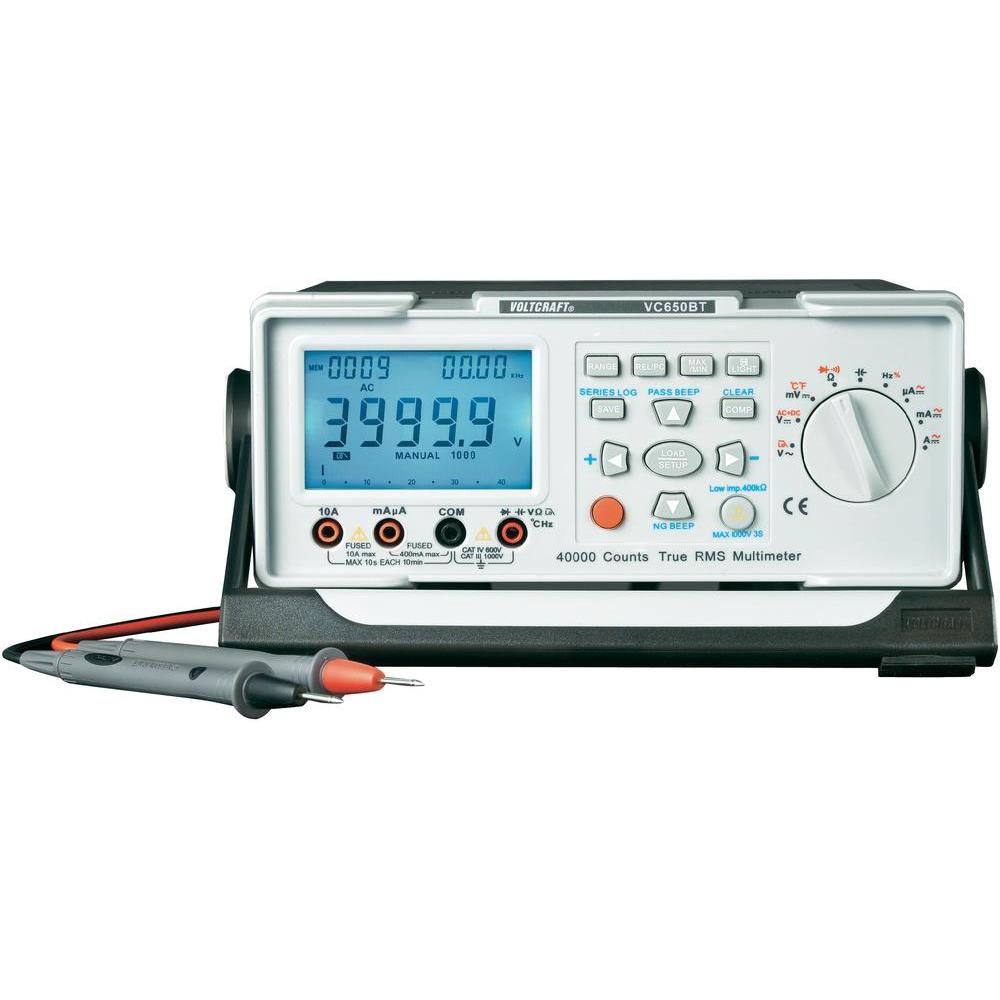
Measuring Current with a Voltcraft VC650BT

Thread Starter

haroldjclements

Joined Nov 8, 2017
9
Hello Forum, I was wondering if anyone had any experience with the Voltcraft VC650BT; in particular how to measure current. I have had this meter for over a year but have not had time for many electronics projects recently. This is the first time that I have tried to measure current.

As a test circuit, I have 3 AA batteries (4.5v) flowing through a 10K resistor. I have moved my probe wires to mA and set the dial to the same. Without anything connected, the meter starts beeping and displays a warning. As soon as I put the positive probe to the positive side of the battery and connect the negative side to the positive side of the circuit (in parallel), the beeping and warning stops, but reads 0.0000 and no voltage flows through the circuit. I did the same test with a £10 meter and had a reading.

Does anyone have any suggestions?

Thank you in advance,
Harold Clements
 

MrChips

Joined Oct 2, 2009
34,807
You have committed a common newbie cardinal sin.
Looks like you have blown the internal 400mA safety fuse in the meter.


In order to measure current, the black probe remains in the black COM jack. The red probe is plugged into the red 10A jack if you anticipate that the current to be measured will be greater than 400mA. That is the place to begin with the range switch set to A when measuring current .

Once you have verified that the current measured is lower than 400mA you can plug the red probe into the red mAμA jack and change the range setting to mA.

The meter emits a warning beep if the probes are not in the correct place with respect to measuring voltage vs current.

Secondly, the purpose of the ammeter is to measure current flowing through a circuit without impeding the flow of current. Hence the internal resistance of the ammeter is very low (a few ohms). If you put an ammeter across a voltage source, the current I = V/R is huge and you will blow the internal fuse.

To measure current through a circuit, you must break the circuit and insert the ammeter in series with the circuit. It is the resistance of the circuit that will limit the current and prevent the fuse from blowing. Exceed the 400mA and the fuse will blow.
 

Thread Starter

haroldjclements

Joined Nov 8, 2017
9
Thanks 'MrChips', I would like to clarify my statement above. I did have my meter in series and not parallel as I mistakenly rote above.
However, I did not put it on the 10A first as I know that my circuit was drawing 250mA at most... So maybe I did something inadvertently stupid.

I guess changing the fuse should not be too hard to do... or at least check that it has blown...

Again, thank you for your response...
Harold
 

MrChips

Joined Oct 2, 2009
34,807
Thanks 'MrChips', I would like to clarify my statement above. I did have my meter in series and not parallel as I mistakenly rote above.
However, I did not put it on the 10A first as I know that my circuit was drawing 250mA at most... So maybe I did something inadvertently stupid.

I guess changing the fuse should not be too hard to do... or at least check that it has blown...

Again, thank you for your response...
Harold
It did occur to me that there is a possibility that the fuse was blown sometime in the past.
 

Thread Starter

haroldjclements

Joined Nov 8, 2017
9
Yes, very true....

The fuse was easy enough to get to, and I can confirm it has blown...

So off to the hardware store...

Thanks once more...
 
Top