Measuring coil emf

Thread Starter

Anish723

Joined Apr 26, 2015
9
I need to measure the emf of relay coils.

Measuring is done by energizing the relay coil with the nominal voltage and de-energizing the coil, and at that moment the voltage is sampled. That negative voltage need to be sampled and read using ADC.

But the problem is that in actual condition an emf of 0 to 150 V will be generated and we need to measure the emf ranging from 0 to 50 V with a precision of 0.01 V DC.

Since the emf is momentary and need to be measured, we are doing with sample and holding technique. But the voltage need to be sampled varies from 0 to 50 V, we are not able to identify the correct resources. Also an excess voltage of 50 - 150 V needs to be eliminated for a better performance.

Please help in this regards.
 

The Electrician

Joined Oct 9, 2007
2,986
I need to measure the emf of relay coils.

Measuring is done by energizing the relay coil with the nominal voltage and de-energizing the coil, and at that moment the voltage is sampled. That negative voltage need to be sampled and read using ADC.

But the problem is that in actual condition an emf of 0 to 150 V will be generated and we need to measure the emf ranging from 0 to 50 V with a precision of 0.01 V DC.

Since the emf is momentary and need to be measured, we are doing with sample and holding technique. But the voltage need to be sampled varies from 0 to 50 V, we are not able to identify the correct resources. Also an excess voltage of 50 - 150 V needs to be eliminated for a better performance.

Please help in this regards.
How much money do you have in your budget to buy equipment?
 

Thread Starter

Anish723

Joined Apr 26, 2015
9
How much money do you have in your budget to buy equipment?
Actually i need to incorporate this feature in an ongoing project. Project is an automatic relay testing station which ensures the parameters of a relay are within spec or not and coil emf is a parameter to be measured.
 

Alec_t

Joined Sep 17, 2013
15,114
Also an excess voltage of 50 - 150 V needs to be eliminated for a better performance.
I don't see how that is consistent with measuring to a precision of 0.01VDC :confused:. How will you compare a batch of relays which all generate a back-emf >50V ?
 

Thread Starter

Anish723

Joined Apr 26, 2015
9
I don't see how that is consistent with measuring to a precision of 0.01VDC :confused:. How will you compare a batch of relays which all generate a back-emf >50V ?
There will be a selection for the nominal voltage, free wheeling diode across coil selection in the operator interface software, by which some circuits can be switched for eliminating the excess 50 to 150 V.

Besides 0.01 V precision, how the voltage spikes of 0 to 50 V measured. Please help if you have idea.
 

tcmtech

Joined Nov 4, 2013
2,867
Sounds like you are over engineering a simple process. :rolleyes:

Step one: Check coil resistance and if its between the intended upper and lower limits go to step two.

Step two: Apply power and see if the relay pick up and drops out within acceptable upper and lower time limits with free wheeling diode in place.
 

crutschow

Joined Mar 14, 2008
38,449
I agree with tcmtech.
I see no purpose in measuring the back EMF of a relay coil since that is normally suppressed in the circuit in which it is used. :confused: Who suggested that it be measured?

You can measure the coil inductance since that is what causes the back EMF and it is much easier to measure accurately. But even that seems unnecessary.

I see no reason to measure anything besides the relay coil resistance (or operating current) and its pull-in and drop-out voltage. What's the purpose of measuring anything else?
 

ebeowulf17

Joined Aug 12, 2014
3,307
Isn't the emf readily calculated if the inductance is known? There are meters to test inductance, and there are several ways to build such tests into your own circuit, at least according to this:

http://m.wikihow.com/Measure-Inductance

This is over my head and only theoretical to me, but sounds like a more approachable problem than measuring the emf directly.

EDIT: I see crutschow beat me to it, and then some!
 

AnalogKid

Joined Aug 1, 2013
12,102
Isn't the emf readily calculated if the inductance is known? There are meters to test inductance, and there are several ways to build such tests into your own circuit, at least according to this:

http://m.wikihow.com/Measure-Inductance

This is over my head and only theoretical to me, but sounds like a more approachable problem than measuring the emf directly.

EDIT: I see crutschow beat me to it, and then some!
Like like like like...
 

Thread Starter

Anish723

Joined Apr 26, 2015
9
Thank you all for your replies

Coil resistance, pick up and drop out parameters are being measured in the concerned system. But the customer requirement is to measure the coil emf too, so there is no way to go. Have to measure the same:(..
 

Alec_t

Joined Sep 17, 2013
15,114
The coil back-emf will depend strongly on circuit parameters such as source and wiring impedances and switch-off speed. How will you factor those in?
 

crutschow

Joined Mar 14, 2008
38,449
I think you need to convince the customer that the back EMF measurement is a poor parameter to measure since it is highly dependent on the circuit parasitic capacitances, and other uncontrolled and variable parameters.

The coil inductance is what generates the back EMF and that is what should be measured if back EMF is a concern.
 

Thread Starter

Anish723

Joined Apr 26, 2015
9
The coil back-emf will depend strongly on circuit parameters such as source and wiring impedances and switch-off speed. How will you factor those in?
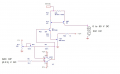
Voltage source to the relay test coil is programmed from a DAC (circuit attached). Circuit is capable of generating 0 to 50 V DC. If for example relay is having a nominal voltage of 24 V DC, DAC will program a 24 V to the test coil for a moment and then to zero. Switching speed will be in the order of 0 to 10 ms.

Wiring impedance will be considerably very low, since the testing socket is very near to the testing system.

upload_2015-5-17_14-42-39.png

Regards,
Anish
 

Thread Starter

Anish723

Joined Apr 26, 2015
9
I think you need to convince the customer that the back EMF measurement is a poor parameter to measure since it is highly dependent on the circuit parasitic capacitances, and other uncontrolled and variable parameters.

The coil inductance is what generates the back EMF and that is what should be measured if back EMF is a concern.
In the meanwhile will try to convince the customer.
 

Alec_t

Joined Sep 17, 2013
15,114
Voltage source to the relay test coil is programmed from a DAC (circuit attached).
Actually, your circuit is a controlled current source for the relay. The voltage across the coil will therefore depend on the coil's resistance.
Switching speed will be in the order of 0 to 10 ms
If the switch-off speed is that variable then the back-emf will be equally variable. You're not seriously using a 741 opamp for switching control, are you? It's pretty sluggish. Have you considered the effect of temperature on the switching characteristics of Q1 and Q2?
 

Thread Starter

Anish723

Joined Apr 26, 2015
9
Actually, your circuit is a controlled current source for the relay. The voltage across the coil will therefore depend on the coil's resistance.
If the switch-off speed is that variable then the back-emf will be equally variable. You're not seriously using a 741 opamp for switching control, are you? It's pretty sluggish. Have you considered the effect of temperature on the switching characteristics of Q1 and Q2?
If I can use a relay contact at the collector of Q2 to the test coil for switching off, will it be reliable?
 

Alec_t

Joined Sep 17, 2013
15,114
I guess that depends on the relay ;). Contact resistance and relay drop-out (hence contact-opening) time are likely to vary as the relay ages.
 

ErnieM

Joined Apr 24, 2011
8,415
I've been in this same place when designing the test stand for a relay time delay controller. One of the importaint measurements was the spike voltage; that insured the clamp diode was installed correctly.

This is an acceptance test, that is a test to insure what was built was correctly built to plan.

While I completely agree the test needs be done I don't see the need for the 0.1V resolutuon: it simple needs to be within some limits. If the limits are say 40-50V and your measurement device is only good to 0.5V, then insuring the device is between 40.5 and 49.5V means it is good.

When I built my test stand I was not concerned with measuring the voltage but seeing it was below some maximum. I have a 28V relay with a 36V zener clamp so my spike was in the 64 volt range for normal operation, but would hit 300V when the clamp wasn't there. I just used a fast zener to clip away any pulses under 75 volts, so bad parts would give a pulse. Obviously this test was go/no go and have no variable data.

I wouldn't spend much time on the circuit you designed, there are several fundamental errors. You do want to drive from a voltage source, plus the relay voltage at the emitter of Q2 will go negative for the spike. You want to make a fixed voltage there and switch the end you ground: that gives you a positive voltage to measure. Keep in mind this voltage is the transient PLUS the supply voltage, so you may need to do a subtraction.

There is no reason you can't use a transistor, MOSFET, relay, or anything to do the switch. Just properly derate it and I would also protect it with a zener or transorb to catch large spikes when the supression coil is missing.
 

Thread Starter

Anish723

Joined Apr 26, 2015
9
I've been in this same place when designing the test stand for a relay time delay controller. One of the importaint measurements was the spike voltage; that insured the clamp diode was installed correctly.

This is an acceptance test, that is a test to insure what was built was correctly built to plan.

While I completely agree the test needs be done I don't see the need for the 0.1V resolutuon: it simple needs to be within some limits. If the limits are say 40-50V and your measurement device is only good to 0.5V, then insuring the device is between 40.5 and 49.5V means it is good.

When I built my test stand I was not concerned with measuring the voltage but seeing it was below some maximum. I have a 28V relay with a 36V zener clamp so my spike was in the 64 volt range for normal operation, but would hit 300V when the clamp wasn't there. I just used a fast zener to clip away any pulses under 75 volts, so bad parts would give a pulse. Obviously this test was go/no go and have no variable data.

I wouldn't spend much time on the circuit you designed, there are several fundamental errors. You do want to drive from a voltage source, plus the relay voltage at the emitter of Q2 will go negative for the spike. You want to make a fixed voltage there and switch the end you ground: that gives you a positive voltage to measure. Keep in mind this voltage is the transient PLUS the supply voltage, so you may need to do a subtraction.

There is no reason you can't use a transistor, MOSFET, relay, or anything to do the switch. Just properly derate it and I would also protect it with a zener or transorb to catch large spikes when the supression coil is missing.
Thank you for the informative.
 
Top