Measuring inductance of a large coil with oscilloscope

Thread Starter

Simranjit

Joined Apr 16, 2024
41
Hi everyone, I will try to be as descriptive as possible

Problem: Large coil not resonating at resonant frequency. I am trying to verify the calculated result of 281.2mH of large coil with oscilloscope.

What have I tried:
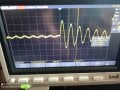
Measure resonant frequency of another small coil successfully. I will attach picture of my small coil resonating with 100n capacitor.
I have tried using using capacitors of different values ( 1u, 100n, 10n, 1n, 100p, 10p ) with large coil. At 1u the signal on oscilloscope is almost flat at 5v. Decreasing the value of capacitor just gives sharper signal of square wave I'm generating with Arduino.

Specifications of small coil:
Resonant frequency = 86kHz (from oscilloscope, see picture below)
Inductance = 36uH ( https://www.omnicalculator.com/physics/resonant-frequency-lc )

Specifications of large coil:
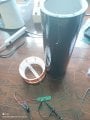
Diameter coil = 15.35cm (7.675cm radius)
Wire diameter = 0.1601 mm (34 AWG)
Coil height = 39.5cm
Coil resistance = 979 ohms = 3753 feet = 114391.4 cm ( https://cirris.com/wire-resistance-calculator/#quick-calculator )

Calculated result = 2372 turns ( https://www.calctool.org/electromagnetism/helical-coil )
281.2 mH
 

Attachments

sparky 1

Joined Nov 3, 2018
1,218
The coil should be up off the floor, hang it up using a string.
A fast intense high voltage spark near the coil is also much like the captured image.
It shows the a ringing dampened wave with 6 iterations which is indicative of a resonance.

Why test just the coil alone and then the coil and capacitor?
Because the capacitance in the leads or coax makes a difference at high voltage due to
skin effect and other effects could be overlooked.
The circuit shown is correct but when you ask about inductance of the large coil which has
many windings and self capacitance the self resonant test is also relevant, because you are measuring resonance.
To understand we need to know basics of Current, Voltage and Frequency to understand.

Tesla or Ruhmkorf had a spark gap, they could adjust the gap estimating voltage

What about current and phase?
The schematic you are using might imply Thompson with yet another different effect.
The energized coil performs real work on the aluminum ring, Faraday/Thompson!
 
Last edited:

crutschow

Joined Mar 14, 2008
38,320
You large coil is highly damped with its large series resistance so the Q is low, generating no significant oscillations.

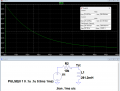
You could try measuring the coils L/R time-constant by looking at the output voltage decay (LTspice sim below):
One L/R time-constant is where the voltage decays 0.632 of the total decay (here about 0.569V of the total 1V to 0.1V).
Note that the R is the total of R2 plus the inductor resistance.

1720531955314.png
 

MrAl

Joined Jun 17, 2014
13,667
Hi everyone, I will try to be as descriptive as possible

Problem: Large coil not resonating at resonant frequency. I am trying to verify the calculated result of 281.2mH of large coil with oscilloscope.

What have I tried:
Measure resonant frequency of another small coil successfully. I will attach picture of my small coil resonating with 100n capacitor.
I have tried using using capacitors of different values ( 1u, 100n, 10n, 1n, 100p, 10p ) with large coil. At 1u the signal on oscilloscope is almost flat at 5v. Decreasing the value of capacitor just gives sharper signal of square wave I'm generating with Arduino.

Specifications of small coil:
Resonant frequency = 86kHz (from oscilloscope, see picture below)
Inductance = 36uH ( https://www.omnicalculator.com/physics/resonant-frequency-lc )

Specifications of large coil:
Diameter coil = 15.35cm (7.675cm radius)
Wire diameter = 0.1601 mm (34 AWG)
Coil height = 39.5cm
Coil resistance = 979 ohms = 3753 feet = 114391.4 cm ( https://cirris.com/wire-resistance-calculator/#quick-calculator )

Calculated result = 2372 turns ( https://www.calctool.org/electromagnetism/helical-coil )
281.2 mH

Hello there,

I was talking to someone on the phone recently about a similar problem.

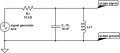
I am not entirely sure what you are doing here though because you say you are testing the resonant frequency of the coil, yet you seem to be testing for the resonant frequency of a coil in parallel with a capacitor, and fed by a resistor. Maybe you could explain that.

There are a few things we can talk about here also...

For the first thing, resonance is not exactly the same as a ringing. The difference between the resonant frequency and the ringing frequency can be quite substantial. They can also be close. It all depends on the damping factor. Keep in mind that ringing damps out while true resonance does not.

For the second thing, you won't see ringing unless this condition is satisfied:
Rs^2*C^2*RL^2-2*Rs*C*L*RL+L^2-4*Rs^2*C*L<0

That's where RL is the resistance in series with the inductor (inductor ESR) and Rs is the total resistance in series with the source. So you can see that Rs is a part of this too not just RL. All components: Rs, RL, C, and L are all involved in the damping factor, and also the source internal resistance is part of Rs.
That condition above is when the critically damped response turns into a sinusoidal response with exponential damping. If that is not satisfied, there is no sinusoidal component.

You might get better results if you place a fast diode like a 1N5817 in series with the source. That pings the LC part then lets it ring.
 
Last edited:

MisterBill2

Joined Jan 23, 2018
27,181
You can use a scope with the 10X probe across the large coil, and drive it with a second coil of a few turns, fed from a signal source. That will allow you to find a resonance close to actual, you will need to add a series resistor to the scope connection to reduce that small amount added by the scope probe.

AND, that is an awesome coil. Please let us know whan you get that project finished.
 
Top