Measuring a motor's back EMF

WBahn

Joined Mar 31, 2012
32,875
You've hit the nail on the head with that one... analysis paralysis is my main weakness.... I want to achieve about 8% of the motor's rated RPM's.
And you might be on to something... but now that I think of it, maybe I'm being too demanding since I want to control the motor's speed to very low RPM's ... say, if a motor is rated at 1,200 rpm (unloaded), I'd like to be able to run it all the way down to 30 ... and I doubt that the back EMF would be strong enough and clean enough to be able to do something with it ... so maybe for this application a medium resolution encoder would be the way to go.
Something isn't jiving. If the rated speed of the motor is 1,200 rpm, then 8% of that is 96 rpm. So you seem to be saying that the accuracy on your measurement is within about 100 rpm (perhaps plus or minus 50 rpm?). But then you say that you want to operate all the way down to 30 rpm.

Perhaps we aren't in agreement about what was asked. I took GopherT's question to be how accurate do you need your rpm measurement to be? If your measurement claims the motor is turning at 30 rpm, what is the slowest and fasted it can actually be turning and your system still be considered to be successfully in control?
 

GopherT

Joined Nov 23, 2012
8,009
You've hit the nail on the head with that one... analysis paralysis is my main weakness.... I want to achieve about 8% of the motor's rated RPM's.
So if you are somewhere between 6 and 10% will you be happy?

That gives you a huge range to play with. A 12V motor, you'll get 0.72 to 1.2V back EMF. If you have protection diodes in there, and high-side vs low side switching will have to be accounted for.

What are you thinking?
 

Thread Starter

cmartinez

Joined Jan 17, 2007
8,768
Something isn't jiving. If the rated speed of the motor is 1,200 rpm, then 8% of that is 96 rpm. So you seem to be saying that the accuracy on your measurement is within about 100 rpm (perhaps plus or minus 50 rpm?). But then you say that you want to operate all the way down to 30 rpm.

Perhaps we aren't in agreement about what was asked. I took GopherT's question to be how accurate do you need your rpm measurement to be? If your measurement claims the motor is turning at 30 rpm, what is the slowest and fasted it can actually be turning and your system still be considered to be successfully in control?
Ok... let me clarify, I'm not throwing numbers around just for the sake of it. Maybe what I have in mind is too broad an application. In one, I'd like to see how low I can go in an almost unloaded, permanent magnet DC motor (it's a feeding application), and in the other one I'd be regulating the speed of a self-excited-type drill motor, which requires a constant speed under varying load conditions. That's the why of my previous ball park numbers...

At this point, I'm currently re-reading this very interesting document that Ray so generously reminded me about:


I hadn't realized that there were so many different techniques to regulate the speed of a brushed type of motor. But then again, I'm trying to avoid the trap that Gopher warned me about...
 

Bernard

Joined Aug 7, 2008
5,784
On a 12 V DC motor with a 20 slot code wheel at very low control V motor advances slot to slot like a step motor, about 30 RPM. So ??
 

Thread Starter

cmartinez

Joined Jan 17, 2007
8,768
On a 12 V DC motor with a 20 slot code wheel at very low control V motor advances slot to slot like a step motor, about 30 RPM. So ??
That should do it. A 20 slot code wheel can be turned into a 40-pulse resolver... but I very much doubt it will behave like a step motor, with its jittering and all... I expect it will run smoother... guess I'll just have to build it and see
 

MrAl

Joined Jun 17, 2014
13,708
Hi,

This question actually comes up a lot on the web.

Old cassette players used a transistor circuit that took advantage of the back emf of the motor to regulate speed and did pretty well. The back emf is proportional to shaft speed so it's reasonable to measure it to use as feedback for a motor speed control circuit.

The analog back emf in steady state is:
Vb=w*Kb

where
w is the angular speed,
Kb is the 'back emf' constant of the motor.

Pretty tough huh? :)

The armature current in steady state is:
Ia=(Va-Vb)/Ra

which is very easy to visualize because the internal drive voltage is Va-Vb, and thus the back emf voltage is:
Vb=Va-Ra*Ia

Now of course the logical question is, what is Ra and how do we find it?

Ra is of course the armature resistance, which you can roughly measure, but trial and error in a working system will get you there too. The old cassette players used to provide a cheap trim pot to accomplish this.

To use this in a feedback system we measure Ia and Va, subtract Ra*Ia from Va with an op amp, then use that as negative feedback to adjust Va. As we vary Ra we will find that at some point when we place additional load on the motor shaft (with a finger on small systems like the cassette player) the speed stays constant, but with other values it still changes either getting slower or faster.
The last part is we may want to integrate the feedback signal to get stable operation.
The whole circuit can be one LM358 op amp for example with drive transistor and some small parts like resistors and capacitors.

So that's the description of the analog method used in various control systems.
For more dynamic systems the inductance factor can also be included in the system feedback.
 

Thread Starter

cmartinez

Joined Jan 17, 2007
8,768
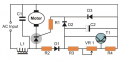
I found the following circuit, obtained from this link.

Capture.PNG
Back EMF Looped, AC Motor Speed Controller Circuit. SCR Controlled, Closed Loop Type, AC Motor Speed Controller Circuit Diagram.
The shown circuit of a back EMF, closed loop AC motor speed controller is presented on request from Mr. Amir, the circuit has the following salient features:

  • Can be operated with high current AC loads
  • The torque is directly proportional to the load
  • The back EMF from the motor winding is used as reference for automatically adjusting the torque, as the load is increased.

Parts List:
  • R1 = 56K
  • R2 = 33K
  • R3 = 15K
  • R4 = 22K
  • D1, D2, D3 = 1N4007
  • T1 = BC547B
  • SCR = As per the specified load current
  • C1 = 104/1KV, PPC
  • C2 = 100uF/100V
  • L1 = 30 to 50 uH, 6 Amp.


Questions:

Although I more or less understand how a triac works and is triggered, I'm not sure how this thing is supposed to work. Also, no value is given for VR1. Would it be possible to sim it in LTSpice?
 

Thread Starter

cmartinez

Joined Jan 17, 2007
8,768
Agreed, but the symbol and description should match, with Triac there is no confusion with the single SCR device.
Max.
That's one of the reasons why I'm a little wary of the circuit... not gonna build the thing until I understand how it works... and it seems that the author has made one or two omissions, besides the very salient point of his not bothering to explain how it works
 

MrAl

Joined Jun 17, 2014
13,708
Hi,

Yes i thought it was a DC motor at first.

Also yes that there should be an explanation of WHY it works, that is, what principles it is working under.
I would have to look at it closer and maybe do a simulation, but i'd want to see something in there that measures current too in order to make use of the 'back emf'.
 

kubeek

Joined Sep 20, 2005
5,796
Doesn't look right to me, back emf is related to speed, so I don't understand the connection to torque there. Maybe it is constant speed and therefore it doesn't care about the torque?
 

Thread Starter

cmartinez

Joined Jan 17, 2007
8,768
Doesn't look right to me, back emf is related to speed, so I don't understand the connection to torque there. Maybe it is constant speed and therefore it doesn't care about the torque?
Yes, that's what I understand in the sentence: "The back EMF from the motor winding is used as reference for automatically adjusting the torque, as the load is increased." ... the circuit is supposed to control speed, and for it to remain constant, it has to adjust current according to the load, and hence, torque.
 

MrAl

Joined Jun 17, 2014
13,708
Doesn't look right to me, back emf is related to speed, so I don't understand the connection to torque there. Maybe it is constant speed and therefore it doesn't care about the torque?
Hi there,

The back emf is also related to the armature current and the resistance, so measuring the current and assuming the resistance is a method used for controlling motor speed.
A guess might be that they use L1 to measure current, but this would have to be checked.

Also it says "AC motor speed controller" but they dont specify if the motor is DC or AC, as they might mean the *circuit* is *run* by AC even though a DC motor is used.


Anyone care to build one ? :)
 

Alec_t

Joined Sep 17, 2013
15,121
If the SCR were in fact a triac, I think that circuit will fire the triac close to the start of alternate half cycles but will delay the firing in the other half cycles. So you'd get some sort of speed control.
Anyone got a good Spice model for an AC or universal motor?
 

MaxHeadRoom

Joined Jul 18, 2013
30,672
There was this in the feedback "Back EMF Looped, AC Motor Speed Controller Circuit I have tried this circuit and it does not work.....'
Max.
 

Thread Starter

cmartinez

Joined Jan 17, 2007
8,768
If the SCR were in fact a triac, I think that circuit will fire the triac close to the start of alternate half cycles but will delay the firing in the other half cycles. So you'd get some sort of speed control.
Anyone got a good Spice model for an AC or universal motor?
Right... clever observation... the diodes' arrangement seems to confirm that. So maybe the circuit is powering the motor on the positive half of the sinewave, and it's using the negative side to "measure" the back EMF, by charging C2 through T1, which is being controlled by the pot configured as a rheostat...

That would make for a rather lousy speed controller, since it would only be able to extract up to 50% of the motor's total power. And it would maybe cause "jumpy" behavior...
 
Top