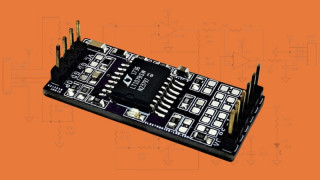
MCP6002 bias for audio

Thread Starter

rpschultz

Joined Nov 23, 2022
808
The MCP6002 is a rail to rail op amp that operates at up to 6v. My application is for use with an audio signal.
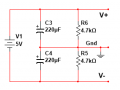
If I power at 5v, on a single sided supply, normally a voltage divider is used to put the signal in the middle, or in this case 2.5v.

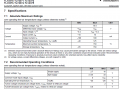
But it's common mode input range is Vss-0.3 and Vdd-1.2.
Or -0.3 - 3.8v. The midpoint of that is 1.8v.

Shouldn't I bias it to put the center of the signal there?
So instead of using a 1M||1M voltage divider, shouldn't I bias it like 1M||2M would put the signal at about 1.67v
 

nsaspook

Joined Aug 27, 2009
16,259
The MCP6002 is a rail to rail op amp that operates at up to 6v. My application is for use with an audio signal.
If I power at 5v, on a single sided supply, normally a voltage divider is used to put the signal in the middle, or in this case 2.5v.

But it's common mode input range is Vss-0.3 and Vdd-1.2.
Or -0.3 - 3.8v. The midpoint of that is 1.8v.

Shouldn't I bias it to put the center of the signal there?
So instead of using a 1M||1M voltage divider, shouldn't I bias it like 1M||2M would put the signal at about 1.67v
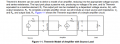
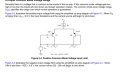
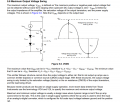
Read a little more OPAMP theory about input common mode specifications vs output level specifications.
https://www.ti.com/lit/an/sloa011b/sloa011b.pdf

1744986346399.png

1744986407693.png

1744986464591.png
 

Ian0

Joined Aug 7, 2020
13,100
That's some good information. But it doesn't explain how the input range can be MORE than the supply range. For a 5v supply it suggests the input range is -0.3 to 5.3, for a total range of 5.6v.
Unfortunately, Microchip doesn't put the internal circuit on its datasheet, but look at the LM358 datasheet for an example.
The input stage is a two pnp transistors one driving the other, therefore the emitter of the second is 1.3V above the base of the first. The collector can get almost to the emitter voltage, and that collector drives an NPN transistor which needs its base at about 0.6V.
So the collector of the 2nd input transistor can be at 0.8V, the base can be at about 0.2V which means that the 1st input transistor can have its base at about -0.4V and the circuit will still work.
 

nsaspook

Joined Aug 27, 2009
16,259
Yeah you're right. Foiled by chatgpt again!
Best advice you will get today, DON'T use chatgpt as a source of technical information. Every, never, never .... It has no understanding of what you ask about, it only makes good looking text garage at times that's indistinguishable from the good by beginners in technical fields. If you're a expert, it's OK as a unreliable source because you can easily see the BS but as a beginner, you won't know when your being spoon feed BS with sprinkles on it.
 

BobTPH

Joined Jun 5, 2013
11,474
That's some good information. But it doesn't explain how the input range can be MORE than the supply range. For a 5v supply it suggests the input range is -0.3 to 5.3, for a total range of 5.6v.
Why? That is typical of rail-to-rail amps, The 0.3 limit is because the Schottky protection diodes on inputs conduct at that point.

Common mode, by the way, means both inputs are at the same voltage. This does not imply you can have 5.6V between the two inputs. In an opamp operating linearly (not clipping) with negative feedback, the differential input is always will be tiny since it is amplified by about 100K.
 

Thread Starter

rpschultz

Joined Nov 23, 2022
808
So the TL072, is not rail to rail:

1744988481604.png

If I read that right, at 9v supply it will have a useful audio range of 1.5 - 7.5v?
 

BobTPH

Joined Jun 5, 2013
11,474
The input stage is a two pnp transistors one driving the other, therefore the emitter of the second is 1.3V above the base of the first
Of course the Microchip opamps are CMOS, and the gate voltage of MOSFETS can be a wide range above and below the source.
 

Thread Starter

rpschultz

Joined Nov 23, 2022
808
The TLV2372 is rail to rail. What's the difference between INPUT VOLTAGE and COMMON-MODE INPUT voltage. They are similar. But for this one I basically get full range input 0-9v on a single sided 9v supply.

1744988700206.png
 

Ian0

Joined Aug 7, 2020
13,100
Best advice you will get today, DON'T use chatgpt as a source of technical information. Every, never, never .... It has no understanding of what you ask about, it only makes good looking text garage at times that's indistinguishable from the good by beginners in technical fields. If you're a expert, it's OK as a unreliable source because you can easily see the BS but as a beginner, you won't know when your being spoon feed BS with sprinkles on it.
Here's an example:
I wondered what the wiring colour code was for wires that could be either AC or DC, and couldn't find the wiring regs book. I thought Google might give me the relevant page, but Google gave me its AI answer and told me what the colour code was.
I was sceptical and went to hunt down whichever colleague was the last to use the regs book, and identified the culprit. Then I was able to look up the relevant section and find that there is no colour code specified for wires which could be either AC or DC.
 

Ian0

Joined Aug 7, 2020
13,100
Of course the Microchip opamps are CMOS, and the gate voltage of MOSFETS can be a wide range above and below the source.
Agreed, but the only datasheets which show internal circuitry are OLD, before CMOS op-amps got good enough to be popular.
The same argument applies to TL071s which have P-channel JFET inputs which will work with inputs above the positive supply.
 

nsaspook

Joined Aug 27, 2009
16,259
Here's an example:
I wondered what the wiring colour code was for wires that could be either AC or DC, and couldn't find the wiring regs book. I thought Google might give me the relevant page, but Google gave me its AI answer and told me what the colour code was.
I was sceptical and went to hunt down whichever colleague was the last to use the regs book, and identified the culprit. Then I was able to look up the relevant section and find that there is no colour code specified for wires which could be either AC or DC.
Exactly. We are banned from using AI as technical references for work for this and other proprietary information reasons.

I never trust DC wiring on AC cables. I always check with a meter for terminal continuity or a tracing tone to +, - and GND connections on remote connections. I've used every color combination but the bare AC ground wire for +- power lines. The bare wire should never be a current carrying connector even with DC.

1744990190869.png1744990291518.png

Black negative, white positive because physical electrons move slowly from negative to positive in physics, so the black wire is HOT and the white wire is NEUTRAL. That's my self imposed standard for isolated power DC power systems. It's just a convention. but it's mine.
 
Last edited:
Top