Facebook
 Google
 GitHub
 Linkedin

Sometimes for my own edification I like to recreate the functional diagrams from IC datasheets in my iPad simulator and tinker with them to figure out how and why they work. Spot the current mirrors, the diodes, the diff pairs and you're usually off to a good start; figure out which parts make the device work and which parts are protection, compensation and correction for non-idealities and you've pretty much got it. But I'm stumped here and hoping someone with experience/industry knowledge can help.
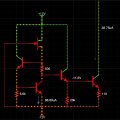
This little bit of biasing circuitry is not uncommon; I've seen versions of it all over the place in op amps. But it doesn't work *at all* in my simulator. On the original datasheet for this particular instance (the LM318, https://www.ti.com/lit/ds/symlink/lm318-n.pdf ) the 500Ω resistor is marked as trimmable so I'm guessing it was tested and modded during manufacture. The trouble is, changing the value of that resistor--at least in my simulator--does absolutely nothing. It doesn't modify the output (the long wire passing 36.75μA) in the slightest. The only thing that *does* seem to change it is altering the specs of the JFET. There's a narrow range of threshold voltage and gain where I get the 37ish μA output and going above or below that I don't get anything at all. Given that the LM318 is famously one of the first fast devices I find it kind of hard to believe it kicks things off with a diff pair that under-powered...but hey, it's also possible I don't know what the heck I'm talking about. (There's also obviously no clues about the proper specs for the JFET which I know are grown a different way from the bipolars so maybe they act really different than discrete ones?)
Any hints, insight or links much appreciated!
This little bit of biasing circuitry is not uncommon; I've seen versions of it all over the place in op amps. But it doesn't work *at all* in my simulator. On the original datasheet for this particular instance (the LM318, https://www.ti.com/lit/ds/symlink/lm318-n.pdf ) the 500Ω resistor is marked as trimmable so I'm guessing it was tested and modded during manufacture. The trouble is, changing the value of that resistor--at least in my simulator--does absolutely nothing. It doesn't modify the output (the long wire passing 36.75μA) in the slightest. The only thing that *does* seem to change it is altering the specs of the JFET. There's a narrow range of threshold voltage and gain where I get the 37ish μA output and going above or below that I don't get anything at all. Given that the LM318 is famously one of the first fast devices I find it kind of hard to believe it kicks things off with a diff pair that under-powered...but hey, it's also possible I don't know what the heck I'm talking about. (There's also obviously no clues about the proper specs for the JFET which I know are grown a different way from the bipolars so maybe they act really different than discrete ones?)
Any hints, insight or links much appreciated!