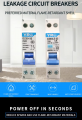
MCB or conventional fuse to protect a 240 VAC circuit

Thread Starter

vas.tzor

Joined Sep 13, 2024
29
Hi there

I have a 240 volt line wired to the load side of a contactor. Instead of using a conventional fuse to protect the circuit I figured I could use a 2 pole MCB coupled with a 2 pole RCCB both of which are rated L + N. The 240 VAC line wired to the contactor has 2 hots (L + L) and a ground - no neutral. The Chinese supplier selling the MCB and RCCB assured me the circuit will run just fine. Having limited knowledge though I cannot help but to be skeptical. Hopefully someone knowledgeable out there can shed some light.

Thanks
 

Ian0

Joined Aug 7, 2020
13,097
Hi there

I have a 240 volt line wired to the load side of a contactor. Instead of using a conventional fuse to protect the circuit I figured I could use a 2 pole MCB coupled with a 2 pole RCCB both of which are rated L + N. The 240 VAC line wired to the contactor has 2 hots (L + L) and a ground - no neutral. The Chinese supplier selling the MCB and RCCB assured me the circuit will run just fine. Having limited knowledge though I cannot help but to be skeptical. Hopefully someone knowledgeable out there can shed some light.

Thanks
Perhaps you should have started by telling everyone which country's electrical system this connects to.
I assume from the fact that it is 240V formed by two lives and no neutral, it must be North American.

A 2-pole MCB would be safer than 2 fuses, because when one fuse blows, it leaves the circuit connected to the other live.
There are two sorts of 2-pole MCB, one type only senses current on the live side, but has a two pole switch.
 

Thread Starter

vas.tzor

Joined Sep 13, 2024
29
You assumed correctly. However my question still remains unanswered. I have one supplier telling me the circuit will run just fine while another supplier of the same MCB telling me running a split phase 240 VAC through an MCB which is rated L + N and not L + L is not advised. Little bit confused. Hopefully an engineer can chime in.
 

Ian0

Joined Aug 7, 2020
13,097
You assumed correctly. However my question still remains unanswered. I have one supplier telling me the circuit will run just fine while another supplier of the same MCB telling me running a split phase 240 VAC through an MCB which is rated L + N and not L + L is not advised. Little bit confused. Hopefully an engineer can chime in.
Neither situation will prevent it from running. After all, in normal operation both an MCB and a fuse are just a piece of wire.
It's what happens when it is not running properly that is important.
I'm not familiar with American MCBs, so I can't comment further unless they are identical to European ones.
 

panic mode

Joined Oct 10, 2011
4,864
You didn't post anything that could help answer the question. No part number, no datasheet, no rating,no interrupting capacity, no approvals, no country name to know what standards apply...
 

Thread Starter

vas.tzor

Joined Sep 13, 2024
29
Well, well, well. Who would have thought Mr Panic Mode himself. So far I have spent over $700 trying to bring that clever circuit of yours into fruition. Will get all that info and post soon.
 

Thread Starter

vas.tzor

Joined Sep 13, 2024
29
"MCBs and RCCBs serve different purposes in an electrical system. MCBs are used to protect against overloads and short circuits, while RCCBs are used to protect against electric shock caused by earth leakage currents"
 

MisterBill2

Joined Jan 23, 2018
27,159
What is a MCB? And an RCCB?
The definitions certainly had me confused for a while also. In my world, MCB was Main Circuit Breaker, and all the rest were branch circuit breakers. Why would a breaker be referenced by it's physical size rather than the current rating??? And by application would make even more sense.
Now we hear about dul breakers that only protect the hot side, but open both sides when they are tripped. So if some fault pits a huge overload current into the neutral from some source, there will be no tripping. It sounds like a very poor way to save a few cents.
AND I have seen installations that have all of the breakers, branch and main, as the same size, but quite different ratings.
 

Thread Starter

vas.tzor

Joined Sep 13, 2024
29
The MCB will be installed in Canada. My power source is coming from a 240 VAC 20 Amp outlet please see picture of outlet below. The model # of the MCB in question is DZ47 rated for 20 amps. This is a 2 pole D type MCB and is manufactured by a company called TOMZ in China. This product is not CSA or UL listed however it has CE approval. Please see attached:Capture.PNGScreenshot 2024-10-23 113932.pngScreenshot 2024-10-23 114110.png
 

MisterBill2

Joined Jan 23, 2018
27,159
What sort of incident would you anticipate tripping the Branch circuit breaker? And certainly, in my breaker panel, they are not "miniature" devices, compared to the miniature circuit breakers found in a plug-strip.
Do you refer to other folks as "short people" and "big people"??
 

Ian0

Joined Aug 7, 2020
13,097
The definitions certainly had me confused for a while also. In my world, MCB was Main Circuit Breaker, and all the rest were branch circuit breakers. Why would a breaker be referenced by it's physical size rather than the current rating??? And by application would make even more sense.
Now we hear about dul breakers that only protect the hot side, but open both sides when they are tripped. So if some fault pits a huge overload current into the neutral from some source, there will be no tripping. It sounds like a very poor way to save a few cents.
AND I have seen installations that have all of the breakers, branch and main, as the same size, but quite different ratings.
Referencing by physical size does have logic to it - it's the size that fits fuse boxes (aka Consumer Units). The acronym MCB doesn't cause confusion with Main Circuit Breaker as the incoming supply is always fused.
I don't know who first called them "miniature" because the standard (EN60898) doesn't refer to them as such, but it must have been someone who made much larger circuit breakers.
So, an MCB is a circuit breaker that is 17.5mm wide per pole and fits a 35mm DIN rail, with tripping currents up to 63A and breaking capacities of either 6kA or 10kA.
They are available in B, C and D tripping characteristics, and in 1P, 2P, 3P and 4P, all of which have sensing on each pole and a physical interlock. There are also 1P+N and 3P+N devices which sense only the live current but switch all poles.
What our friend requires is a 2P type not a 1P+N type, because on a split phase supply there could be a fault current to neutral or earth from either pole.
 

panic mode

Joined Oct 10, 2011
4,864
MCB aka "Miniature Circuit Breaker" is a common term in industrial automation. and it refers to small breakers (100A max) with lower rated voltage and interrupting capacity (up to 18kA, sometimes only 10kA or even less).
MCCB aka "Molded Case Circuit Breaker" is a bigger brother, supporting higher voltages, higher currents (2500A or so) and interrupting capacity.

there is also a class of products called supplementary protection devices. physically they look like MCBs but are of different construction/performance - CBs react to both thermal and magnetic trips, supplementaries do not, which is why they cannot be used as standalone protection, they always require proper overcurrent protection (fuse or CB).

https://www.wolfautomation.com/blog...-vs-supplementary-circuit-protection-ul-1077/

DZ47-63 is MCB but as expected specs are on the lower side. interrupting capacity is only 4kA. the main issue is that this product is not CSA or UL tested and approved so it does not qualify to be used as an overcurrent protection in Canada. so.... talk to your electrical inspector, he may allow you to use it as a supplementary protection. i have seen retrofits of imported machines where fuses were added in front of each CB. sometimes entire cabinets were added to accommodate the many fuses.

Fuses are of course lower cost and even small ones (CC, J etc.) have higher interrupting capacity. the only downside is that when they are blown, they cannot be simply reset, they need to be replaced. And most places have maintenance departments that are not proactive so spares are often not at hand - which means downtime...

DZ47-63 in 2-pole configuration 20A seem to be some $25CAD on Amazon or $8CAD on AliExpress
UL approved circuit breaker is of course going to cost much more... like $80-150 CAD. (FAZ-D20-2-NA is 63USD at AutomationDirect)
 
Last edited:

MisterBill2

Joined Jan 23, 2018
27,159
MCB aka "Miniature Circuit Breaker" is a common term in industrial automation. and it refers to small breakers (100A max) with lower rated voltage and interrupting capacity (up to 18kA, sometimes only 10kA or even less).
MCCB aka "Molded Case Circuit Breaker" is a bigger brother, supporting higher voltages, higher currents (2500A or so) and interrupting capacity.

there is also a class of products called supplementary protection devices. physically they look like MCBs but are of different construction/performance - CBs react to both thermal and magnetic trips, supplementaries do not, which is why they cannot be used as standalone protection, they always require proper overcurrent protection (fuse or CB).

https://www.wolfautomation.com/blog...-vs-supplementary-circuit-protection-ul-1077/

DZ47-63 is MCB but as expected specs are on the lower side. interrupting capacity is only 4kA. the main issue is that this product is not CSA or UL tested and approved so it does not qualify to be used as an overcurrent protection in Canada. so.... talk to your electrical inspector, he may allow you to use it as a supplementary protection. i have seen retrofits of imported machines where fuses were added in front of each CB. sometimes entire cabinets were added to accommodate the many fuses.

Fuses are of course lower cost and even small ones (CC, J etc.) have higher interrupting capacity. the only downside is that when they are blown, they cannot be simply reset, they need to be replaced. And most places have maintenance departments that are not proactive so spares are often not at hand - which means downtime.
The only "miniature" circuit breakers that I have used have indeed been snapped onto Din rails in control panels. Because they are WIRED on both supply and load side they are not at all suitable for application in a distribution panel at all, at least where I live. Distribution panel breakers are fed off of a bus-bar, which is protected by a Main Circuit Breaker, always with a greater current rating.
So the type of breaker utilized depends greatly on the application, at least where some regulations apply. And still, not calling them BRANCH circuit breakers, relating to the application, makes a lot more sense to me.
 
Top