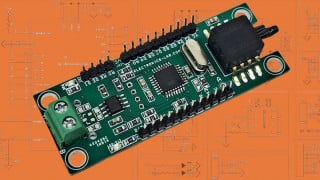
Maximum length for TTL UART between two boards

Tranceivers are "hardened" somewhat. e.g. they are designed to be plugged an unplugged a lot, can operate over moderate distances, maybe tolerent to ESD, It will meet an acceptable standard.

As an example, The Macintosh used an RS422 port. You could manipulate the signals and get an ersatz RS232 signal that worked most of the time. e.g. To connect to modems a few feet away. Well, I tried to connect to a motion controller. It would not work. I had to use a real converter.
RS232 was specified to work with +-25 V signal levels with +-3V a dead zone.

So,, 3.3 Logic levels won't cut it at all. You do see +-5V RS232 which mostly works.
 

Thread Starter

mishra87

Joined Jan 17, 2016
1,063
So you want to drive the line directly from the micro?
That's generally not a good idea. You should have some sort of buffer circuit between the micro and the line.
If you need to add a circuit for this, than just use an RS-232 chip.
Yes correct ,
Using buffer is good idea.
Using RS-232 chip is good idea.

But these solutions are going to add extra cost in BOM.

So I should go ahead with these solutions .

Thanks !!!
 

MrChips

Joined Oct 2, 2009
34,841
Your solution ought to be clear by now.

How reliable is your system?
What is the consequence of failure?
How much do you care about your reputation and prospects for future contracts?

You are designing a system for a customer.
You cannot anticipate how your customer is going to use the system.
You cannot anticipate in what industrial environment your customer's customers will be deploying the system.

MCU GPIO pins have limited protection from ESD and industrial noise.
RS-232 transmitters/receivers provide that protection.
 

John P

Joined Oct 14, 2008
2,063
One thing that hasn't been stated or asked about--do you trust that the ground levels on the two connected units will be the same, or are you planning to use an extra wire to join them? Actually a 3-wire RS-232 link would have a ground, but only minimal current ought to flow in it. RS-422 needs grounds that are close in voltage, if not exactly the same. If this is a problem, then a wire pair driving an opto-isolator might be a good idea, and they're very cheap if the baud rate is low. Note that with a wire pair, the same current flows in opposite directions, so immunity to noise is inherently pretty good.

An advantage to optically isolated data lines is that if one unit has a meltdown, it can't send high voltage into the other. That might reassure nervous customers!
 
Top