Maximum continuous discharge and peak current, and capacities for standard batteries.

Thread Starter

-live wire-

Joined Dec 22, 2017
959
Many times I have had AA, AAA, D cell, or other standard batteries and wondered: how much current can these things supply, peak and continuous? And what is their capacity under different conditions? When making something that is intended to be low cost, for consumers, or with limited supplies, you often will use standard alkaline batteries for your design.

So what are the specs for typical AAAA, AAA, AA, C, D, and other alkaline batteries? I have some things in mind if I can get a few amps from the larger ones. This could be very useful information to someone trying to design anything using those batteries.
 

Reloadron

Joined Jan 15, 2015
7,866
I only see the capacities, nothing about the current draw.
The capacities are stated in mAh. That is about as good as it gets. If a battery has a capacity of 1,000 milli amp hours it is rated as delivering 1 amp for 1 hour before it's voltage drops to a pre determined point. In theory that same battery will deliver 2 amps for 30 min, 4 amps for 15 min and 8 amps for 7.5 min which we know is not going to happen. I also added a link to the ANSI spec in my previous post. Batteries are rated by their capacity and I have never seen one rated by peak current with the exception of some thermal batteries used in guided missile applications and those were not off the shelf batteries.

Battery University is another pretty good source as to about anything anyone could want to know about batteries.

Ron
 

Reloadron

Joined Jan 15, 2015
7,866
Here is a little more which may interest you. A Guide to Understanding Battery Specifications from our friends at MIT. You may want to note how they mention;
"Maximum Continuous Discharge Current – The maximum current at which the battery can be discharged continuously. This limit is usually defined by the battery manufacturer in order to prevent excessive discharge rates that would damage the battery or reduce its capacity. Along with the maximum continuous power of the motor, this defines the top sustainable speed and acceleration of the vehicle".
"Maximum 30-sec Discharge Pulse Current –The maximum current at which the battery can be discharged for pulses of up to 30 seconds. This limit is usually defined by the battery manufacturer in order to prevent excessive discharge rates that would damage the battery or reduce its capacity. Along with the peak power of the electric motor, this defines the acceleration performance (0-60 mph time) of the vehicle".

The end result with much of this leads back to what MrSoftware mentions and a manufacturer's data sheet for a specific battery.

Ron
 

WBahn

Joined Mar 31, 2012
32,712
I've also found it annoyingly difficult to get decent numbers for something that would seem to be so important to anyone choosing a battery to power something -- how much current is it reasonable for this battery to deliver?

The data sheets from the battery manufacturers almost never provide this information and you have to try to infer it from their curves but you have no idea whether those curves were even meant to just match, no more no less, the range of reasonable current draws. If they don't match (which is a very good bet), then you have little idea what the upper limit on reasonable current draws is.

Years ago one of the battery manufacturers had a chart that did a decent job of capturing that information for their batteries, but I have never been able to find it since and I don't remember which company it was for. IIRC, it was a pretty simple chart that had continuous discharge current on the horizontal axis and percent of nominal capacity on the vertical axis. Then it had a line plotted for each of their batteries. The horizontal extent of the line only went out as far as they recommended pulling continuous current from that battery based on thermal considerations. The chart certainly didn't catch all factors such as temperature, age, or different cutoff voltages. But it was EXTREMELY useful for quickly identifying a set of batteries to consider for a project.
 

MisterBill2

Joined Jan 23, 2018
27,211
Most battery applications have long life as a target, which is a lot different from getting the maximum current for some very short period of time. When the company that I worked for needed that information about 20 years ago we wound up purchasing batteries and running tests our selves. One problem that you will find is that different brands of the same size type will be different in the very high current mode.
 

WBahn

Joined Mar 31, 2012
32,712
I'm not really talking about the high current mode that pushes them to the limits.

Let's say that I have a design that I want to be battery powered and it draws 120 mA and I would like it to run for at least 10 hours. That's not a particularly long time, but it's not particularly short, either. Many batteries are used in applications where that is a target lifetime, particularly rechargeable ones.

So I need a nominal capacity of at least 1200 mAh. Let's say I roughly double that and say that I will only consider batteries of at least 2000 mAh nominal capacity. A typical AA alkaline has a capacity of about 2500 mAh, so that's a good fit. But that, alone, doesn't tell me whether a typical AA alkaline battery is a good choice for a 120 mA continuous current draw.

Now, I just went out to Duracell's website and was very pleasantly surprised to see that (at least for their AA Coppertop) their current data sheet very nicely shows a family of constant current curves that start at 5 mA and go in the 1-2-5 sequence up to 1000 mA. This covers service lives (to 0.8 V) from about 650 hours down to about an hour. This is extremely helpful and would seem to cover most "reasonable" applications for this cell.

If they have done this for all of their batteries, the someone that needs to select batteries on a regular basis could spend a couple hours collating the information into a spreadsheet and make a nice little reference for themselves to at least use as a first cut. I don't know if Duracell has done this and made it available, but it would be nice if they did.
 

MrAl

Joined Jun 17, 2014
13,671
Hello there,

The problem spans a few different dimensions such as energy density, specific heat capacity, surface area. The limiting dimension is usually temperature, and that is determined from those.
For example, we have an AA cell that has a load of 1000 Ohms. What is the peak temperature of the surface of the cell after a test run that discharges the cell. Because the energy in the volume is limited, the temperature is limited, and of course the load limits the temperature too and the discharge time is fairly long. 80 degrees C is usually a cutoff point, but i've seen 100 degrees C too.
But what about for a 1 ohm load. The energy is still limited, and now the cell discharges much faster. So the peak temperature might still be less than 80 degrees C even though we are pumping out a lot of current. And what about a zero ohms load. The key is does the energy have time to push the temperature up to above 80 degrees C before the cell runs down complately.

But now put it into a case for a product and that changes because the cell surface does not have free air flow now. So how could we rate the cell. I would think a free air rating would be a good idea, but i am guessing that there is some load that causes the peak temperature (over many batteries discharged) and that peak stays below a temperature rise of around 60 degrees C. That's just a guess though.

Now enter into the rechargeable cell market and we see a completely differnt story. They almost always publish their max discharge specs, and that is based on of course internal resistance and the other stuff above. As the cell discharges the internal resistance generates heat, and the temperature rises, and the max temperature rise should be around 60 degrees C or maybe a little less.

Could it also be that the way the alkaline AA cells are made allow them to be discharged at any current with a presumed passive load? That's what i am thinking, although i never tested for that.
For sure Li-ion cells are NOT like that at all and have a max discharge current rating that must be followed exactly because going over that would cause the cell to over temperature and possibly burn up literally.

BTW recently i tested two brands of alkaline cells: Wegmans and Maxell.
The Wegmans came out to be 2107mAHr and the Maxell came out to be 1421mAHr.
Now before you jump to any conclusion here though, the Wegmans were just purchased about a week ago while the Maxells where purchased about 5 years ago (next month). So i think it is reasonable to think that the Maxells were at least 2000mAHr when new. Unfortunately i dont have any test to confirm that yet.
 

MrAl

Joined Jun 17, 2014
13,671
You can find datasheets for batteries on the internet. Take this one as an example:
data.energizer.com/pdfs/1215.pdf

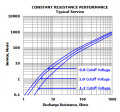
There is often a chart like the one below, from which you can estimate typical maximum current into a given load.
View attachment 151274

Hi,

That's informative too, but didnt he mean the max discharge that SHOULD be taken from the cell?
In other words, when it gets dangerous, if it indeed does.
For Li-ion cells this spec is an absolute must.

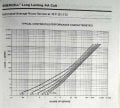
That looks like discharge information, which is also useful though.

Pg_077R.jpg
 
Last edited:

WBahn

Joined Mar 31, 2012
32,712
You can find datasheets for batteries on the internet. Take this one as an example:
data.energizer.com/pdfs/1215.pdf

There is often a chart like the one below, from which you can estimate typical maximum current into a given load.
View attachment 151274
How does that chart either allow you to estimate typical maximum current into a given load OR determine what the maximum continuous current that you should draw from a cell should be?

Let's say that I have a load of 10 Ω. What's the max current into that load and how was it determined? Is that current a reasonable continuous current or not?

Even with the current data on the Duracell sheets it's difficult (technically impossible, I would say) to tell what the maximum current that should be drawn continuously is.
 

WBahn

Joined Mar 31, 2012
32,712
Radio Shack used to have a nice data book for their batteries (and the Enercell batteries were darn good batteries back in the day) and they had a nice table that gave the recommended battery for difference current draws and then most of the individual battery sheets had a little table that gave info specific to light, moderate, and heavy load conditions, which they defined a few different ways depending on typical use for that battery.
 

WBahn

Joined Mar 31, 2012
32,712
There are several charts in the datasheets that cover these things. Have a look.
data.energizer.com/pdfs/1215.pdf
It's nice to see the constant current discharge curve there -- it would appear that it has become the norm since I last looked at battery specs in detail quite some years ago.

But I still don't really see an answer to the TS's basic question, certainly not easily discernible.

So let's phrase it this way. I design a circuit and it needs a continuous current of X. I'm not at all concerned about battery life (for whatever reason -- perhaps I've already ascertained that the capacity is more than sufficient to meet my needs). So I tell you X and you look at this datasheet and give me a thumbs up or thumbs down based solely on whether that continuous current draw is reasonable for that battery.

What is the maximum value of X that you would definitely give me a thumbs up?

What is the minimum value of X that you would definitely give me a thumbs down?

Also, notice that their data is seemingly inconsistent.

The voltage measurements all appear to be closed-circuit (i.e., CCV). They claim that at 21°C the internal resistance is 0.5 Ω in a test with a 4 Ω load, which would equate to a current draw of about 1.5 V / 4.5 Ω = 333 mA.

Yet their constant current discharge curve (presumably done at room temperature) says that it takes 0.1 hours to reach a cutoff voltage of 1.0 V at a current of 1000 mA. However, even if the internal resistance did not go up with the higher current draw (which is the norm), the CCV of the battery immediately upon application of a 1000 mA draw would be 1.0 V. Now, the fresh open-circuit voltage is probably more like 1.6 V, but I would think the increase in internal resistance would more than cancel that out.

Since different measurements are taken is quite different ways, it is probably not surprising that these kinds of inconsistencies pop up, but it further highlights the difficulty in divining the answers to seemingly common questions when none of the measurements taken and data presented are aimed at answering those questions directly.
 

MrAl

Joined Jun 17, 2014
13,671
There are several charts in the datasheets that cover these things. Have a look.
data.energizer.com/pdfs/1215.pdf
Hello again,

Both what you are talking about and what the OP seems to be talking about are based on current and internal resistance, but what i believe the OP is talking about is also based on temperature.

Take a cell, load it with 10 ohms as WBahn was saying, now combine it with the internal resistance to calculate the loaded voltage. That's basically what the graphs so far show, except they also show the time it takes with that load to reach a given cutoff voltage like 0.9v for example.
But what i believe the OP is asking also involves temperature of the cell. If the cell gets too hot, it poses a danger. So the question really is what is the max temperature of the cell with a given load run for as long as the cell can supply energy. Or stated another way, is there any load that actually causes the cell to overheat and cause a danger just because of the temperature itself.
The higher the temperature the worse it gets because the cell could have problems with high temperature and of course the surroundings come into question. They may not pay attention to the surroundings (such as the enclosure) but the cell might explode if subject to too much heat. There's the chance that it will never explode or cause a fire though, which i dont know myself for say alkaline. As we all know though, for Li-ion there is such a real danger and so we always see specs for those cells.

I keep bringing up Li-ion as a comparison cell because i think he is looking for a similar spec for alkalines and maybe carbon zinc. There is a chance though that such a rating is not needed but again i do not have that info. That just looks like a possibility at this point because we never see any spec like that for those kinds of cells.

I guess the ultimate question is, can a brand new cell take a short circuit and not blow up :)
 

Thread Starter

-live wire-

Joined Dec 22, 2017
959
I did some quick tests on D cell batteries and they seems to have an ESR of .2-.4 ohms. Really disappointing. But they survived a dead short for many seconds. They didn't even get hot. HOWEVER, I only measured 3.4 amps.
I guess the ultimate question is, can a brand new cell take a short circuit and not blow up :)
So yes, many can.
 

Reloadron

Joined Jan 15, 2015
7,866
I guess the ultimate question is, can a brand new cell take a short circuit and not blow up
I did some quick tests on D cell batteries and they seems to have an ESR of .2-.4 ohms. Really disappointing. But they survived a dead short for many seconds. They didn't even get hot. HOWEVER, I only measured 3.4 amps.
I am putting my money on who made the battery. That along with what day of the week it was made. :)

On a more serious note if I were planning a project which involved battery power I would likely do several test using the actual intended load and allow myself maybe a 25% margin. If my load under normal use for example were 300 mA I would use a 375 mA load for my time duration I wanted.

Ron
 

MrAl

Joined Jun 17, 2014
13,671
I did some quick tests on D cell batteries and they seems to have an ESR of .2-.4 ohms. Really disappointing. But they survived a dead short for many seconds. They didn't even get hot. HOWEVER, I only measured 3.4 amps.

So yes, many can.
Hi,

That's what i was thinking too. The internal resistance probably goes up too so it limits current.
I once had a AA cell that was not quite dead yet and i wanted to throw it away but i wanted it to be completely dead first so i shotted it out. I heard a short "pop" sound and that was it. No heat, nothing.

A 'D' cell has a large surface area too so it probably wont get hot.

Since the cell heats up gradually, there may be a certain value load that causes the highest temperature rise before it dies.

As Ron was saying, some good tests always help understand any problems that might come up.

This is a bigger issue with some other types of chemistries. We dont get off so easy. Ask the 195 or so people who's vape cigarettes blew up in their faces between the years 2009 to 2016 as was pointed out in the FEMA report on exploding Li-ion cells used in e cigarettes.
 
Top