I saw someone post a comment about an output duration of 30 minutes or more for a 555 timer is way too long. What would be a better alternative for a timer circuit but still be able to vary the output duration with a potentiometer?
The datasheet indicates maximum component values for reliable operation. Note that much higher circuit impedances, and thus longer time periods, are possible with the CMOS 555 because of its much lower input currents.
You are ultimately limited by the leakage current of the capacitor and the inout current of the 555. Using the 7555 solves the input current problem, but capacitor leakage remains the ultimate limit.
Your only solution is to use a faster oscillator and a frequency divider such as a CD4060.
An 8-pin microcontroller could give you delays as long as you want with no external components and about 1% accuracy. Add a crystal and you can get much more accuracy.
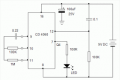
You can reduce the size of the capacitor needed for any given time period (therefore reducing leakage) by increasing the threshold voltage using the CV pin.
The only real issue there is you can no longer use the standard formula to calculate the time period.
That would be limited by the common mode range of the comparators, which isn’t specified in the datasheet. The constant is -ln(1-Vth/Vcc).
If Vcontrol is increased to 5/6 of the supply from 2/3, the timing period increases by 63%, but the charge current at the end of the timing period halves. That makes it much more likely that the charging current may be lower than the capacitor leakage current, and if that happens it never times out.
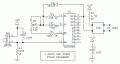
Here is something from a thread on another forum about two years ago. On power-up it energizes a solid state relay (SSR) for one hour. If at any time during that period you press the button, the one-hour timer restarts, extending the output. Note that the SSR requires less than 3 mA, which the 4060 can sink when running on 12 V.
For a nominal 30 minute period, decrease C1 to 1.0 uF.
You don't say how much adjustability you need. The ratio of R1 to R2 determines the adjustment range.
The only functional difference between this circuit and the one in post #5 is that feedback through D1 causes the circuit to halt aftr one timing period rather than run continuously.
The single timing resistor is replaced by a fixed and a variable resistor in series. When the R2 is turned to 0 ohms, R1 sets the maximum oscillator frequency, which determines the shortest timing period. When R2 is at its max value, R1+R2 sets the minimum oscillator frequency, and the longest timing period.
A way to avoid that problem is to tie the timing capacitor common to V+ instead of ground.
That way the leakage current may reduce the time period, but it will always time out, since the leakage adds to the charging current instead of subtracting.

 Facebook
 Google
 GitHub
 Linkedin