Making an Electronic Weight-Based (Non-Tipping) Rain Gauge

Tonyr1084

Joined Sep 24, 2015
9,744
Once again, there are two types, BOTH HAVE SPRING LOADED actions.
There are others. I have (somewhere) a small solenoid valve that came off of that same 1989 Celica. It's a vacuum port. No pressure, not pressure differential, just a valve that is either open or closed, depending on its design. In fact, I've seen yet another engine vacuum valve, one that operates like a relay. A common port, a Normally Open port and a Normally Closed port.

My sprinkler valves require pressure to open. Yes, I know about those types. The gas valve on my water heater is another but it operates on a much lower level of pressure. Gas pressure is around 4 to 6 PSI in most cases. Those DO take a pressure to open them against a spring. The valve in the toilet that refills the tank - takes pressure to open. But not all valves are diaphragm types. Those on the car have spring loaded pistons. When in one position the valve is open. No pressure required. When in the other position - closed.

I get your point. I hope you get mine.
 

Tonyr1084

Joined Sep 24, 2015
9,744
Here are drawings of the three versions I'm talking about: (all valves are in the de-energized configuration)
View attachment 353998
View attachment 353999

View attachment 354000

None of these valves require a pressure or vacuum of any sort. Apply power to the coil and the plunger pulls in. Depending on the configuration, one is normally closed, (top) the second is normally open (middle) and one is both open and closed at the same time (bottom) depending on which ports you are considering. there is no pathway from NC to NO. Only from C to NO (in the unenergized config.) or from C to NC (in the ENERGIZED config.).
 

MisterBill2

Joined Jan 23, 2018
27,741
Certainly those valves have the required function. I suspect that the moving portions, and the springs, are steel parts and probably not intended for water service. I have seen several valves built for air control rusted solid when used for wet service duty.
 

Thread Starter

wxman

Joined Oct 13, 2022
69
This is an example of what I had in mind.

https://www.aliexpress.us/item/3256802673037062.html

Notice how you can choose between "pressure type" and "non-pressure type"...Description says:

Code:
Pressure Type (Inlet Water valve)   Suitable for water pressure 0.02~0.8Mpa
 
Non-pressure Type pressure (drain Water valve)  Suitable for water pressure 0~0.01(0~0.02) Mpa
The non-pressure "drain" valve sounds like what I'm looking for, but it's only available in the normally closed. The "normally open" ones are only available in the pressure type.....I did find this one at Amazon, which seems like it may work for a normally open, though it's twice the price and is brass. Seems overkill, considering I would be connecting to a PVC pipe, but it may be the best I can do:

https://www.amazon.com/SNS-2WK025-N08-Electric-Solenoid-Normally/dp/B07SPK59LP/

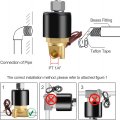
BUT, I found that same model number on another listing and it has this graphic suggesting it must be mounted horizontally and cannot be mounted vertically. Not sure why this is? But the rain gauge would have to be a vertical pipe in order to fully drain by gravity. :

solenoid.jpg
 

MisterBill2

Joined Jan 23, 2018
27,741
The normally closed type of valve is exactly what you need for the drain valve. AND, with the size port that it will have the drain process will be quite fast. Or is it that important to measure every single rain drop?? This is the sort of situation where the "tipping bucket" system would do much better.
AND certainly the tipping bucket scheme can be very accurate. I recall seeing an article showing how to build a very accurate one in the "Amateur Scientist" section of a Scientific American" magazine many years ago. With just a bit of focus on accuracy, better that within 1% ACCURACY was obtained. BUT every bit was carefully made with copper and stainless steel, with a Teflon pivot and copper buckets, and it was inside a wind-proof housing. It was not at all the blow-molded junk that was used as the comparison.
 

Tonyr1084

Joined Sep 24, 2015
9,744
Certainly those valves have the required function. I suspect that the moving portions, and the springs, are steel parts and probably not intended for water service. I have seen several valves built for air control rusted solid when used for wet service duty.
Yeah, I suppose you're right. I hadn't thought of that.
This is an example of what I had in mind.
That may still require more pressure than a quarter inch of head pressure will deliver.
Making an Electronic Weight-Based (Non-Tipping) Rain Gauge

As for the automotive solenoid valves - I suppose the manufacturer would have taken into account the possibility of rust. Certainly in high humidity environments, moving air will still carry considerable amounts of moisture. But the TS wants a Non-Tipping rain gauge.
 
Last edited:

MisterBill2

Joined Jan 23, 2018
27,741
I have seen, and replaced, small solenoid valves used to control the water for furnace mounted humidifiers. They were controlling "city water" which has assorted stuff added to it. The ones replaced were plugged with "gunk", which I have no clues about.
 

Tonyr1084

Joined Sep 24, 2015
9,744
The non-pressure "drain" valve sounds like what I'm looking for, but it's only available in the normally closed.
The normally closed type of valve is exactly what you need for the drain valve. AND, with the size port that it will have the drain process will be quite fast.
I'd be concerned about the diameter of the drain pipe. It's going to take a bit of water to fill up before the vessel starts to measure rainfall.
Or is it that important to measure every single rain drop?
In order to measure as much as possible, the inlet side will need a reducer as close as possible to the valve. A plastic fitting to reduce down to 1/4" tubing would probably suit the purpose quite well. The illustrations show the "correct" orientation of the valve as being level. Personally I don't think there'd be much of a problem if the valve is tilted as much as a 45˚ angle. Otherwise, there will always be some residual moisture remaining in the line. Since this is a "Non-Pressurized" line teflon tape probably isn't needed. Just some teflon paste should do well enough to seal the pipe threads. Everything else should be plastic tubing and barbed connections. Rubber tubing could work too, but if this is kept outdoors and there's sunshine on the rubber tubes I believe they would start to break down possibly as quickly as one season. I doubt rubber tubing would last two years. I'd consider drip irrigation tubing for the job.
 

Thread Starter

wxman

Joined Oct 13, 2022
69
I emailed the Amazon seller on that brass solenoid asking why it says not to install vertically. The response was:

" If installed vertically,It may not close tightly, causing water leakage. "

In this case, the rate of any potential leakage would be critical to know. Being that it only closes off for a few seconds during emptying, a few drops would not cause any issues. But a steady stream of water pouring in would be problematic. Probably no way to know without trying one out.

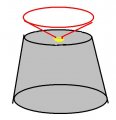
I'm thinking of trying to make a cheap rough draft of the laser version. Perhaps initially as a manual empty with no solenoids. Upside down utility bucket with a hole drilled in the center of it's base. Stick a kitchen funnel through the hole and seal around with rope caulk.

bucket1.JPG

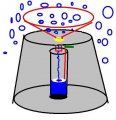
Then imagine we're taking a 3D X-Ray of the bucket to show the insides. Inside the funnel drains into a slightly wider PVC pipe with a closed cap on it's bottom. Plastic or foam float inside the PVC pipe. Laser distance sensor shines into the PVC pipe measuring the distance to the float. Subtract that current distance to the float from it's known distance at the bottom of the pipe, and you've got your water depth into the pipe......Say the funnel is 8 inch diameter and the PVC pipe is 1 inch diameter...That's a 64X magnification. So every 0.64 inch (~16 mm) depth increase in water level equals another 0.01 inch of rain.

bucket2.JPG

I can manually pour known amounts of water into the funnel to do calibrations and confirm that the laser sensor is working correctly.

If all works well, then add solenoids; Normally open on the bottom of the funnel and a normally closed on the pipe's bottom and the two solenoids wired together in parallel such that when the pipe opens to drain, the funnel closes and vice versa. Hopefully there's no drip on the bottom solenoid when closed and little to no drip on top when closed.

If it still works, then work on scripting to convert the measured distances to rain inches and activating the drain solenoids at the appropriate times/rain amounts to prevent overflow.
 

Tonyr1084

Joined Sep 24, 2015
9,744
1 inch of water in a 1 inch diameter tube poured into a half inch vessel will yield 4 inches of water in a 1/2 inch diameter vessel. Whatever size your vessel is measure out 1 inch and then fill as close as possible to that level. Then pour it into your rain gauge vessel. It should be according to the diameter of the vessel.
 

MisterBill2

Joined Jan 23, 2018
27,741
No discussion as to how you will accurately weigh the water, but now talk about calibrating the system. I agree that the mechanics of an accurate weighing system are a bit complex. The pain is always in those details.
 
Last edited:

MrAl

Joined Jun 17, 2014
13,726
In the past there was the use of an LVDT to measure weights, and it was good enough for Pfizer in their medical research.
The idea is to create a ridged construction with four columns. Two wires are run across diagonal corners with the LVDT in the middle. As the weight pushes the center of the wires down, the LVDT detects the movement and the signal is amplified and conditioned. The final signal represents the weight of the object placed on top of the center of the construction.

I don't know if you want to go through this much trouble though :)
 

MisterBill2

Joined Jan 23, 2018
27,741
Given that accurate and repeatable weight measurements certainly require a fair amount of effort, M.A., in post #53, asks a totally valid question.
And I ask an additional question, which is: "How much effort and expense is the TS willing and able to pay for a weighing system more accurate than a well done and accurate tipping bucket system???"Does the TS even understand just what the requirements actually would be??
 

Tonyr1084

Joined Sep 24, 2015
9,744
"How much effort and expense is the TS willing and able to pay for a weighing system more accurate than a well done and accurate tipping bucket system???"
"Making an Electronic Weight-Based (Non-Tipping) Rain Gauge"
It's a simple and low cost design, but accuracy is +/- several percent, at best as it's sensitive to rain rate, etc.. For that reason, they're often not accepted for official measurements
I don't think the TS wants a "Tipping Bucket" system.
 

MisterBill2

Joined Jan 23, 2018
27,741
"Making an Electronic Weight-Based (Non-Tipping) Rain Gauge"

I don't think the TS wants a "Tipping Bucket" system.
My point being that what the TS wants does not, by itself, assure any greater accuracy, except when compared to what I would class as "really cheap junk" of the very poorest quality.
 

Tonyr1084

Joined Sep 24, 2015
9,744
It's only that I recall you blasting me for offering an alternative suggestion to a thread, for not answering the question the way the TS wanted.

Personally, I see a lot more complexity than I think the TS realizes, and perhaps a tipping bucket might be a better way to go. But because the TS has clearly stated they don't want a tipping bucket then the solution is either to answer the question the way they want it or to not answer at all. There've been a lot of threads I've shied away from simply because my answer would not conform to the request. I think it's only fair that your words to me should apply to you as well.
 

MisterBill2

Joined Jan 23, 2018
27,741
It's only that I recall you blasting me for offering an alternative suggestion to a thread, for not answering the question the way the TS wanted.

Personally, I see a lot more complexity than I think the TS realizes, and perhaps a tipping bucket might be a better way to go. But because the TS has clearly stated they don't want a tipping bucket then the solution is either to answer the question the way they want it or to not answer at all. There've been a lot of threads I've shied away from simply because my answer would not conform to the request. I think it's only fair that your words to me should apply to you as well.
I did not intend any offense. So my apology if I came across as that.
I have been involved with the design of quite a few weighing systems that demanded better than +/-1% accuracy, and none of them were simple or cheap. Of course, the other demand was that the systems remained accurate for months before re-calibration.
 

Tonyr1084

Joined Sep 24, 2015
9,744
No offense taken. Just felt compelled to point out how you once felt it important to correct me and now your words echo back in my mind.

Enough of this back and forth, we're off topic and may get our posts removed. All I wanted to say is that the TS does not want tipping buckets. From this thread I've learned a few things, largely due to your comments about tipping buckets. I clearly didn't understand tipping buckets before this thread. It has me thinking about a project with my grand children, teaching them to think about how things work and how they can put different things together and come up with new ideas.

Again, I'm not offended by anything you have posted. Just that I've noticed that despite the restrictions against tipping buckets you keep going back to that very topic. Two of my grandsons got into an argument. Each saw things the way they did and continued to insist they were right even though BOTH of them were not right. Each couldn't see the other point, nor could they see my point. In the end they agreed that they can't agree and let the subject drop. They're 13 and 11 years old.

The TS wants a non-tipping rain gauge. I've offered my thoughts but clearly it has been pointed out there are drawbacks, enough that probably negate my suggestions. So-be-it. Did what I could, now I'm watching and learning.
 

Werecow

Joined Aug 4, 2025
37
For what the TS wants to do, a solenoid pinch valve might be the ticket here. They can be purchased in both N/O and N/C configurations, and can be mounted with the pipe in a vertical direction.
 
Last edited:
Top