Making an AC drill motor run faster

Thread Starter

cmartinez

Joined Jan 17, 2007
8,788
Came late to this thread. Perhaps you have mentioned it. What size hole and how deep? I saw something to the effect of 3/8" to 3/4".

Have you considered just using a different style bit? At 3/8" with a standard 118° drill, it may wander, depending on the grain. I would consider a Forstner or auger style drill bit at slow speed. The Forstner style in that size will have a relatively large and stiff shaft, but may not provide the depth you need. An auger will provide more depth.

Here's a Forstner:
View attachment 160345

Here's an auger style:
View attachment 160346

The sharp point will help keep either type going straight through hard grain sections. They run well at low speeds, and the auger type provides particularly good chip clearance.

John
Thanks, John.

Diameters are 21/64" and 11/16". But there's a catch, they have to last for a long time, drilling plywood. That means that the only material that qualifies is tungsten carbide, afaik.

It's good to know about Forstner and Auger options though.
 

Thread Starter

cmartinez

Joined Jan 17, 2007
8,788
@cmartinez Drill presses are notable for some run out, that is why they are no good for converting to a small mill, Here is a 'belt and braces' method of testing run out,


If possible I prefer to use a Morse taper drill if your drill stand has this option with the chuck removed.
Max.
Thanks, Max. But maybe I didn't explain myself clearly.

I don't intend to use the chinese drill press as such, but rather dismount its motor and install it in one of my machines. I intend to discard the press mechanism altogether.
 

MisterBill2

Joined Jan 23, 2018
27,697
OK, evidently my previous post did not post properly I got that warning that I must wait at least 30 seconds, I don't understand, 30 seconds after what????
But now that I know you are drilling plywood none of the holes would be over an inch deep, I don't think.
So a longer bit is not a good choice. You might even be able to use milling bits, which are tough enough to make good cuts in steel. And as you undoubtedly already know, the smoothness of the hole depends on feed rate as well as speed.
 

jpanhalt

Joined Jan 18, 2008
11,087
I would not consider a type with that threaded point that pulls the bit into the wood...
The auger type is available with or without the screw point. The screw point is useful for hand drilling or from a position where applying feed pressure is awkward (e.g., overhead through floor joists to run a wire). It was just a picture I grabbed to illustrate an auger type. The ones I use in a drill press do not have the screw point.
 

-live wire-

Joined Dec 22, 2017
959
I've run small 3-6V AA battery motors on upwards of 30V, no smoke. How? It had no load. So it only drew about 100mA at 30V (and about 10mA at 20V). I of course made sure there was a current limit. So you could possibly try 220V with a current sensor and current regulation. However, it is probably not the best idea. Additionally, you could do things to improve heat dissipation and increase the voltage with a variac. But just be prepared to replace a motor if you go with the latter (you could also try the latter and the former).
 

Thread Starter

cmartinez

Joined Jan 17, 2007
8,788
How about using a pneumatic motor? Something like a dentist's drill only a little bit bigger.
those lack the kind of power that I need ... I know them, and they won't deliver under the conditions that I want

I've run small 3-6V AA battery motors on upwards of 30V, no smoke. How? It had no load. So it only drew about 100mA at 30V (and about 10mA at 20V). I of course made sure there was a current limit. So you could possibly try 220V with a current sensor and current regulation. However, it is probably not the best idea. Additionally, you could do things to improve heat dissipation and increase the voltage with a variac. But just be prepared to replace a motor if you go with the latter (you could also try the latter and the former).
As I said before, I needed to at least triple the 600 rpm that the original motor is running at its output shaft. And considering that the motor itself is running at more than 20,000 rpm, revving it up by applying more voltage to it was out of the question. Running that thing at 60,000 rpm would've been insane.
 

Tonyr1084

Joined Sep 24, 2015
9,744
Sorry. I thought you said earlier that you would have a light load so that a high RPM and low torque wouldn't have been an issue.

Refer back to post #3
 

Thread Starter

cmartinez

Joined Jan 17, 2007
8,788
Sorry. I thought you said earlier that you would have a light load so that a high RPM and low torque wouldn't have been an issue.

Refer back to post #3
You're right ... I guess I used the term "light" in relative terms ... as when comparing drilling wood against drilling steel
 

MisterBill2

Joined Jan 23, 2018
27,697
For good bearings intended to run at higher speeds you really need a "spindle" drive system. Those are made for exactly what you plan on doing. Some of them come with motors included. PRICE will be the only pain part of it, though. but a spindle assembly is made to be servicable and to last a long time.
 

Tonyr1084

Joined Sep 24, 2015
9,744
Variable speed router! Those things can spin faster than a snot in a storm. And they come with some reasonable torque.

But I think you said you've found the solution, so any further comments seem to be less relevant.
 

Thread Starter

cmartinez

Joined Jan 17, 2007
8,788
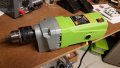
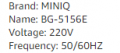
The drills are here! (I bought a couple of them) ... they seem not as robust as the other ones, but then again, their work load is much lighter than the ones I was previously working on. They're rated to run at 2,800 rpm on 220VAC (no problem with that) at 50 Hz ... that last part has me wondering, because AC down here is at 60Hz, so now my question is, will they run proportionally faster because of that? Like, will they run at 3,360 rpm? ... if that's the case, then I'm not worried because they have a speed control knob that can easily be adjusted to the appropriate rpm. But will they run hotter? Will their lifetime be affected?

57db4af6-8744-47f5-9bcd-4bbefd765074.jpg
 
Last edited:

MisterBill2

Joined Jan 23, 2018
27,697
With a higher line frequency the impedance of the inductance increases a bit and so the current would be a bit less and the motor will run a bit cooler. So running a 50 Hz motor on 60 Hz is not a problem. AND, if it is a brush type of motor it is even less likely to have any issues. But also, the speed range will be very similar.
 

MaxHeadRoom

Joined Jul 18, 2013
30,699
Runs slightly better on DC! :cool:
The series motor does not run faster on 60hz as it does with a induction motor.
The rpm is decided by load and friction, rpm increases as the (series) field current Decreases.
Max.
 

jpanhalt

Joined Jan 18, 2008
11,087
Runs slightly better on DC! :cool:
The series motor does not run faster on 60hz as it does with a induction motor.
The rpm is decided by load and friction, rpm increases as the (series) field current Decreases.
Max.
My thoughts exactly. In fact, considering its speed control, it may actually run on unfiltered DC PWM.
 

MaxHeadRoom

Joined Jul 18, 2013
30,699
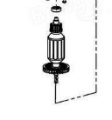
They are series connected motors, so the armature current also runs through the field.
It will certainly run on unfiltered DC, although many such circuits use a series choke for some degree of filtering.
Max.
 
Top