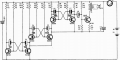
Here is a first pass at a (((concept))) schematic. The component values are rough guesses, there is no LED current limiting, and if Vcc is above 5 V the transistor bases need reverse voltage clamping diodes (which changes significantly the timing component values). The oscillator block is a 2-transistor multivibrator. The osc can steer current to two alternating strings of LEDs by adding two transistors.
An alternative is to use the 7 sections of a ULN2003/2004. Each section is an NPN darlington transistor. Five sections would replace the four transistors, two diodes, and one resistor.
Re-read parts of the thread, found the operating voltage and transistor type. Re-worked the schematic. Because of the much higher transistor gain, R1-R6 can be adjusted upwards, maybe by as much a 10x. Because of the much greater current rating, the delay line transistors can switch the LEDs directly.
I see you have a ULN2003 coming. One of my all time favorite parts for something like this. I'll post that schematic tomorrow.
OOPS - major blunder in the schematic. More later.
If you make the multivibrator with two PNP Darlingtons (instead of NPN) like the TIP125, they can switch power between the two banks of LEDs. Now you're down to 5 transistors total for the entire circuit, including alternating banks / colors / whatever.
This circuit uses both outputs from the multivibrator circuit to trigger the delay line. This is necessary for the two-group alternating pattern requested.
UPDATE: New, complete schematic including the oscillator with direct drive to the LEDs. DX and DY represent the LED arrays / groups / strings / whatever. I don't show current limiting because that might be built-in. If not, it gets added at common point E and is shared between the two LED groups.
Five transistors and no logic chips, although there are two logic functions. If you consider either LED being lit as an output logical 1 (negative-true), then D3 and D4 form an inverted-input NOR gate (if either input is low, the output is low). You could say that DX and DY form an OR gate (if either input goes high, the output condition is a 1), but since each input is the inverse of the other, this is a null function - a "don't care" in map language. From the point of view of the oscillator outputs, point E is high all the time.
Note: all component values are hasty approximations, good enough to show the concept.
You are right about the caps. I had them correct, then flipped them because - ?
At the end of an oscillator half-cycle, right before a transition, Q2 is on, the + end of C4 is near (two diode drops below -ish) Vcc, and the - end is at GND, held there by R7 and the resistors inside Q3. Thus, C4 is fully charged, and C3 is fully discharged by R5. At the transition, Q1 comes on. Through D1, it yanks C3 up to near Vcc. This yanks up the - end of C4, reverse biasing D2, and C4 starts to discharge through R6. A very small amount of charge will transfer from C4 to C3, until D2 cuts off, but this is microseconds out of a multi-second period. The junction capacitance is less than 30 pF.

 Facebook
 Google
 GitHub
 Linkedin