Blink camera to operate a relay.

Thread Starter

ulms

Joined Mar 19, 2024
179
I have an amazon blink doorbell camera. It operates on three volts. When it is recording an LED lights up. Before I take it apart, which I'm not sure how to do yet do you think it's possible that I can remove that LED and using a transistor in its place activate a three volt relay coil. What I want is a contact closure during recording. Im not looking for final details yet. I just want to know if it's possible with relative ease and worth my time disassembling the camera.
 

WBahn

Joined Mar 31, 2012
32,703
I have an amazon blink doorbell camera. It operates on three volts. When it is recording an LED lights up. Before I take it apart, which I'm not sure how to do yet do you think it's possible that I can remove that LED and using a transistor in its place activate a three volt relay coil. What I want is a contact closure during recording. Im not looking for final details yet. I just want to know if it's possible with relative ease and worth my time disassembling the camera.
It depends entirely on the construction details of the camera. It may be easy, or it may be next-to-impossible.

But one option that would not involve any disassembly would be to mount a phototransistor that is "looking" at the LED and use that to activate your relay. It may require a bit of light shielding to keep ambient light from activating it, but that shouldn't be difficult.
 

Thread Starter

ulms

Joined Mar 19, 2024
179
It depends entirely on the construction details of the camera. It may be easy, or it may be next-to-impossible.

But one option that would not involve any disassembly would be to mount a phototransistor that is "looking" at the LED and use that to activate your relay. It may require a bit of light shielding to keep ambient light from activating it, but that shouldn't be difficult.
Brilliant! That is a very interesting idea. I like that.
 

Thread Starter

ulms

Joined Mar 19, 2024
179
It depends entirely on the construction details of the camera. It may be easy, or it may be next-to-impossible.

But one option that would not involve any disassembly would be to mount a phototransistor that is "looking" at the LED and use that to activate your relay. It may require a bit of light shielding to keep ambient light from activating it, but that shouldn't be difficult.
What I want to know is, without concern for the physical construction limits, is it sound thinking that an LED can be replaced with a transistor to drive a relay. The power in this camera comes from 2 AA batteries. It is an old model and I don't have literature for it and it is not sold anymore.
 

MisterBill2

Joined Jan 23, 2018
27,164
Another option that is less likely to damage the camera is to add a current sensing circuit that will close the relay when the current draw increases. That could be fairly simple because it does not need to be an accurate measureent at all.The sencond bebefit is that it does not need to be near the camera atall, either. Ands if you put the current sensor before a voltage regulator then it will not affect the camera operation at all.
 

Thread Starter

ulms

Joined Mar 19, 2024
179
MB2
I'm liking this idea. How would I implement this?Is it something I can buy pre made. Is there a sensor that I would put in series with the AA batteries that powers it.
 

WBahn

Joined Mar 31, 2012
32,703
MB2
I'm liking this idea. How would I implement this?Is it something I can buy pre made. Is there a sensor that I would put in series with the AA batteries that powers it.
How long does this unit run on a pair of AA batteries?

You would power the camera from an external source (remove the batteries) since you need the camera current to come from whatever line you are sensing the current in. It might be possible to sense the battery current, but that depends on some of the fine details. Since it seems like you are already planning/willing to have something with wires run to where the camera is, and you need to power whatever that is, it shouldn't be much additional burden to power the camera and the mods to the camera for doing so should be much simpler than trying to get at the LED. Depending on where you need to locate the relay in question, this also gives you a lot more flexibility in routing things.

When it is recording, where is that recording going to? If it is being received by something onsite, it might be possible to have that thing operate your relay. Again, the devil's in the details.
 

Thread Starter

ulms

Joined Mar 19, 2024
179
How long does this unit run on a pair of AA batteries?

You would power the camera from an external source (remove the batteries) since you need the camera current to come from whatever line you are sensing the current in. It might be possible to sense the battery current, but that depends on some of the fine details. Since it seems like you are already planning/willing to have something with wires run to where the camera is, and you need to power whatever that is, it shouldn't be much additional burden to power the camera and the mods to the camera for doing so should be much simpler than trying to get at the LED. Depending on where you need to locate the relay in question, this also gives you a lot more flexibility in routing things.

When it is recording, where is that recording going to? If it is being received by something onsite, it might be possible to have that thing operate your relay. Again, the devil's in the details.
Nice! It was burning through very expensive batteries every three months. This mod goes to a 12 V Lead acid battery with a buck converter and is charged by a twenty W solar panel. This current sensing device will go in series with one of these wires?

20251202_151502.jpg
 

MisterBill2

Joined Jan 23, 2018
27,164
Isnt there an option of external power via the doorbell terminals?? I know that the other brand of doorbell button camera that I installed for a client a couple of years ago would work with power from the doorbell circuit, OR adding internal batteries. That was what the instructions said, at least. Of course, they had me install it because the doorbell did not work, and it was programmed to send an image to tghe resident's phone. (At least THAT is what they said they were going to do, but they ARE technically illiterate folks)
Download the "BLINK" manual and see if it can be powered by the existing doorbell power. THAT would be the simplest scheme if it is avaailable.
 

Thread Starter

ulms

Joined Mar 19, 2024
179
Those terminals are nothing but a contact closure that will ring your old time electromechanical door chime. They will also send a signal to a digital chime in a camera of theirs that is mounted in your house. I read that carefully before I bought it knowing it was useless to me. They boast of it saving your battery life. But that's minimal.
 

MisterBill2

Joined Jan 23, 2018
27,164
OK, and THANKS FOR THE WARNING!! It seems that I will need to do some more thinking.
I like the concept in post #9, is it possible to show a couple more views?? Like how the wires exit? and the rest of those dowls instead of batteries! That is brilliant!! It could make monitoring the current a lot simpler. AND avoid the price of batteries.
 

Thread Starter

ulms

Joined Mar 19, 2024
179
OK, and THANKS FOR THE WARNING!! It seems that I will need to do some more thinking.
I like the concept in post #9, is it possible to show a couple more views?? Like how the wires exit? and the rest of those dowls instead of batteries! That is brilliant!! It could make monitoring the current a lot simpler. AND avoid the price of batteries.
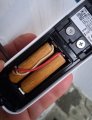
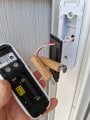
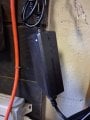
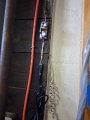
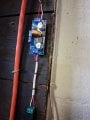
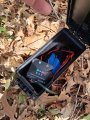
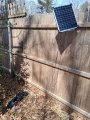
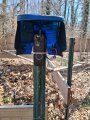
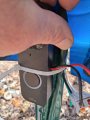
I've got three of these cameras total. They are cheap and small and weather resistant (The new model is a little bigger and uses 3 AA batteries). The wooden dowels required springs and nails as shown to handle changes due to the weather. The cameras for the front door and back door have a whole drilled in the back cover. The camera in the woods behind my house is the one with the lead acid battery, buck converter and the solar panel. For this one mounted under the coffee container I drilled a hole for the wires through the side and instead of making the dowels, I soldered leads directly to the battery contacts inside. I scuffed them with sandpaper and tinned them first. The transformer and buck converter in the basement powers the front and back doorbell through the house's original doorbell wiring.

20260320_134259.jpg20260320_134535.jpg20260320_134529.jpg20260320_134539.jpg20260320_131035.jpg20260320_134827.jpg20260320_134844.jpg20260320_134855.jpg

1.5 years of not changing the expensive required lithium batteries will pay for everything. There is a buck converter under the blue tape in the battery box.
 
Last edited:

MisterBill2

Joined Jan 23, 2018
27,164
OH WOW!!! Certainly all of the details that I asked for, and a lot more!!
Now I see how to make the holes for the power wires, and how you wind upwith the specified 3v2 DC for the cameras. NowI should be able to get busy.
THANKS INDEED!!!
 

Thread Starter

ulms

Joined Mar 19, 2024
179
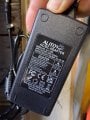
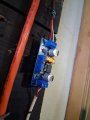
The biggest problem I had, and I had posted about it here back in December was that I was buying cheap power supplies that weren't delivering what they said they would amp wise. The usual assembly of All About Circuits guys helped out with suggestions and ideas. Below is a picture of the power supply that delivered enough current to run the two cameras simultaneously in parallel (front door and back door) in record mode. The buck converter has 2 pots on it. I marked them A for amps and V for volts. The volt pot is set at 3.4 V, I got reliable working there. I don't remember where the amp pot is set, probably about four amps. I totally underestimated the amp requirement for the camera while it is recording.
20260320_160313.jpg20260320_160301.jpg
 
Top