Magnetic field - magnetic flux

Thread Starter

linhvn

Joined Nov 6, 2024
297
I read this , but cannot differentiate between the magnetic field H and the magnetic flux B as the pic below, Can sb show the difference shortly and direct to the points, if you can compare to something which is visible around us is good, because is this quite abstract to me.

1735697272350.png
1735697635465.png
 

crutschow

Joined Mar 14, 2008
38,316
The magnetic field intensity, H, is basically a mathematical value based upon the number of ampere-turns in a coil, that allows the magnetic flux generated by that coil to be determined.
It is rather a misnomer as it is not a physical field.
The magnetic flux density, B, which is a physical field, is determined by the value of H, and the magnetic relative permeability, μ, of the material inside the coil.
The value of μ is given a value of 1 for free space, and can have a value of several thousand or more for a good magnetic material such as iron.
Thus magnetic flux density is thus much less in an air core, than one with an iron core for the same field intensity (ampere-turns).
 

Thread Starter

linhvn

Joined Nov 6, 2024
297
The magnetic field intensity, H, is basically a mathematical value based upon the number of ampere-turns in a coil, that allows the magnetic flux generated by that coil to be determined.
It is rather a misnomer as it is not a physical field.
The magnetic flux density, B, which is a physical field, is determined by the value of H, and the magnetic relative permeability, μ, of the material inside the coil.
The value of μ is given a value of 1 for free space, and can have a value of several thousand or more for a good magnetic material such as iron.
Thus magnetic flux density is thus much less in an air core, than one with an iron core for the same field intensity (ampere-turns).
So B means water after passing through a strainer, H is water before passing through a strainer and u is the strainer??
 

Thread Starter

linhvn

Joined Nov 6, 2024
297
Sorry, but that analogy does not make sense.
Read my explanation again.
You mean they are the same. Just in di different environment in free space b is called h in other material B is H*u. You mean naturally they are the same??
 

crutschow

Joined Mar 14, 2008
38,316
You mean naturally they are the same??
No.
I specifically said that the magnetic field intensity is not a real field but just a mathematical value, while the magnetic flux density is a real field.
Are you having difficulty understanding my English?
 

Thread Starter

linhvn

Joined Nov 6, 2024
297
No.
I specifically said that the magnetic field intensity is not a real field but just a mathematical value, while the magnetic flux density is a real field.
Are you having difficulty understanding my English?
Yeah. Hard to understand. Wish you can make an analogy of something physical
 

Alec_t

Joined Sep 17, 2013
15,101
For a water analogy you could think of H as the water pressure, u as the ease with which a pipe can pass water and B as the resulting flow in the pipe. But it is only a rough analogy.
 

Thread Starter

linhvn

Joined Nov 6, 2024
297
For a water analogy you could think of H as the water pressure, u as the ease with which a pipe can pass water and B as the resulting flow in the pipe. But it is only a rough analogy.
okay, and can you show the difference between the one in red circle and B? @Alec_t
1735745544923.png
1735745969284.png
 
Last edited:

MrAl

Joined Jun 17, 2014
13,667
I read this , but cannot differentiate between the magnetic field H and the magnetic flux B as the pic below, Can sb show the difference shortly and direct to the points, if you can compare to something which is visible around us is good, because is this quite abstract to me.
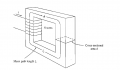
View attachment 339344
View attachment 339346
Hello,

One of the common ways to look at this is to use the electrical equivalency idea.
In that sense, H would be the applied voltage, and B would be the 'resulting' current flow.
In that way you can relate the B and H to electrical quantities found in a wire or resistor.
Another equivalent is the magnetic reluctance. That is equivalent to the electrical resistance.
So there you can relate these new quantities to voltage, current, and resistance, and that makes it easier to deal with.

BTW, if you look up the units for B and H that may help also.
 

sparky 1

Joined Nov 3, 2018
1,218
A diode is different from an inductor and the fields they produce are not the same.
An electro-magnetic circuit can use a multimeter because of the normal BH curve or magnetic hysteresis
is used rather than a longer process measuring with a Gauss meter. A purely magnetic circuit can be simply
differentiated from an electric circuit, that a magnet will not run a flashlight without shaking it through a coil.
Then there is conversion from electro to magnetic and back. A hop skip and jump using math.
The term Resistance is a familiar term but what about the term Reluctance.

For electrical circuits, Ohm's law states: V = IR In like manner, for magnetic circuits
we have: F = ΦR Where F is the magnetomotive force (or MMF) in amp-turns, Φ is the magnetic flux in webers, R is the reluctance
of the material in amp-turns/weber. Having an idea about what B and H we can see how their characteristics are used,
The similarity does not allow us to replace a battery with a magnet. It shows the degree of alignment of domains in ferrous material.
In turn the magnetization effect influences the magnetic field.

There are mathematical relationships that are used in our measurements.
Magnetic hysteresis - Wikipedia

By comparison the characteristics of a diode are different from an inductor,
The core of an inductor plotted as B/ H is different from plotting V/I for a diode junction.
Curve tracer - Wikipedia
 
Last edited:

Thread Starter

linhvn

Joined Nov 6, 2024
297
A diode is different from an inductor and the fields they produce are not the same.
An electro-magnetic circuit can use a multimeter because of the normal BH curve or magnetic hysteresis
is used rather than a longer process measuring with a Gauss meter. A purely magnetic circuit can be simply
differentiated from an electric circuit, that a magnet will not run a flashlight without shaking it through a coil.
Then there is conversion from electro to magnetic and back. A hop skip and jump using math.
The term Resistance is a familiar term but what about the term Reluctance.

For electrical circuits, Ohm's law states: V = IR In like manner, for magnetic circuits
we have: F = ΦR Where F is the magnetomotive force (or MMF) in amp-turns, Φ is the magnetic flux in webers, R is the reluctance
of the material in amp-turns/weber. Having an idea about what B and H we can see how their characteristics are used,
The similarity does not allow us to replace a battery with a magnet. It shows the degree of alignment of domains in ferrous material.
In turn the magnetization effect influences the magnetic field.

There are mathematical relationships that are used in our measurements.
Magnetic hysteresis - Wikipedia

By comparison the characteristics of a diode are different from an inductor,
The core of an inductor plotted as B/ H is different from plotting V/I for a diode junction.
Curve tracer - Wikipedia
why are you mentioning diode here? do you know the difference between the one in the red circle and B?
1735962855226.png
 

Jony130

Joined Feb 17, 2009
5,593
do you know the difference between the one in the red circle and B?
The flux Φ is the magnetic current. And the B = Flux/Area is flux density (magnetic current density). Or B can be thought of as how many magnetic flux lines are crossing a given cross-section area. The magnetic voltage will be the magnetic field strength H.
 
Last edited:

Ian0

Joined Aug 7, 2020
13,097
For electrical circuits, Ohm's law states: V = IR In like manner, for magnetic circuits
we have: F = ΦR Where F is the magnetomotive force (or MMF) in amp-turns, Φ is the magnetic flux in webers, R is the reluctance
This is a concept that it took me ages to get.
The comparison of Hopkinson's lawScreenshot from 2025-01-05 20-09-59.png with Ohm's law is an abstraction. (This is a scientific forum, why can't it display the appropriate characters?)
It confused me for ages because the magnetomotive force is a result of the current I in the circuit, but its comparison with I in Ohm's law is purely mathematical.
 
Last edited:
Top