Looking for 3 Tesla magnetic field sensors

Thread Starter

caseyjamesn

Joined Apr 3, 2025
3
I was hoping someone could help with information on additional ICs used for measuring magnetic fields. Technically we only need to orthogonal vectors to be measured, so if that means two different parts that's okay.

I'm struggling to find any sensors that can handle a magnetic field up to 3 Tesla. This is a sensor to be used in the MRI. So far I have found two sensors. Senis SENM3Dx_v2 (range up to 4T):
https://www.senis.swiss/sensors/3dhall-3-axis-hall-magnetic-sensor-senm3dx/

Metrolab MagVector™ MV2 (up to 30T):
https://gmw.com/product/magvector-mv2/

The Metrolab part runs $900 per IC, and it's overkill for what we need at 30T. We are currently using the Senis part, but we want to find alternatives. Has anyone worked with high magnetic field measurements? It's sort of a new realm for me so I'm still learning as well. Thanks so much for the help.
 

Thread Starter

caseyjamesn

Joined Apr 3, 2025
3
This is excellent, truly thank you so much for the quick response. I hadn't heard of them before, but does look like they have some 3T products. This may work out really well, i appreciate it. I don't know much about hall sensors but I'm learning.

Regarding this part:
https://www.sonnecy-shop.com/media/pdf/76/fc/a0/CYSJ106C.pdf
I'm unable to find the measured B-field vector direction coming from the IC. Is the field to be measured just perpendicular to the the plane that IC is mounted on?
 

nsaspook

Joined Aug 27, 2009
16,250
1743722437907.png1743724486303.png
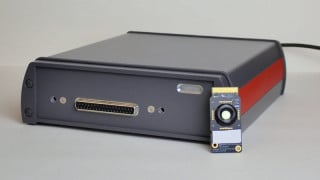
That part is just the raw single axis Hall sensor. You would need the sensor amplifier (that I was repairing) to make it usable. Your $900 chip has the sensor elements and amplifiers with a digital interface. It's not really expensive compared to the costs of what we use on modern machines.
https://www.ptcusa.com/products/t1?srsltid=AfmBOortfkrsLPJ3kIwn-j-vf5qZVgOBQwtQXQsUObfyhjeLhOlJ81-T
1743726056982.png

For the measured B-field vector direction? Yes, I would think that's the case but I don't have the sensor element measurement vector profile either.
1743723913748.png
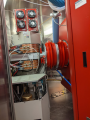
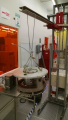
The square long probe sticks into the vacuum chamber to measure the magnetic field across the beam flight tube.
1743724206866.png
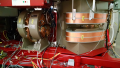
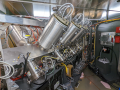
Vacuum flight tubes removed so you can see the magnet pole pieces of the ion bending magnet on the right.

The probe measure the magnetic bending force between the upper and lower electromagnets as accelerated ions move down the vacuum waveguide from into a mass slit apparatus (the flux needed is calculated for energy and AMU of the needed ions) for beam tuning and implanting. The calibrated sensor and amplifier provide measured voltage feedback for the magnet power supplies to lock the flux value to the calculated values from a AMU and energy table of a series of expected process gasses and ion implant energies needed for dosing wafers at X energy with X ions.
 
Last edited:

Thread Starter

caseyjamesn

Joined Apr 3, 2025
3
This is awesome!! So cool to see some of the stuff you've worked on, and I really appreciate the feedback and help on the hall effect sensor for magnetic field measurements. Looks like Chenyeng has maybe 3 hall sensors up to the range I need. I'll order some of those and design some circuits around it for testing.

Thanks again for the feedback.
 

schmitt trigger

Joined Jul 12, 2010
2,027
NSAspook: impressive stuff! I mean it

Me, chanting softly:
I am not worthy!
I am not worthy even to untie your shoelaces.
(Said while prostrated fully to the floor.)
 

nsaspook

Joined Aug 27, 2009
16,250
NSAspook: impressive stuff! I mean it

Me, chanting softly:
I am not worthy!
I am not worthy even to untie your shoelaces.
(Said while prostrated fully to the floor.)
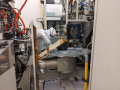
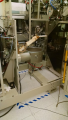
Stop BSing me. :p It's just a job after a while. A fun one at times, but work is work after a while when you've seen the same types of problems over decades. My job was to design countermeasures for the problems so the tech's working on repairing the machines would have less crap to deal with when things go wrong.
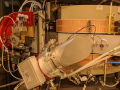
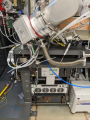
1743807818093.png
Sometimes it something easy, like a big cooling fan for 10KW DC power supplies.

1743807890558.png
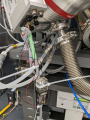
A proper maglev turbo pump interface for the control computer.

1743807923657.png
The vendor hacked a relay to make it work.

1743808129194.png
Proper cooling for the coils to stop overheating.

1743808000406.png
Improved maintenance procedures to stop killing a very expensive ferrofluid vacuum seal for the power shaft and motor.
1743808924535.png1743808945926.png
 
Last edited:

nsaspook

Joined Aug 27, 2009
16,250
This is awesome!! So cool to see some of the stuff you've worked on, and I really appreciate the feedback and help on the hall effect sensor for magnetic field measurements. Looks like Chenyeng has maybe 3 hall sensors up to the range I need. I'll order some of those and design some circuits around it for testing.

Thanks again for the feedback.
Send me a check if it works.
 

schmitt trigger

Joined Jul 12, 2010
2,027
NSAspook;
My intention wasn’t to make fun of you, but to describe my sincere awe at your job experience. I was not attempting to BS you.

I know a job is a job and all will have its high and low water marks. But you have had the opportunity to have worked with very interesting and high tech stuff.
 

nsaspook

Joined Aug 27, 2009
16,250
NSAspook;
My intention wasn’t to make fun of you, but to describe my sincere awe at your job experience. I was not attempting to BS you.

I know a job is a job and all will have its high and low water marks. But you have had the opportunity to have worked with very interesting and high tech stuff.
It (the BS comment) was a mainly a joke. Most of the equipment you see was designed in the 90's and 90's but is still working today with lots of OEM and inhouse modifications. The more high tech stuff are the linear RF ion accelerators with target energies on wafers in the several MeV range. Each resonator was 3KW of RF power (to produce 90 kV RF at each can) to post accelerate an incoming ion stream of 90 Kev up to 3 Mev.
You need some pretty strong magnets to bend a 3 Mev ion beam 70 to 90 degrees when traveling at a good fraction of light speed.
1743869908240.png
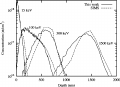
You can control how deep (from the surface of the wafer) the ions will be in wafer by changing the energy of each ion, each with a different AMU. (Atomic Mass Unit)
1743871556979.png1743871804881.png1743872183279.png

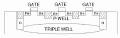
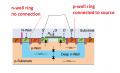
We can create doped regions deep into the bulk wafer substrate of correct for things like leakage currents and to provide charge storage regions for memory devices. The process guys create these requirments
Our job in the EE dept. was to make sure the machines could do it,

1743870689652.png
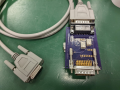
This is the pump adapter PCB to replace the hanging relay mess on this machine.
1743870382162.png
1743870216692.png
Pretty simple if you have complete documentation. That almost never happens. The pumps were ours so it was up to us to integrate them into the vendor vacuum control system. I gave the vendor (I once worked with the guy) some extra boards I built
for good will. This paid off later when they gave us 10K of free service call credit a few years later.

This machine is the cost of a pretty nice house, in Beverly Hills.
 
Last edited:
Top