Magnetic field detection

gootee

Joined Apr 24, 2007
447
A time-varying magnetic field will induce a time-varying current in a conductive loop. (Faraday's Law; Maxwell's Equations)

Have you tried a wire loop "antenna" and an opamp amplifier?

An inpedance/resistance in the loop would have a time-varying voltage induced across it by the time-varying current induced by the time-varying magnetic field.

Make the induced voltage appear across an amplifier's input. Look at the amplifier's output.

Cheers,

Tom
 

Thread Starter

edmo117

Joined Sep 5, 2010
23
A time-varying magnetic field will induce a time-varying current in a conductive loop. (Faraday's Law; Maxwell's Equations)

Have you tried a wire loop "antenna" and an opamp amplifier?

An inpedance/resistance in the loop would have a time-varying voltage induced across it by the time-varying current induced by the time-varying magnetic field.

Make the induced voltage appear across an amplifier's input. Look at the amplifier's output.

Cheers,

Tom
Thanks Tom

That was my original idea, using an inductor to produce the time varying voltage that can be amplified for detection - the problem is that I am no electronic designer so don't know where to start -= that is why I registered with this forum - to see if anyone out there has done this kind of thing before. Your idea is sound but the detail is the killer for me.

Thanks for looking
 

gootee

Joined Apr 24, 2007
447
I think that maybe a larger loop area (not to mention less wire) would work better.

I would start simple and try a single large loop of wire, made with a resistor of about 10K to 100K connected between the two ends of a piece of wire.

Also connect two short pieces of wire to the ends of the resistor so you can use them to connect across the input terminals of an amplifier.

I hope that you have an oscilloscope, so you can see what's coming out of the amplifier (and also what's going in, maybe).

Try different lengths of wire, to see how small you can get it while still getting a strong-enough signal. I'd at least try everything from a few feet to a few inches. I'd also try everything from circular to long and thin PLANAR shapes, and try them with different orientations and at different distances.

Cheers,

Tom
 

Thread Starter

edmo117

Joined Sep 5, 2010
23
I think that maybe a larger loop area (not to mention less wire) would work better.

I would start simple and try a single large loop of wire, made with a resistor of about 10K to 100K connected between the two ends of a piece of wire.

Also connect two short pieces of wire to the ends of the resistor so you can use them to connect across the input terminals of an amplifier.

I hope that you have an oscilloscope, so you can see what's coming out of the amplifier (and also what's going in, maybe).

Try different lengths of wire, to see how small you can get it while still getting a strong-enough signal. I'd at least try everything from a few feet to a few inches. I'd also try everything from circular to long and thin PLANAR shapes, and try them with different orientations and at different distances.

Cheers,

Tom
Thanks Tom, I'll give it a try
 

KMoffett

Joined Dec 19, 2007
2,918
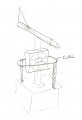
Another thought. A coil, concentric with the fan/wind vane post. and in the plane on the fan axle. Many turns of fine wire, with a diameter to clear the fan frame. The more turns the higher the output. Could be removable like the vane post. Not sure if the position of your magnets would generate simultaneous opposing magnetic fields in the coil.

ken
 

Attachments

Last edited:

Thread Starter

edmo117

Joined Sep 5, 2010
23
Another thought. A coil, concentric with the fan/wind vane post. and in the plane on the fan axle. Many turns of fine wire, with a diameter to clear the fan frame. The more turns the higher the output. Could be removable like the vane post. Not sure if the position of your magnets would generate simultaneous opposing magnetic fields in the coil.

ken
Thanks for the idea Ken but I feel it will not be practical in a production version and it would interfere with the air flow into the fan.
I have been dragged off onto another project for a few weeks but will post the final solution when I have one - hopefully this side of Christmas!
 
I am curious ..... How have you got to a stage where you have so many production limitations without first having even a concept that is practical.
There are so many ways to measure what you want, wind speed and direction, that I simply dont understand your need for a spinning fan placed so far from any potential fixed point of reference.
I get that it may have to look that way for some reason but even then there a myriad of configurations you could have used internally that would have avoided the issue you have yet to find a solution to.
I'm not criticizing, because I almost certainly dont have enough info to judge, but I would love to know what the driving processes are, just because I am so confused by all this.
I will be watching with some interest to see the solution, if there is one, you have me stumped.
 
On aditional thought ... sorry its on my mind now.
Even if you get some sort of magnetic picup to work it will be mounted on an aluminium pole and cant rotate with the head so not only do you need to work at 100mm or so but, once the wind swings round you need to do it through a material that will quench any dynamic field it meets.
Unless you have an entire array of sensors around the pole the plan is surly doomed.
 

Thread Starter

edmo117

Joined Sep 5, 2010
23
Sorry for the delay in my reply but I have been away for a few weeks - retirement is highly recommended!! Anyway, now back to the problem.

Have a look at http://www.aceselectronics.co.uk/product.php?xProd=167&xSec=93
this shows an anemometer with an arrangement exactly like I am trying to achieve. The propeller is only about 10mm dia and its shaft is a magnet. The pick-up is an inductor inside the main case that is a good 2" away. The problem is that the wires from the inductor go into a custom chip so I have no idea how the thing works. However, using my simple propeller, this same units picks up its rotation at well over 2" so I know this can be done.
I understand about the many ways to measure the wind speed and, in an idea case, I would have used the rotating cups method BUT in this application, I do not have the room for that so I am stuck with the propeller method.

Now I am back, I can start to look in detail at what I can get out of a simple inductor and see what can be done with it. I will keep this thread up to date as I proceed later this week.

Thanks to all for the suggestions
 
Top