Magnetic coupled Circuits

Thread Starter

Arun Palani

Joined Jun 13, 2017
7
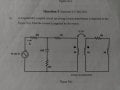
Hi everyone please help me out with this question, If the question is not clear in the picture:

a) A magnetically coupled circuit involving a linear transformer is depicted in the Figure3(a). Find the current Io Supplied by the source.
 

Attachments

wayneh

Joined Sep 9, 2010
18,104
Consider how the degree of coupling affects the answer. Suppose there was no coupling at all. Suppose it was perfectly coupled. (I'm assuming this is homework?)
 

MrAl

Joined Jun 17, 2014
13,704
Hi everyone please help me out with this question, If the question is not clear in the picture:

a) A magnetically coupled circuit involving a linear transformer is depicted in the Figure3(a). Find the current Io Supplied by the source.

Hello there,

This is a circuit that involves mutual inductance. That means you have to know how to analyze circuits that contain mutual inductance. There are a couple different ways to go about doing this, so you should mention how you might go about doing it yourself.
One way for example would be to replace the transformer with a T equivalent model.
 

Thread Starter

Arun Palani

Joined Jun 13, 2017
7
Consider how the degree of coupling affects the answer. Suppose there was no coupling at all. Suppose it was perfectly coupled. (I'm assuming this is homework?)
Ya its my homework, couldnt figure out how to go about it. But your way of thinking sounds good. will try it that way.
 

Thread Starter

Arun Palani

Joined Jun 13, 2017
7
Hello there,

This is a circuit that involves mutual inductance. That means you have to know how to analyze circuits that contain mutual inductance. There are a couple different ways to go about doing this, so you should mention how you might go about doing it yourself.
One way for example would be to replace the transformer with a T equivalent model.
Thank you, didn't think of the T equivalent, will try it
 

MrAl

Joined Jun 17, 2014
13,704
Hi,

Well if you have any problem you can just ask more questions here, no problem with that, and someone here should be able to help.

That "0.5H" is the mutual inductance. That's a measure of how well the windings couple to each other magnetically. You dont have to actually know the coupling factor for this problem, but you can calculate that too if you wish. Once you transform to the T equivalent model from the values given, you can solve the circuit because then it's just a circuit with three regular inductors (plus any other inductors that are not part of the transformer itself of course). After that all you need to know is how to analyze a circuit with several inductors and a sine or cosine source.

So for the transformer alone that starts out as two inductors and one mutual inductance ends up as three regular inductors in a T configuration. If you then calculate the current through that 4 ohm input resistor you'll have your answer.
 

MrAl

Joined Jun 17, 2014
13,704
Hi,

Looks good, except i got 2.2 amps at angle of -4.88 degrees when rounded to three significant figures because the phase came out to -4.87815... degrees.

The only catch then is that the original problem had a source that was 90 degrees so if you want to show the phase angle relative to 0 degrees of the original source then you have to adjust the phase accordingly. Usually we dont have to do that, but if there is some 0 degree sine source elsewhere in the system we may have to do that.
 
Top